Evaluating Third-Party Risk Management Software for AI Coverage
Most third-party risk platforms miss AI-specific threats like prompt injection and model drift.
Third-party risk management software was built to answer three questions: is this vendor financially sound, is its security adequate, and does it follow the rules that apply to it. Those questions work fine when the vendor sells you software that behaves the same way every time you run it. They fall apart the moment the vendor's product is a model that reasons in ways nobody, including the vendor, can fully trace.
Here's the gap I want to walk through: what's actually missing from most TPRM platforms when it comes to AI vendors, and how to tell whether a platform's "AI coverage" is real or just a faster questionnaire.
Traditional TPRM logic assumes predictable inputs, traceable logic, and outputs you can check after the fact. AI systems break all three at once. Outputs are probabilistic, not fixed. Reasoning is often opaque even to the people who built the model. And the "vendor" you signed a contract with may just be the front door to a chain of sub-processors running inference on infrastructure none of them fully control.
That accountability gap gets sharpest in regulated industries. If a model's decision can't be explained, the company using it inherits the explainability problem, not the vendor. A questionnaire built for a conventional SaaS company ends up missing exactly the failure modes that define AI vendor risk: bias, hallucination, training data provenance, model drift, prompt manipulation. None of this is something you patch with a configuration change. The tools are doing precisely what they were built to do, for a category of vendor they were never built to evaluate.
The specific failure modes that fall through the gaps
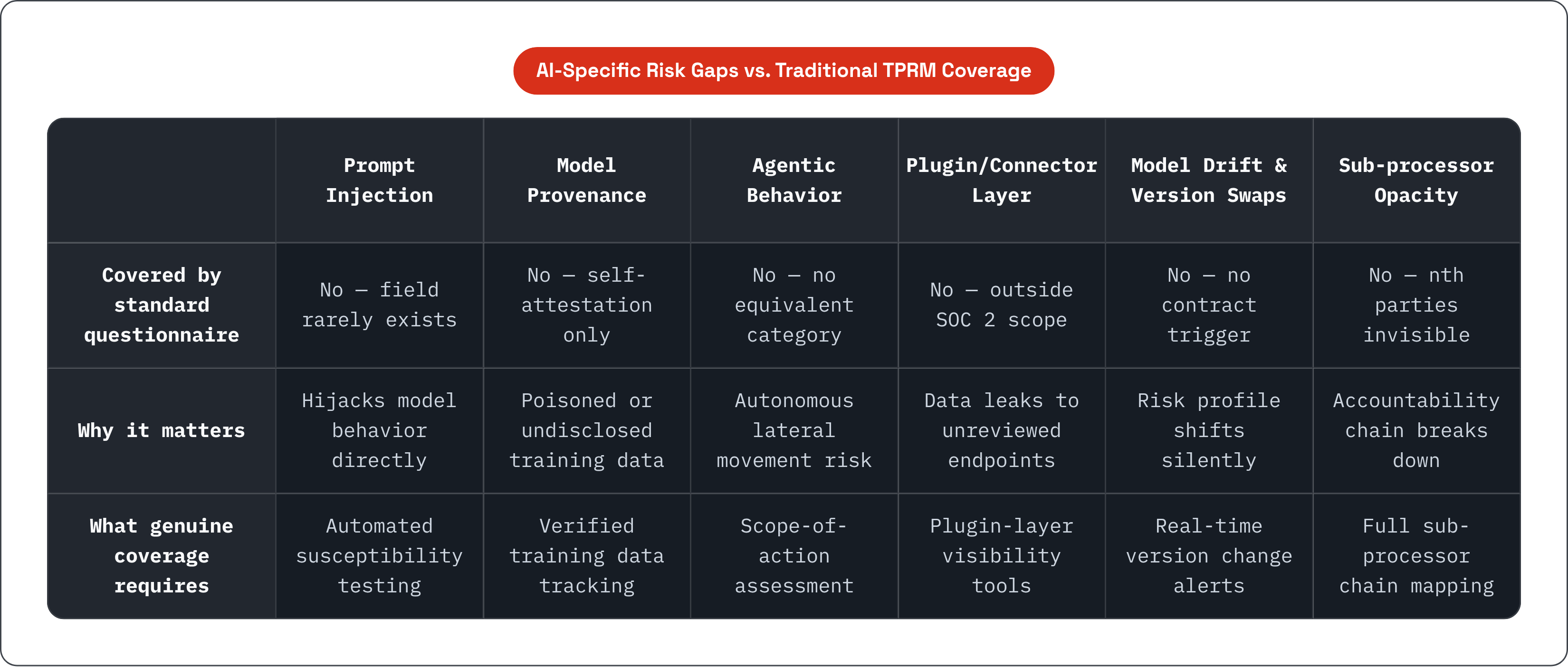
Start with prompt injection: malicious input designed to hijack how a model behaves. Go look at a standard security questionnaire and try to find a field for it. You won't find one; it doesn't exist yet in most templates.
Model provenance is another blind spot. Training sets can be unknown, poisoned, or quietly fine-tuned on customer data the vendor never disclosed. Self-attestation doesn't catch this, because vendors rarely volunteer information that makes their own product look riskier.
Then there's agentic behavior. AI agents that browse the web, run code, or call APIs on their own create a kind of lateral movement risk that traditional software assessment has no real equivalent for. A payroll SaaS tool with database access is one thing; an agent that can decide, on its own, to call an outside service, plays by a different set of rules entirely.
Plugins and connectors deserve their own line item. LLMs with plugin ecosystems can leak data to external endpoints, and that plugin layer typically sits outside the scope of a vendor's SOC 2 attestation. A vendor can be fully SOC 2 compliant on paper while running a plugin that phones home to a server nobody ever reviewed.
Model drift and version swapping are quieter problems, but no less real. A vendor can swap the underlying model without triggering any contract change, and your outputs, your risk profile, your compliance posture can all shift without anyone on your side noticing. Sub-processor opacity makes this worse: AI vendors often run inference through third- or fourth-tier hosts the contracting company never sees. This is where the "nth-party" problem gets ugliest.
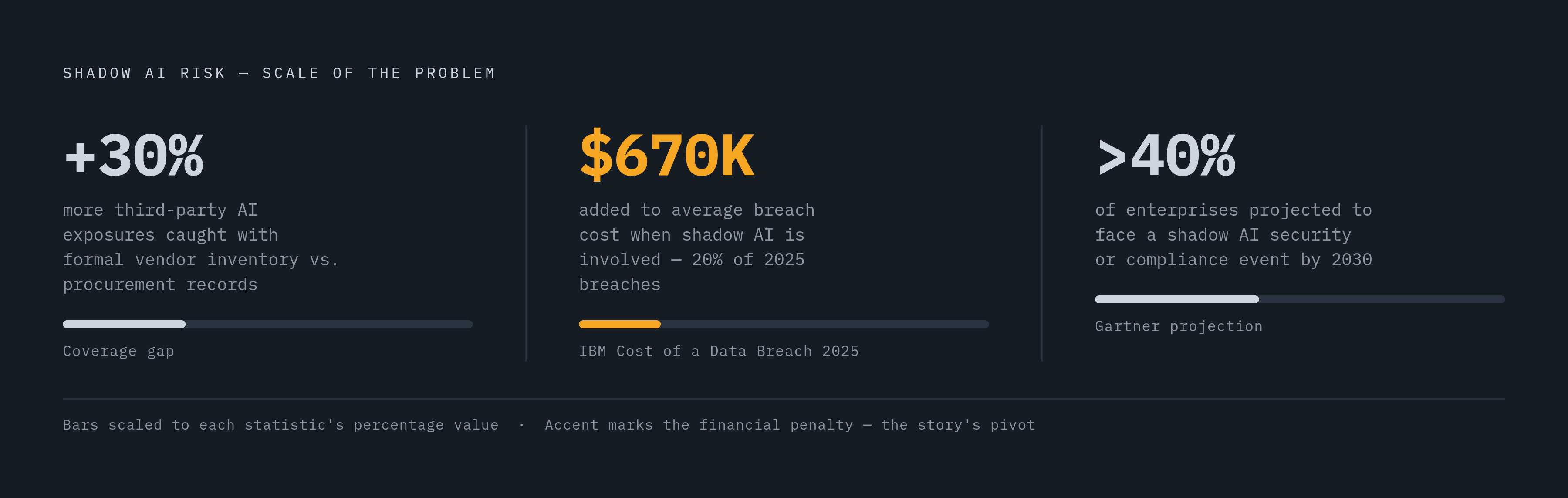
Shadow AI adds another layer. Employees adopt AI tools outside procurement, so those tools never show up in any vendor inventory at all. One study found organizations with formal AI vendor inventories catch about 30% more third-party AI exposures than those relying only on procurement records. IBM's 2025 Cost of a Data Breach Report found shadow AI played a role in 20% of breaches and added roughly $670,000 to the average cost of one. Gartner projects more than 40% of enterprises will face a security or compliance event tied to shadow AI by 2030.
The OmniGPT breach in February 2025, which exposed 34 million chat lines including credentials and healthcare data, is a good reminder of how fast an unvetted AI vendor turns into a real mess.
Where the TPRM market stands today and why AI coverage is still an afterthought for most programs
The market itself is booming. MarketsandMarkets puts TPRM software at $8.57 billion in 2024, projected to reach $37.34 billion by 2035, a 14.2% compound annual growth rate. Software alone is expected to hold 65% of market revenue share in 2025. That's real money chasing a real problem.
Most of that money goes into workflow automation, compliance mapping, and financial risk scoring, not AI-specific coverage. The 2025 EY Global TPRM Survey, which polled 500 executives (20% from the Fortune 500), found that 31% cited AI and machine learning capabilities for better due diligence as the top driver of future investment. That's the leading category, sure, but it's still less than a third of respondents. Even among the more sophisticated programs, AI coverage sits early-stage at best.
Here's a number worth sitting with: only 14% of TPRM programs actively use AI themselves, according to Mitratech's 2025 study. Teams that haven't adopted AI internally are poorly positioned to judge AI risk in someone else's product. How do you assess prompt injection susceptibility if your own team has never worked closely enough with a model to know what that even means in practice?
Across the industry, AI has rapidly risen alongside cybersecurity as a leading third-party risk concern. The industry knows this is a problem, yet it's still structurally behind on solving it.
The coverage gap shows up in plain numbers too: manual TPRM programs monitor somewhere between 25% and 30% of vendors effectively, while AI-powered platforms reach north of 90%. The real evaluation question isn't whether a TPRM tool "supports AI" anymore, since most vendors will say yes to that regardless. Whether the AI coverage is genuine or just cosmetic is the question that actually matters.
What "AI features" in TPRM platforms actually mean — and where they fall short of AI coverage
More than 85 TPRM tools rolled out AI-driven risk scoring in recent years. Automated compliance mapping features and real-time financial instability predictions have both seen significant gains over that window. Those are real process improvements, but they're also not the same thing as AI risk coverage.
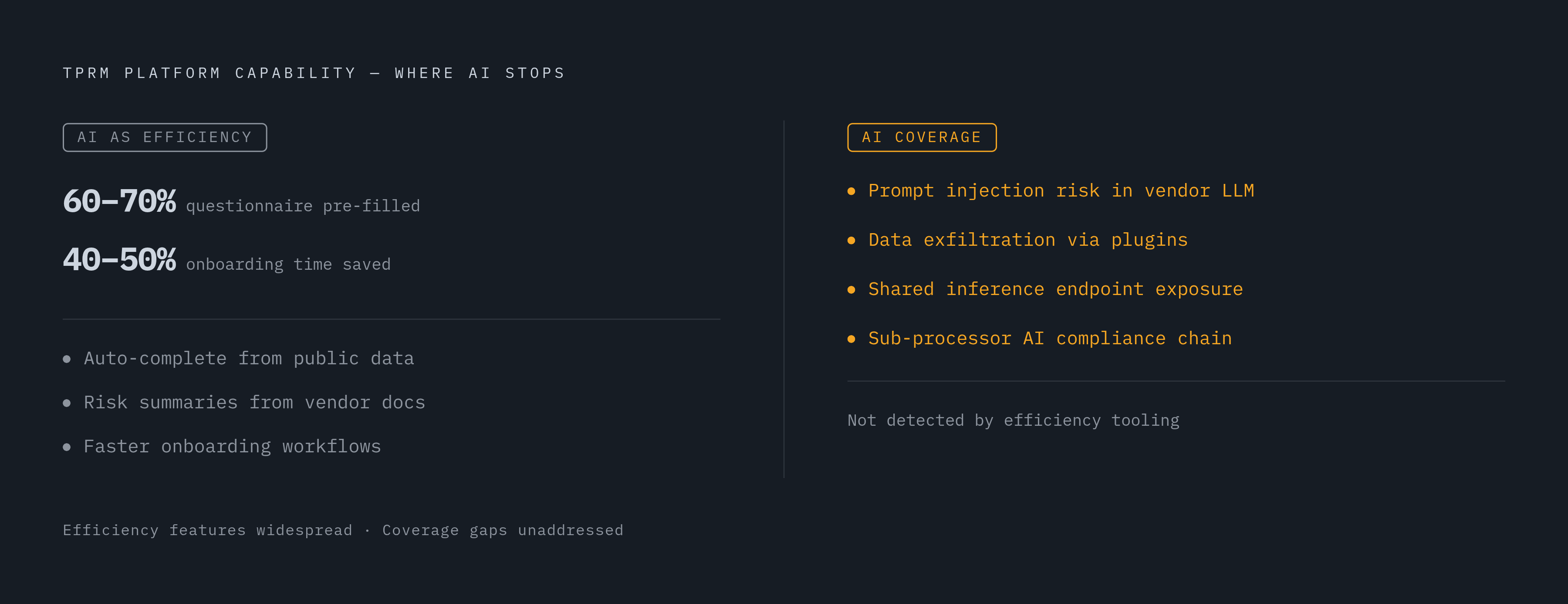
Look at what these platforms actually do with AI today. They auto-complete questionnaires, often arriving 60% to 70% pre-filled from public data and prior vendor answers, cutting onboarding time by 40% to 50%. They generate risk summaries from vendor documents. All useful, none of it tells you whether the vendor's AI models, plugins, agents, or training pipelines create exposure for you.
Here's the actual distinction. AI-as-efficiency means the platform uses AI to process vendor data faster. AI coverage means the platform checks whether the vendor's own AI creates prompt injection risk, data exfiltration paths, or compliance exposure to your organization. A questionnaire that auto-fills SOC 2 and ISO 27001 fields tells you nothing about whether that vendor's LLM shares an inference endpoint with three other customers, one of whom might be your competitor.
Agentic TPRM systems, where several specialized AI agents handle onboarding, monitoring, and anomaly detection on their own, get pitched as the next step forward. That describes how the platform runs internally, but it says nothing about what the platform actually catches in a vendor's AI behavior. When a vendor demos this for you, make them separate those two claims out loud. Don't let "we use AI extensively" answer a question about whether they catch AI-specific risk.
The specific capabilities to probe for when evaluating a platform's AI coverage
Start with asset discovery. Can the platform find AI tools in use across your vendor ecosystem, including tools adopted outside formal procurement? Does it surface a vendor's own sub-processor and inference-host chain, not just the primary relationship you signed?
Move to provenance and version monitoring. Does the platform track which model version a vendor is actually running right now, and alert you when that version changes without notice? Can it flag training data sources that were never verified or disclosed?
Prompt injection and agentic behavior need their own line of questioning. Does the platform include any assessment criteria, or better yet automated testing, for prompt injection susceptibility? For vendors running agents, does the platform check how much autonomous action those agents can take, and what data they can touch or move?
Plugin and connector visibility matters just as much. Does the platform look at the plugin layer of a vendor's AI product, not just the core application? Can it catch data flows to external endpoints that plugins create, flows sitting outside the vendor's formal security attestation?
Continuous monitoring versus point-in-time assessment is maybe the biggest one on this list. AI vendors change faster than traditional SaaS companies do: new model versions, new capabilities, new sub-processors, sometimes all in the same quarter. A periodic questionnaire misses all of it. IBM's 2025 report found supply chain compromises cost an average of $4.91 million and took 267 days to contain. That's where early detection through continuous monitoring actually earns its keep. Ask a platform to show you real-time signal ingestion, not a scheduled reassessment calendar.
Regulatory mapping is its own category now too. The EU AI Act, emerging state-level AI laws in the US, and sector rules like DORA or the AI-specific implications of HIPAA are distinct from GDPR, CCPA, or SOC 2. Does the platform map vendor AI behavior against these newer frameworks, or does it stop at the security standards everyone already had covered?
Last, and maybe most important: self-attestation versus independently observed signals. Most platforms still run on vendor-completed questionnaires. AI risk, especially around model behavior and sub-processor chains, can't be reliably self-attested; a vendor filling out a form has no real incentive to flag its own weaknesses. Ask directly whether the platform generates independently observed threat signals, or just processes what vendors say about themselves.
How leading platforms compare on AI coverage specifically
The right comparison isn't which platform bolted on the most AI features. It's which platforms built actual coverage for the attack surfaces above.
OneTrust is a broad enterprise platform. It fits teams whose AI coverage need is mostly regulatory mapping and privacy-adjacent risk, less so teams chasing prompt injection or model provenance specifically.
Bitsight is oriented toward external monitoring and observed threat signals. It's less built, though, for AI-native attack surfaces like prompt injection or plugin-level data exfiltration.
Prevalent is associated with Mitratech and offers assessment and questionnaire capabilities. How well it covers AI-native risks depends heavily on whether the team using it bothered to extend those questionnaire frameworks to include AI-specific questions in the first place.
ProcessUnity is a TPRM workflow platform. It may suit organizations that aren't chasing AI-specific detection beyond what a structured questionnaire can capture.
Vanta and Drata are compliance-oriented platforms where TPRM is a secondary consideration. AI coverage here is limited by design; these suit earlier-stage companies that aren't yet managing complicated AI vendor ecosystems.
Diligent is worth a look for enterprises wanting AI-augmented governance layered into their TPRM process.
Beyond general TPRM platforms, there's a distinct category of vendors built specifically around AI risk intelligence: continuous monitoring of AI attack surfaces like prompt injection, plugin-based data exfiltration, and model provenance, as the main product rather than a bolted-on feature. For enterprises with heavy AI vendor exposure, say a Fortune 500 company or a law firm handling privileged data, this specialized layer deserves its own evaluation, run alongside the general TPRM platform rather than in place of it.
No single platform on the market today covers every gap from the last section with equal depth. Most enterprises will need to figure out where their highest-priority AI risk actually sits, and weight their platform choice around that.
How to structure an evaluation process that actually surfaces AI coverage gaps
Start with an inventory of your AI vendors. You can't evaluate coverage for a population you haven't defined yet, and shadow AI discovery needs to be step one here, not something you get around to later.
From there, tier vendors by AI risk exposure, not just by data sensitivity or how much revenue depends on them. An AI vendor with agentic access to your internal systems poses a bigger risk than a payroll SaaS provider with equivalent data access, because the attack surface and the ways it can fail are different animals entirely.
Build a gap-specific section into your RFP. Don't take a vendor's standard capability sheet at face value; make them show you coverage for shadow AI detection, model version monitoring, plugin visibility, a real method for prompt injection assessment, and sub-processor chain mapping.
Ask for a live demonstration against a real or simulated AI vendor scenario, not a slide deck. Build the scenario around a vendor that swaps model versions mid-contract, plus a second one running an undisclosed plugin that pulls data to an external service. Watch what the platform actually catches.
Look closely at the monitoring model itself. Periodic assessment cadence, or continuous real-time signal ingestion? Given that supply chain breaches took an average of 267 days to contain per IBM's 2025 numbers, continuous monitoring is the only approach that meaningfully shrinks that exposure window.
Ask the vendor directly whether AI risk assessment was part of the platform's original design or added on top of an existing general TPRM workflow later. The answer tends to explain a lot about how deep the coverage actually goes.
Consider a two-layer setup: a general TPRM platform for broad vendor lifecycle management, plus a dedicated AI risk intelligence layer for continuous monitoring of AI-specific attack surfaces. For enterprises with meaningful AI vendor exposure, that separation is becoming close to standard practice, not a luxury.
Revisit the whole evaluation every year, too. The AI vendor risk landscape moves faster than any platform's release cycle. What a tool covers well today may not match what your vendors are actually running six months from now.