Shadow AI Risk from Unsanctioned LLM Tool Use
Data pasted into unsanctioned AI tools can't be deleted, only learned and potentially leaked.
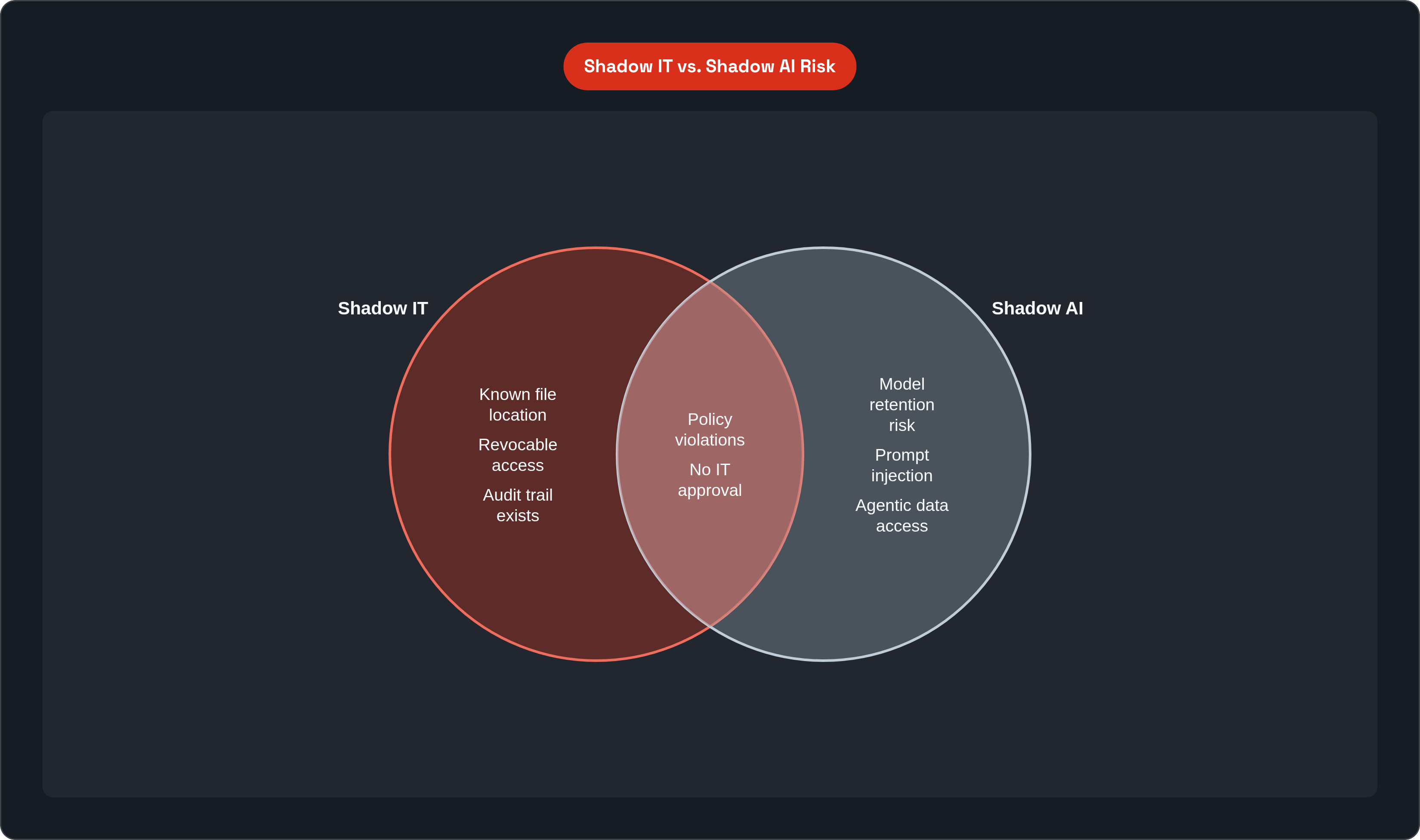
Shadow AI breaks the assumptions baked into shadow IT. When a file lands in an unapproved Dropbox folder, the data left the building and sat somewhere specific. You can find it. When an employee pastes a customer contract into a chatbot, the data enters a system built to remember things, learn from them, and sometimes hand them back to someone else entirely.
Follow that difference all the way through and it stops looking small. A rogue SaaS subscription is a location problem: find the bucket, revoke access, delete the file, done. An LLM behaves more like a process than a place. Depending on the vendor's terms, the prompt you typed might sit in a session log, get folded into a training set, or turn into a weight inside a model that later answers a stranger's question. Large language models can retain and reproduce fragments of what they were trained or fine-tuned on, a behavior researchers have studied and documented in the literature. So the question after a shadow AI incident stops being "where did the data go" and becomes "what does the model know now, and who can talk it into repeating that back."
There's no retrieval here. No delete button, no audit trail the organization actually controls. Killing a Dropbox link takes five seconds. Un-training a model takes years of research that doesn't fully exist yet, if it exists at all.
How widespread unsanctioned LLM use already is inside enterprises
Start with the number that should worry every CISO reading this: 98% of organizations report unsanctioned AI use happening somewhere inside their walls, and 49% expect a shadow AI incident in the next 12 months, according to Vectra AI. Nearly every organization surveyed admitted it, on the record.
The employee numbers hold up from every angle I've checked:
More than 80% of workers use AI tools that were never approved. Among security professionals, oddly, that number climbs to nearly 90%, per UpGuard's November 2025 State of Shadow AI report. Half of all workers use unapproved tools regularly, and fewer than one in five stick to only what the company sanctioned. BCG's 2025 "AI at Work" study, which surveyed more than 10,000 people, found 54% admitted to using unauthorized AI just to get their job done. And 68% of workers who use ChatGPT at work actively hide that fact from their employer.
Even the companies that think they've solved this by rolling out an approved tool usually haven't. Netskope's 2025 Cloud and Threat Report found 47% of GenAI platform users access those tools through personal, unmonitored accounts anyway. A company can do everything by the book, buy the enterprise license, run the training, and still have half its workforce logging in through the version nobody's watching.
The surface keeps growing faster than anyone can chase it, too. Netskope logged GenAI traffic surging more than 890% in 2024, with the number of distinct GenAI SaaS apps it tracks jumping from 317 to over 1,550. How does a governance team build a complete inventory of something expanding at that pace? It can't, not on a quarterly review cycle. The gap between what's approved on paper and what's running on employee laptops keeps widening by the month.
What employees are actually putting into these tools
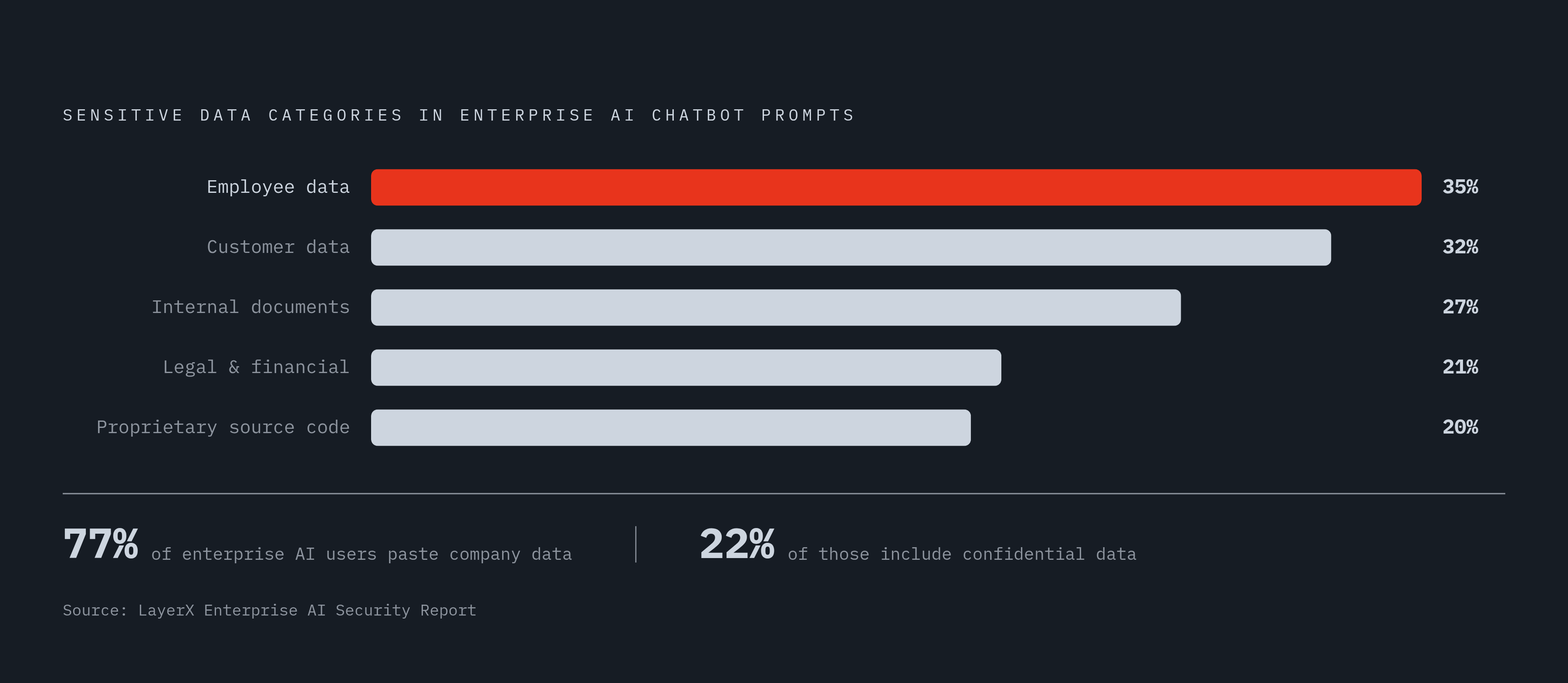
Knowing shadow AI is everywhere only gets you halfway there. The real question is what's inside the prompts, and The LayerX industry report gives a blunt answer: 77% of enterprise employees who use AI have pasted company data into a chatbot query. Of those instances, 22% included confidential personal or financial data.
Broken down by category: employee data shows up in 35% of cases, customer data in 32%, internal documents in 27%, legal and financial information in 21%, and proprietary source code in 20%.
Here's the part that actually stopped me when I first read it. 89% of workers say they associate AI tools with real risk, yet the sharing keeps happening at scale regardless. People know. They do it anyway. That gap between belief and behavior shows up again and again in this data, and it means the awareness campaigns most companies leaned on were never going to fix this by themselves.
A separate Anagram survey from August 2025 found 45% of workers admit to using banned AI tools, and 58% have posted sensitive material (client records, financial data, internal documents) into an AI tool at some point. Separately, 44% of all employees say they've shared confidential data with AI models with zero organizational sign-off.
What actually trips the wire? Zscaler ThreatLabz tracks the DLP violations moving through AI interactions, and the list reads like a compliance officer's worst morning: names, Social Security numbers, source code, medical records, credit card numbers. The full spectrum of regulated content a company is supposed to lock down, moving through a chat window one prompt at a time.
Why data policy violations multiply once personal accounts enter the picture
When an employee logs into a personal ChatGPT, Claude, or Gemini account instead of the company-issued one, that traffic routes around every control the security team built. No DLP inspection, no SSO, no CASB visibility. Detection was never pointed at the personal account in the first place.
Netskope's numbers show what happens once that gap opens. In the average organization, data policy violations tied to GenAI tools have grown sharply over the past year. On average, a small fraction of GenAI users account for a disproportionate share of data policy violations each month.
Then there's the browser extension layer, which most security teams haven't even started thinking about. The LayerX industry report found a notable share of enterprise users have a GenAI browser extension installed, many carrying privileged access to whatever's happening in that session. That's a vector sitting entirely outside network-level controls, watching live browsing data, and it skips the firewall conversation altogether.
So how much visibility do companies actually have into all this? Research consistently finds that most organizations lack meaningful visibility into how data flows to and from AI tools — a blind spot covering most of the industry.
A personal account is simply the default state of consumer AI tools, full stop. Enterprise security architecture was built for a world where the browser talks to sanctioned SaaS apps, not one where it talks to a chatbot with no corporate agreement behind it at all. Zscaler ThreatLabz measured enterprises transferring more than 18,000 terabytes of data to AI applications in 2025, a 93% jump year over year, and most of that volume moved through channels security teams simply can't inspect.
How unsanctioned LLM use creates compliance exposure that standard frameworks don't cover
Most compliance teams miss a trigger sitting right inside GDPR. Using an unvetted AI tool isn't automatically a breach by itself, but the moment an employee pastes personal data into a consumer-grade tool with no enterprise Data Processing Agreement in place, the organization has likely crossed a significant compliance line. That article requires a DPA before any processor can touch personal data on the controller's behalf. It's a checkbox that was either signed or wasn't, and with shadow AI, it usually wasn't.
Once that line gets crossed, the exposure stacks fast. GDPR fines can be severe when EU customer data is processed without proper safeguards in place. Financial and health data categories carry their own regulatory obligations that are implicated when that data enters an unvetted AI tool. And past the regulatory fines sits a quieter cost: enterprise customers who learn their vendor's employees were pasting shared contract terms into a public chatbot tend not to renew.
NIST's AI Risk Management Framework and the EU AI Act both require documented risk processes and real transparency around AI use. Unsanctioned use skips those requirements by definition, because you can't document a risk process for a tool your compliance team doesn't know exists.
So why do audits keep missing this? Compliance audits check whether a policy document exists, not whether employees actually follow it on a Tuesday afternoon under deadline pressure. That gap between the written policy and the lived behavior stays invisible right up until a regulator or a breach forces it into view, and by then the DPA that should have existed six months ago still doesn't.
The financial cost of getting this wrong
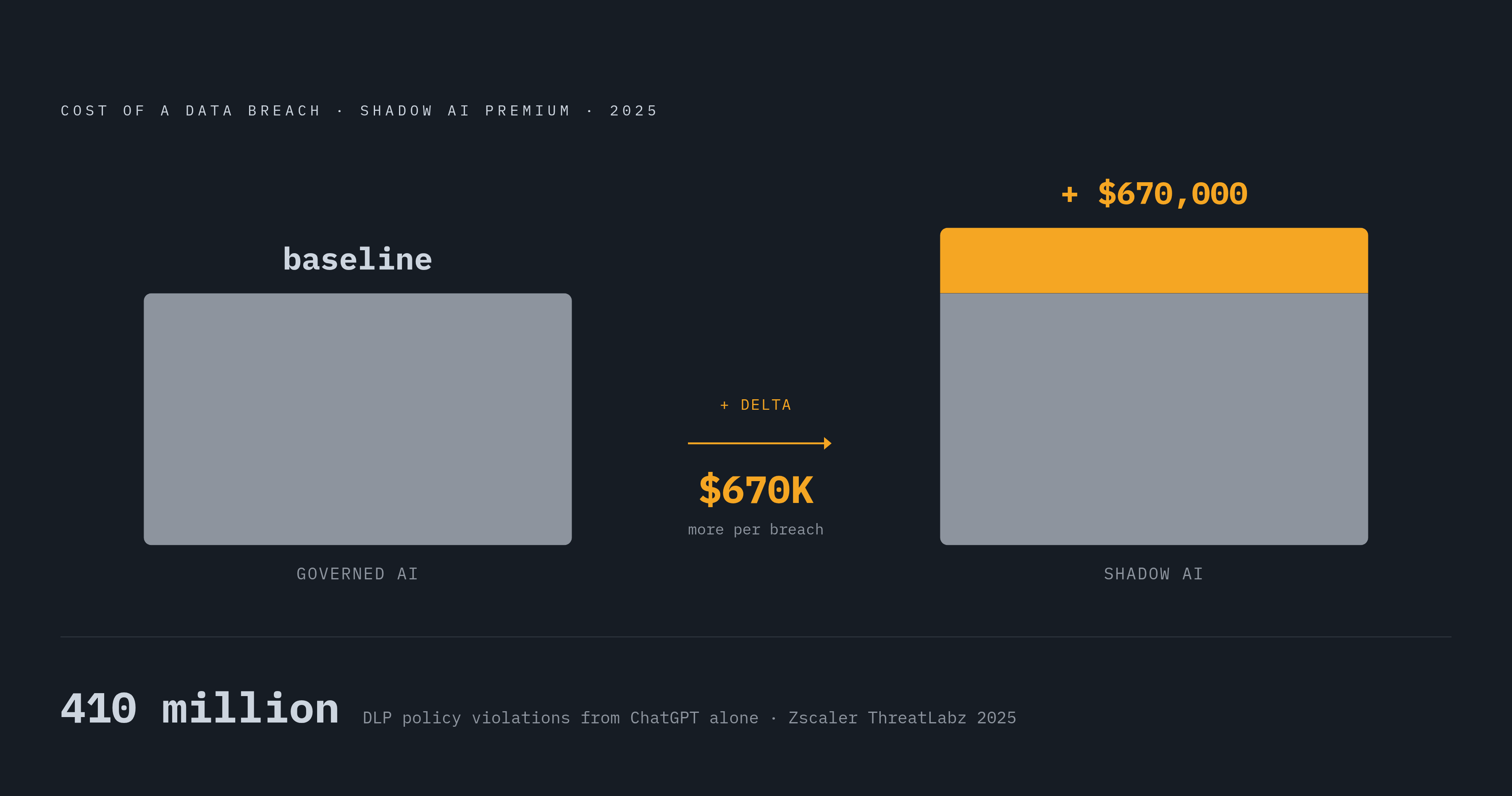
Numbers make this concrete fast. IBM's 2025 Cost of a Data Breach Report found breaches involving shadow AI cost an average of $670,000 more than breaches where AI was properly governed. That's the premium a company pays specifically for not knowing what AI tools its people were running. The same report found one in five organizations has already had a breach tied directly to shadow AI.
There's an insider risk angle worth sitting with, too. The DTEX/Ponemon 2026 Cost of Insider Risks report found that 53% of annual insider risk costs, $10.3 million per organization on average, came from non-malicious actors. Unsanctioned AI negligence makes up a growing slice of that number. Put those two facts side by side and a pattern shows up: the premium organizations pay for shadow AI comes mostly from employees who thought they were just being efficient.
Scale that across a single vendor and the exposure gets hard to picture. ChatGPT alone generated more than 410 million DLP policy violations in 2025, according to Zscaler ThreatLabz. Each one is a moment when sensitive data tried to walk out through an AI tool. The total behind that count dwarfs what any single incident report can capture on its own.
How agentic AI and MCP-layer tools push the threat beyond what employees consciously share
Everything above describes a choice an employee makes, even an uninformed one: they decide to paste something into a box. Agentic AI removes that decision point. These are systems that query, retrieve, and send data on their own, with no human sitting there approving each step along the way.
Analysts widely expect agentic AI adoption inside enterprise applications to accelerate sharply through 2026, opening attack surfaces most security teams haven't mapped yet. That's a fast ramp, and it's opening attack surfaces most security teams haven't mapped yet. MCP (Model Context Protocol) servers now expose internal APIs directly to outside models. Browser extensions with agent capabilities operate on live session data mid-task. OAuth-connected agents keep persistent data access that often outlasts whatever the original authorization was meant to cover. API tokens sprawl into access chains nobody's watching end to end.
This isn't theoretical anymore. Attackers are now targeting the supply chain behind AI tooling itself, in addition to the endpoints running it, with early documented cases of malicious code hidden inside otherwise functional MCP packages.
Zero-click prompt-injection flaws in production LLMs have also been documented, where a crafted input can plant hidden instructions the assistant absorbs through its own retrieval context and acts on without the user clicking, opening, or approving a single thing.
Security assessments of production AI deployments have found prompt injection to be a pervasive condition, baked into how many AI systems already run in the field. That's a condition baked into how most AI systems already run in the field right now. Watching what employees choose to type still matters, but it falls well short of covering the problem, because the real question now is what the AI system does on its own, unwatched.
Why traditional security controls and governance checklists can't close these gaps
DLP tools were built to flag known data patterns moving across known networks. Personal-account traffic and browser-extension exfiltration are mostly invisible to that model; there's no known network to inspect and often no known pattern to match.
CASB controls carry a built-in assumption too: that the organization can list every application its employees use. With more than 1,550 GenAI SaaS applications tracked and climbing, complete enumeration has stopped being merely hard and become operationally impossible.
Policy alone doesn't close the gap either, and the research backs that up. Research including the Raizada et al. study of 215 workers published in Advances in Consumer Research consistently points to policy gaps and task pressure as core drivers of shadow AI behavior. Separately, 40% of workers say they'd knowingly break policy if it meant finishing a task faster. Write the policy, distribute it, get everyone to sign off, and 40% of the workforce will still route around it the moment a deadline gets tight.
Frameworks like NIST's AI RMF and ISO 42001 do real work, but only for AI deployments the organization already knows about. They give structure to managing a known inventory. Shadow AI defeats that at the root, because the inventory itself is incomplete from the start.
There's a blind spot worth naming here, too. Most governance energy goes toward AI built in-house, while vendor-supplied models, plugins, and connectors, the exact things driving prompt injection and exfiltration risk, go unvetted, platforms like PromptArmor, an enterprise AI vendor risk intelligence tool, exist specifically because that unvetted layer is where most of the real exposure sits. The attack surface sits in the supply chain as much as it sits in employee behavior, and treating this as purely a training problem misses where a lot of the real exposure actually lives.
What effective shadow AI governance actually requires
Discovery has to come before policy. You can't govern what you can't see, so continuous discovery of AI tool usage across the enterprise, browser extensions and personal-account traffic included, has to be the starting point before any other control gets bolted on.
Vendor AI assessment deserves its own process, separate from the standard vendor security questionnaire procurement teams already run through. Vetting an LLM plugin or connector means looking at model behavior directly: how the vendor handles data retention, whether a DPA actually covers the use case, and what the tool's exposure to prompt injection looks like under real pressure, not just on paper.
Monitoring can't stop once a tool clears review, either. Both the EchoLeak flaw and the postmark-mcp incident prove a tool can pass every initial check and still turn into a threat vector months later. A point-in-time assessment tells you almost nothing about what a tool will do six months from now.
What does this look like day to day? A few concrete pieces:
- Real-time visibility into data flowing to and from AI tools, sanctioned ones included, not just the shadow ones.
- DLP policies built specifically for AI, covering prompt content, RAG context, and agent output, not just the old file-and-email patterns.
- Monitoring built for what AI agents do unprompted, not only what employees explicitly tell them to do.
- Incident response playbooks written for AI-specific scenarios: prompt injection, MCP-layer exfiltration, the failure modes traditional IR plans were never built around.
Different teams need to hear this in different terms, too. For third-party risk management, shadow AI is fundamentally a vendor risk problem: every AI tool an employee connects to is a data pipeline the organization doesn't control. For InfoSec, the attack surface worth watching is the vendor AI ecosystem itself, alongside the employee's laptop. For legal and privacy teams, the Article 28 DPA gap is already live, right now, in every organization where employees run consumer AI tools through personal logins.
The organizations closing this gap are the ones pairing vendor risk assessment with real-time AI threat detection across the full ecosystem of vendor AI assets, not just the tools IT officially blessed. That combination reaches further than generic governance checklists and traditional security controls, built for a world of files and known networks, were designed to cover.