RAG Pipeline Data Exposure Risks in Enterprise Deployments
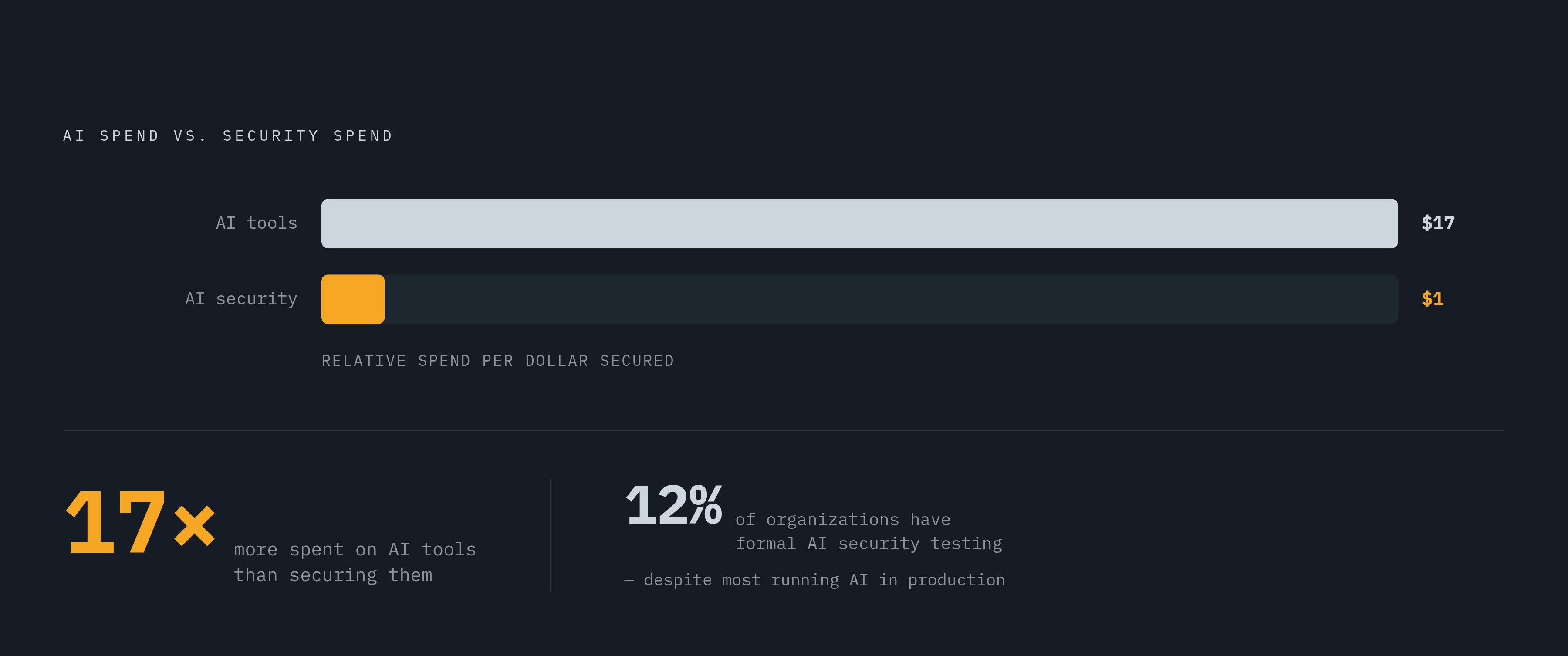
Enterprises racing to deploy RAG systems are spending 17 times more on AI tools than securing them.
The numbers aren't complicated. MarketsandMarkets valued retrieval-augmented generation at roughly $1.94 billion in 2025 and projects it reaching nearly $10 billion by 2030. Grand View Research's trajectory is steeper. Whichever figure you trust, the directional signal is the same: enterprise adoption is accelerating, and it's doing so fastest in the sectors that can least afford a data incident.
Financial services, healthcare, legal. These are the verticals moving quickest into RAG, and they're also the ones where a single misdirected retrieval can trigger a HIPAA violation, a material disclosure, or a privileged communication breach. That convergence isn't accidental. Competitive pressure in regulated industries compresses timelines, and what gets compressed, specifically, is the gap between "pilot" and "production." The security infrastructure that should accompany deployment is still sitting in a procurement queue.
Gartner found organizations spending roughly 17 times more on AI tools than on securing them. Separately, only about 12% of organizations have formal AI security testing programs, despite the majority already running AI in production. Those two figures together describe something specific: a system scaling deployment without scaling oversight. At that ratio, things get left unguarded. That raises an important question: what, exactly, is being left exposed?
The agentic layer changes the calculus in ways that aren't fully appreciated yet. Gartner projects that by end of 2026, roughly 40% of enterprise applications will integrate task-specific AI agents, up from fewer than 5% in 2025. Nearly every agentic system has a RAG layer underneath it. So the RAG attack surface doesn't grow only with RAG adoption; it grows with the entire agentic wave. Security and TPRM teams treating RAG as a bounded product category are inheriting something considerably larger than they've scoped for.
The tooling built to assess these deployments, standard questionnaires, point-in-time audits, perimeter controls, was designed for a fundamentally different architecture. None of it was built for a system where the attack surface is dynamic, query-driven, and partially assembled at inference time. That mismatch is what the rest of this is about.
Knowledge base poisoning: how the ingestion pipeline becomes the entry point
Most people securing an AI system focus on the model and the prompt. Who's typing what, what guardrails exist at the interface. What poisoning attacks reveal is that you can compromise a RAG system without ever touching either of those things, because the ingestion pipeline itself is an entry point that most security models don't treat as one.
The mechanism is straightforward once you see it. An adversary crafts documents that are semantically legitimate, meaning they look like plausible knowledge base content, but contain embedded instructions designed to redirect LLM behavior when retrieved. The attacker doesn't need access to your system. They need to get a document into your ingestion pipeline.
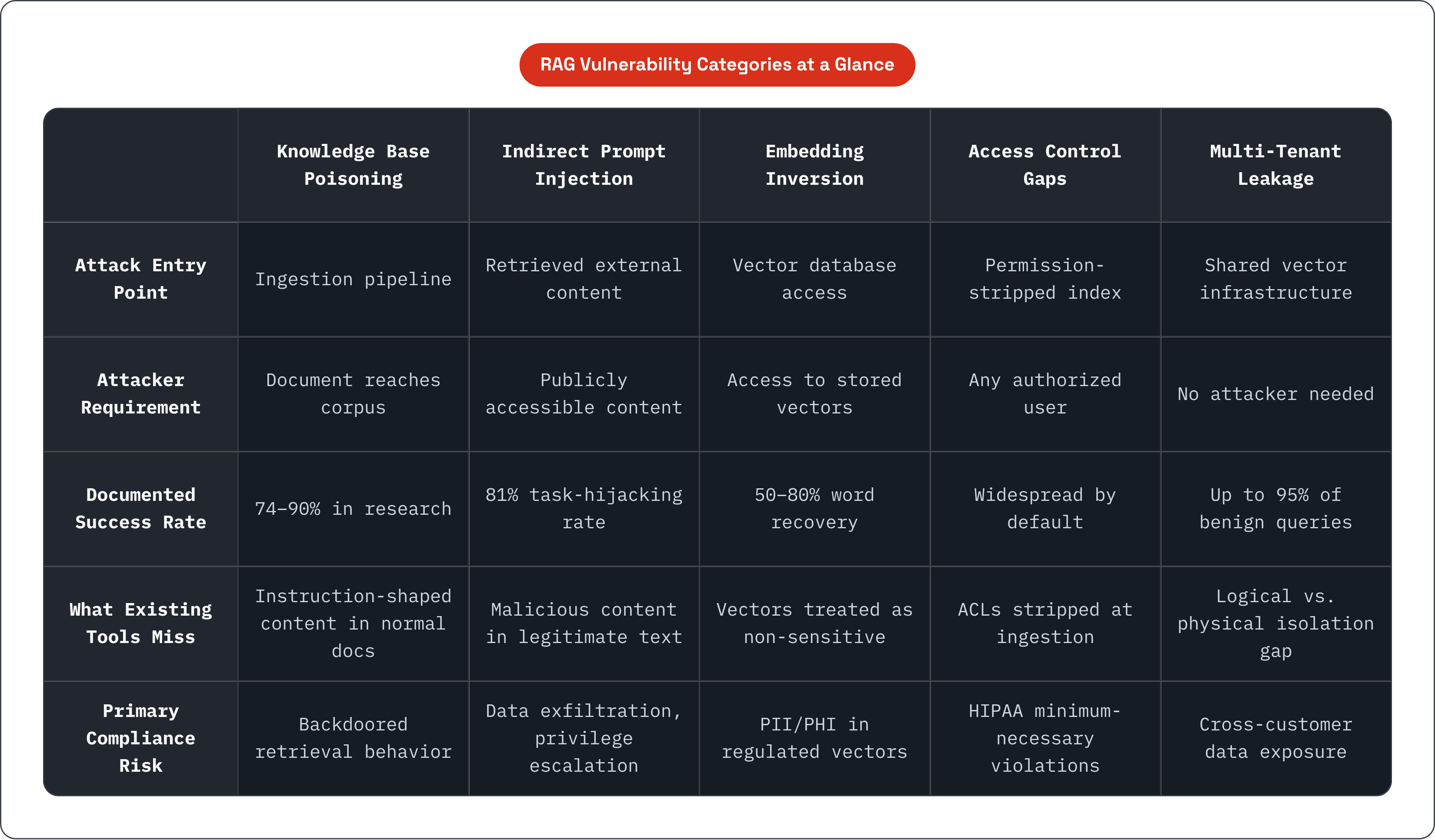
Research published at USENIX Security in 2025 put numbers to how achievable that is. The PoisonedRAG attack demonstrated a 90% success rate by injecting just five poisoned texts per target question into a corpus containing millions of documents. Five documents, in a corpus of millions. But what if your organization is ingesting third-party content at scale? That's not a theoretical edge case — it's a routine operational condition.
A separate 2025 study found that 74% of attempted poisoning attacks succeeded through unsanitized document ingestion. The ingestion toolchain itself, the parsers, loaders, and format converters processing PDFs and Word files before they reach the index, is the attack carrier. Research by Castagnaro et al. showed that malicious content hidden in common document formats can be silently introduced during parsing without directly editing the indexed corpus. The vulnerability isn't in the vector store; it's upstream of it.
AgentPoison, presented at NeurIPS in 2024, extended this into agentic systems, demonstrating the first backdoor attack on RAG-based agents with a success rate at or above 80%. This is precisely why the agentic adoption projections matter: nearly every new agentic deployment inherits this exposure by default.
What makes these attacks particularly difficult to catch is that poisoned documents pass the checks that exist. Keyword filters, format validation, basic content inspection: none of these evaluate whether a semantically normal-looking document contains instruction-shaped content that will redirect LLM behavior at retrieval time. That's a visibility problem, not a configuration problem. The tools in place were designed to look for different things entirely.
Indirect prompt injection: attacks that enter through retrieved content, not the user interface
Poisoning attacks require placing a document inside the knowledge base. Indirect prompt injection, however, requires only that your RAG pipeline retrieve content from the external world.
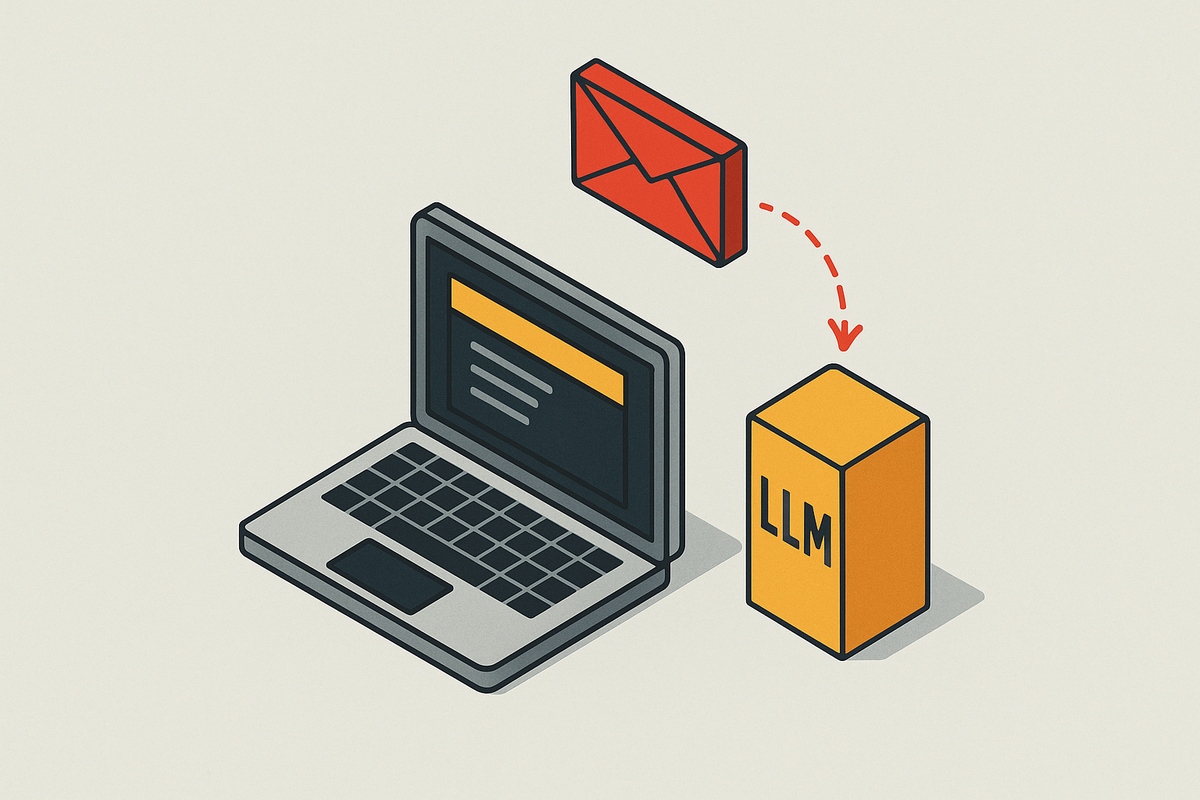
The mechanics: an attacker embeds malicious instructions in a document sitting somewhere accessible, an email, a PDF, a public GitHub README, a web page. At query time, your pipeline retrieves it because it's semantically relevant to the user's query. Those instructions enter the context window alongside legitimate content. The LLM, which treats retrieved content as trusted input, executes them. The attacker never touches your AI interface and needs no account on your system.
Content filtering at the retrieval layer does not reliably catch this. That approach assumes malicious content looks different from legitimate content, which is precisely what makes these attacks effective.
The incidents are no longer hypothetical. EchoLeak, disclosed in late 2025, showed a specially crafted email manipulating Microsoft 365 Copilot's enterprise RAG pipeline into retrieving and exfiltrating sensitive corporate data with zero employee interaction. Nobody clicked anything. CVE-2025-32711 documented a hidden instruction in an email causing an enterprise copilot to exfiltrate user data without any user awareness. In August 2025, attackers implanted hidden instructions in public GitHub README files; when developers used an AI coding assistant to summarize those repositories, the AI executed the hidden commands.
A researcher demonstration in January 2025 showed a single publicly accessible document causing an enterprise RAG system to leak proprietary business intelligence to external endpoints, modify its own system prompts to disable safety filters, and execute API calls with elevated privileges. All of this flowed from retrieved content being treated as equally trustworthy as the system's own configuration.
NIST formally expanded its adversarial ML taxonomy in early 2025 to cover indirect prompt injection and agent tool supply chain attacks against RAG. Their research found novel agent attacks achieved an 81% task-hijacking success rate compared to 11% for known baselines. That gap quantifies exactly what defenders preparing for yesterday's attacks are missing. OWASP's 2025 LLM Top 10 added system prompt leakage and vector and embedding weaknesses specifically because more than half of companies now rely on RAG and agentic pipelines.
Most enterprise deployments predate these controls. Standard content inspection tools still aren't evaluating whether retrieved text contains instruction-shaped content. Instead of scanning for known malware signatures, which is a fundamentally different question, they need to evaluate whether retrieved text contains instruction-shaped content.
Vector database exposure and embedding inversion: why "anonymized" vectors aren't anonymous
The assumption is understandable. Vectors are opaque numerical representations, mathematical summaries of documents rather than the documents themselves. Recovering original text from a vector seems implausible.
It isn't. OWASP's LLM Top 10 for 2025 formally recognizes embedding inversion as a top-10 risk and cites recovery rates of 50 to 70% of original input words from standard dense embedding models. More recent research using gradient-based optimization and trained inversion models pushes that figure to 60 to 80% accuracy. For a medical record, that's not an abstract statistical result; that's patient names, diagnoses, and treatment details becoming accessible to anyone with access to the vectors. Why exactly does this happen? Because the mathematical structure of embeddings preserves far more of the original content than most practitioners assume.
The ALGEN framework research, published in early 2025, found that as few as 1,000 alignment samples are sufficient to mount a partially successful inversion attack on black-box encoders. The practical implication: sharing embeddings with third-party services, or storing them in insufficiently protected vector databases, is functionally comparable to sharing the underlying documents. Not identical, but close enough to constitute a material compliance concern.
Documented failures bear this out. In one fintech case, attackers used reconstruction techniques to reverse-engineer embeddings back into original client investment portfolios. A separate access-control bypass in a vector database exposed hundreds of thousands of healthcare records. These are production failures, not proof-of-concept demonstrations.
It is also worth considering a secondary exposure surface that's easy to miss. User queries also get encoded into embeddings for retrieval. In cloud-hosted RAG services, those query embeddings traverse the provider's infrastructure. Even if your knowledge base is locked down, the queries themselves, which often carry sensitive intent, sensitive terminology, or sensitive identifiers, are moving through infrastructure you don't control. That exposure exists independent of everything you've done to protect your corpus.
The compliance framing matters here. If source documents contain PII, PHI, or trade secrets, and those documents were embedded and stored in a vector database, the vectors are regulated data. Most enterprises haven't applied that classification to their vector stores. The regulatory exposure exists whether or not the classification has been made.
Access control misconfiguration and the permissions gap that most RAG pipelines ship with
Research indicates that the overwhelming majority of enterprise RAG implementations ship without role-based access controls, audit trails, or permission-aware retrieval logic. This is the default state of most RAG deployments, and it is a widespread problem. To understand why this happens, we must first look at the architecture itself.
When documents are converted into vector embeddings, the access control lists that existed on the source documents don't travel with them. The permissions that Microsoft SharePoint or your document management system enforced on the original files are stripped during ingestion. The vector representation has no memory of who was and wasn't permitted to see the source material.
Most RAG pilots get stood up with broad repository access granted through a service account. At pilot scale, that feels manageable. At production scale, however, it means any authorized user of the system can surface documents they would never have been permitted to access directly.
Two failure modes appear most consistently. First, sensitivity label bypass: RAG pipelines retrieve data without evaluating classification labels, so the system surfaces confidential or restricted content that the underlying controls were specifically designed to block. Second, cross-role leakage: a customer service agent's query can retrieve documents indexed from executive strategy files when the retrieval layer operates on a flat, permission-stripped index.
The regulatory exposure is precise. Under HIPAA, a clinical RAG system that retrieves Patient A's records into the context of a query about Patient B has violated the minimum necessary standard. The violation is in the retrieval itself, not in whether Patient A is named in the final response. That distinction matters enormously in an audit or incident investigation, because the retrieval log will show the exposure regardless of what the LLM ultimately said.
Proper remediation requires per-request authorization enforced at the retrieval layer, not only at connection time. Deployments that authenticate solely at the service account level are carrying the full permissions gap on every single query.
Multi-tenant RAG deployments and how shared vector infrastructure creates cross-customer data boundaries
When SaaS vendors build RAG products, a common architectural decision is sharing a single vector database across customers or business units. The motivation is real: reduced operational overhead, lower infrastructure cost. The trade-off, however, is that the retrieval layer becomes a potential data cross-contamination channel.
What's particularly striking about the documented risk here is that cross-tenant leakage requires no attacker. Research documented in an arXiv preprint found that in a multi-tenant corpus with four tenants, up to 95% of benign queries triggered cross-tenant leakage. Organic entity connections, shared vendors, common personnel, natural semantic overlaps between tenant data: these create retrieval pathways that expose one tenant's content to another tenant's queries without any adversarial intent. The architecture itself generates the vulnerability. But how does this affect our original promise of secure, isolated deployments? Consider what that means for enterprises that have already deployed vendor-supplied RAG products without asking about the underlying isolation model.
Subsequent research on isolation patterns formalized three approaches: Silo, Pool, and Bridge. Only physical Silo-pattern isolation, where each tenant has a fully separate vector store, provides strong security guarantees. Pool and Bridge patterns carry inherent leakage risk. That trade-off is real and should be explicit in every vendor evaluation conversation.
This becomes a TPRM issue the moment an enterprise deploys a vendor-supplied RAG product. The isolation architecture of that vendor's underlying vector infrastructure is a material security question, and it's not one that standard vendor questionnaires currently ask. The question that should be in every RAG vendor assessment: is tenant isolation physical or logical, and is retrieval gated by per-request authorization or by shared index access?
If the vendor can't answer that cleanly, you have your answer.
Why the standard compliance and governance frameworks leave these gaps unaddressed
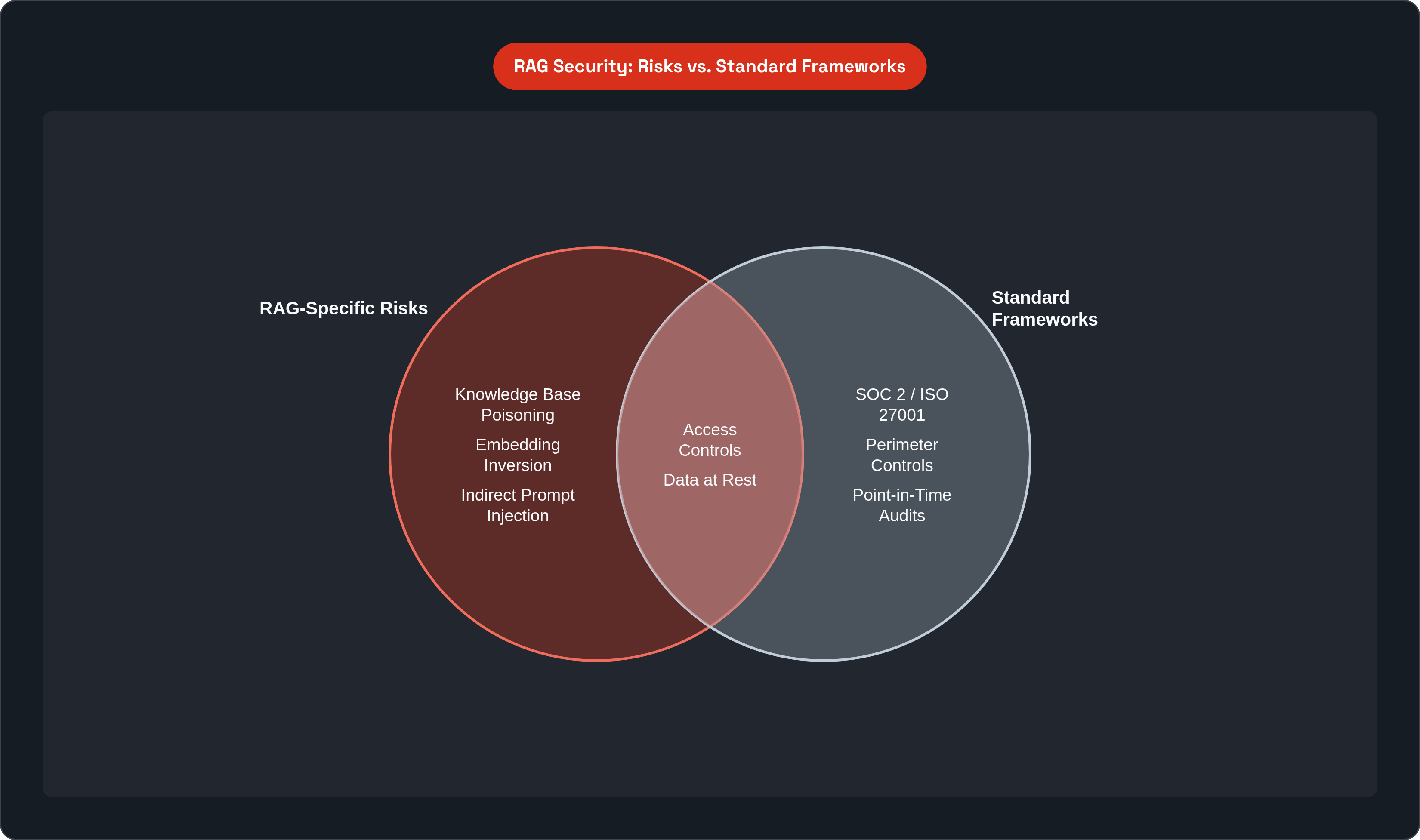
This is where the most practical friction lives for security and TPRM teams. The gap isn't a failure of effort. It's a structural mismatch between the timing of the frameworks and the timing of the technology.
SOC 2, ISO 27001, standard vendor questionnaires: these were designed around data at rest and in transit, access to systems, and human-operated processes. They produce meaningful assurance about those things. However, they have no evaluation criteria for a retrieval layer that dynamically assembles context from thousands of documents at query time, because that retrieval layer didn't exist when the frameworks were written. You can't audit for what you haven't named yet.
The AI risk governance models that have emerged treat AI risk as a model-level concern: model cards, bias assessments, explainability documentation. Legitimate questions, all of them. But they have no clause for indirect prompt injection through retrieved content, and they don't address poisoned retrieval corpora or embedding inversion. A system can satisfy every requirement on the standard checklist and still carry every vulnerability described here, fully intact and undetected.
OWASP's 2025 LLM Top 10 update and NIST AI 100-2 E2025 are the most current formal acknowledgments that these gaps exist and matter. However, acknowledging a threat surface and providing audit-ready controls that map onto enterprise security programs are different things. Neither framework yet produces the assessment methodology a security team can hand to a vendor or apply to an internal deployment.
The Gartner finding that organizations invest 17 times more on AI tools than on securing them reflects, in part, that the budget categories simply don't exist yet. There's no line item for retrieval layer monitoring in most enterprise security programs because the frameworks driving security budgeting haven't named it as a requirement. The absence of a control creates the absence of a budget, which creates the absence of coverage.
One might argue that existing certifications provide sufficient assurance — but a vendor can carry SOC 2 Type II certification and still be shipping a RAG implementation without permission-aware retrieval, without embedding access controls, and without any instrumented defense against indirect prompt injection. The certification and the vulnerability coexist because they're measuring different things. That's not a loophole; it's a structural gap, and it will remain one until the frameworks catch up.
What continuous monitoring of RAG pipelines requires that point-in-time assessments miss
The limitation of point-in-time assessment for RAG isn't methodological; it's temporal. A knowledge base changes continuously as new documents are ingested. A clean assessment at deployment can be invalidated by a single poisoned document ingested the following week. The attack surface at assessment time is not the attack surface at query time, and that gap widens with every ingestion event.
The same logic applies to indirect prompt injection. External content feeding into retrieval at inference time didn't exist at assessment time. You cannot assess your exposure to a document that hasn't been written yet. Compliance checked once is not compliance maintained.
Continuous monitoring for RAG pipelines needs to do things that traditional security monitoring was never designed for. It needs to track retrieval behavior over time, not just access logs, because what gets retrieved for a given query can shift as the corpus changes without any change in the query itself. It needs to surface anomalous retrieval patterns: documents appearing with unexpected frequency, queries returning semantically inconsistent content, retrieval results spanning permission boundaries. It needs provenance tracking on ingested documents, because a document's origin is often the only early signal that it merits closer scrutiny.
Behavioral baselines matter in a way they don't for static systems. A system retrieving different documents for the same query on different days isn't malfunctioning; that's expected behavior. However, if the drift in retrieved content correlates with a specific external source, or precedes unusual API calls, or follows a pattern that consistently appears before anomalous generation outputs, that sequence is detectable with the right instrumentation. The signal is there. The question is whether anyone is looking at the right layer.
Traditional DLP, perimeter controls, and endpoint agents operate on structured data flows and known formats. They have no visibility into what a similarity search retrieves or what an LLM does with retrieved content inside a context window. The telemetry doesn't reach that layer, which means the exposure can be ongoing and completely invisible to a security team running an otherwise mature program. Platforms like Promptarmor, an enterprise AI risk intelligence platform that continuously monitors the security and privacy risks of AI vendors and deployments, are attempting to close that gap, though the field is early enough that the tooling should be evaluated carefully, with clear distinctions between what's proven and what's still being tested.
For security, privacy, and TPRM teams, the practical implication is that RAG risk cannot be managed at the same cadence as conventional infrastructure risk. Annual assessments, quarterly reviews, point-in-time vendor audits: appropriate for systems where the attack surface is stable. RAG pipelines are not those systems. The knowledge base is a living document, the retrieval layer is a dynamic function, and the attack surface is whatever external content your pipeline can reach on any given day. So monitoring has to match that pace, or the gap between assessment and reality compounds with every new document ingested.