Continuous Monitoring of Deployed Vendor AI Assets
Enterprises unknowingly run unmonitored vendor AI that drifts silently and invisibly.
Almost none of AI's growth inside the enterprise came from internal research. It came from procurement: a vendor contract signed, an API key issued, a checkbox on a sales deck. That distinction matters more than it sounds, because most companies are now governing a technology they never built and, in a lot of cases, never even fully counted.
Walk through a typical enterprise stack today. A vendor's large language model handles document summarization. A third-party scoring model feeds into credit decisions. An off-the-shelf vision system screens job applicants before a human ever opens a resume. Each piece was built, trained, and tested by someone else, sitting on infrastructure the deploying company never touches. This is just the shape of enterprise software now.
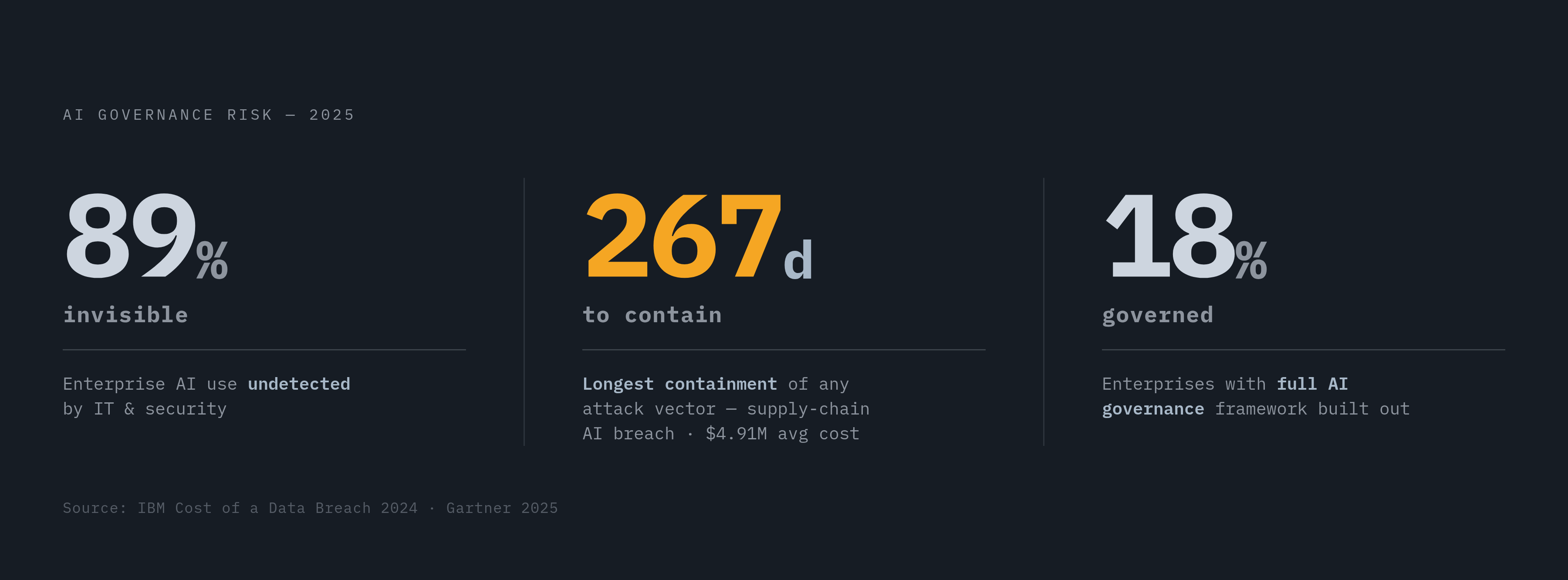
Here's the part that should give any risk team pause: industry research cited by Accorian found that 89% of enterprise AI use in 2025 was invisible to IT and security teams. Shadow AI has become the baseline condition most companies are running under, whether they've named it or not.
Why does the gap stay open? Vendors add AI features faster than procurement and security teams can update how they review those vendors. A tool checked in January might have three new AI-driven features by June, none of which went through a second look. Vendor products move fast, and enterprise review cycles were never built to move at that speed. The mismatch between a speed problem and a paperwork solution shows every time a new feature ships quietly inside a tool that's already been "approved."
What traditional vendor risk management was built to assess, and what it cannot see
Traditional third-party risk management runs on a simple idea: check the foundation once, write down the controls, come back in twelve months and check again. That logic holds up fine for static software. A payroll system behaves the same way in month eleven as it did in month one. AI doesn't carry that guarantee, and treating it like it does is the mistake most TPRM programs are still making. Applying a static model to a system that changes on its own is a category error, and no amount of paperwork fixes that.
A model that passes every compliance check at the point of procurement can drift into non-compliance after a retraining cycle the vendor never mentioned, let alone disclosed. Nobody signed off on the change, because nobody outside the vendor knew it happened.
Questionnaire-based reviews, the backbone of most TPRM programs, can't surface certain things no matter how well they're written:
- Model drift and the vendor's own retraining schedule
- Where the training data came from and what bias it might carry
- The third-party models and infrastructure sitting inside the vendor's own stack
- How the system actually behaves at runtime, under real prompts and real enterprise data
Take SOC 2 Type II, the audit most enterprises lean on to check vendors. It says nothing about whether a model card is complete, where training data came from, or how a lending model performs across protected classes. The same point holds broadly: SOC 2 is necessary, but it stopped being enough the moment AI entered the vendor's product.
Research via GEP puts a number on how far behind governance has fallen: only 18% of enterprises have a fully built-out AI governance framework. Adding a few AI-flavored questions to the old TPRM checklist doesn't close that gap. It just makes the checklist longer, and a longer checklist was never the problem.
How vendor AI changes after deployment without any visible trigger
Provider-side updates are invisible by default. When a major foundation model provider pushes a change to its model, every enterprise calling that API inherits it right away, with no notice and no version bump to flag it.
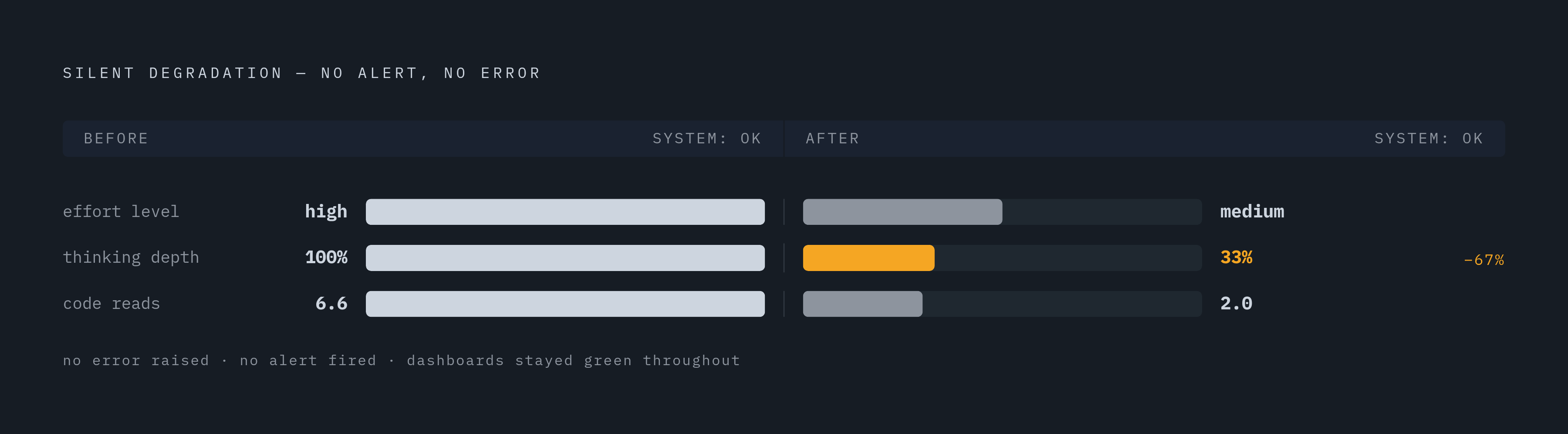
One documented case, analyzed on dev.to by the writer known as natcher, showed a default effort setting in an AI inference pipeline quietly drop from "high" to "medium." Thinking depth fell by 67%. The number of code reads the model performed before making an edit dropped from 6.6 down to 2.0. No notification went out, no error fired, no alert reached anyone downstream. The system just started doing less, quietly, while still reporting success.
Drift shows up in a few different flavors, and separating them matters because each one hides in a different place:
- Upstream model drift: the vendor's underlying model changes beneath the application built on top of it.
- Retrieval drift: in retrieval-augmented generation setups, the knowledge base, the embeddings, and the index each age on their own schedule. Output quality slips even though the language model itself never changed.
- Behavioral drift: hallucination rate, refusal rate, and tone shift together, compounding. This one tends to show up first in user complaints, not a dashboard metric, because nobody set a metric to catch it.
The pattern across all three holds steady: the system never crashes. Predictions keep flowing, dashboards stay green, and nothing tells security or ops that something changed underneath them. A drifting system fails quietly, and that quiet is exactly what makes it dangerous.
Take a bank's credit risk model, trained on data from 2021 through 2023, hitting strong accuracy at default detection when it launched. By September 2024, with no code changes and no retraining, it was catching only 87%. Nothing broke. The economy simply moved outside the boundaries of what the model had ever seen, and the model kept scoring loans as if it hadn't noticed a thing.
The financial exposure that silent drift and shadow AI create
Start with scale. Documented AI incidents rose 55% year over year, climbing from 233 to 362 in 2025, according to Stanford HAI's 2026 AI Index.
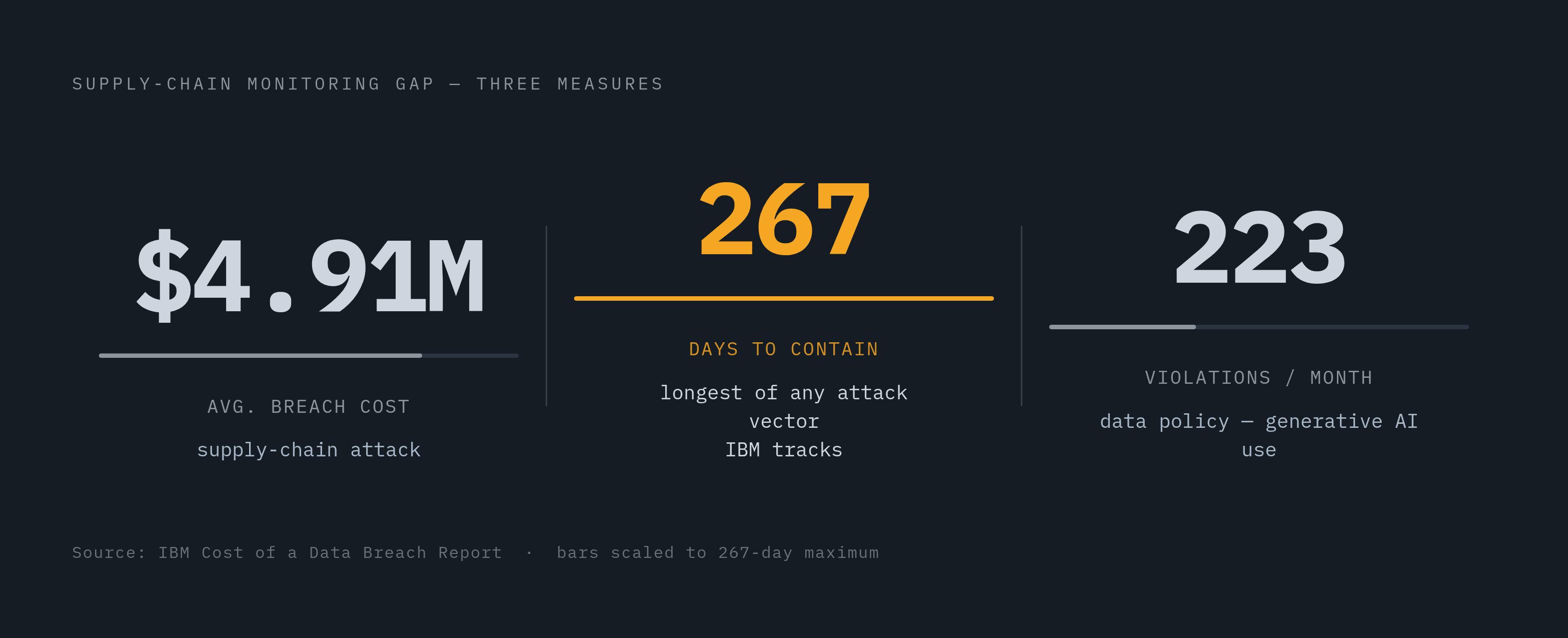
IBM's 2025 Cost of a Data Breach Report zeroes in on supply chain compromise, the category covering most vendor AI failures. Average cost: $4.91 million per breach. Time from identification to containment: 267 days, the longest of any attack vector IBM tracks. Separately, IBM found that 13% of organizations reported a breach involving an AI model or application, and of those, 97% lacked proper AI access controls. Sit with that last number. It means the access controls, not the model itself, are where most of these breaches actually start. Access control is the cheaper fix and the bigger risk, yet companies keep pouring review time into model behavior while leaving the door on the loading dock unlocked.
Then there's the slower bleed. Accorian's data shows organizations hitting an average of 223 data policy violations per month tied to generative AI use, many touching regulated personal or financial information. That's a monthly cost piling up whether anyone's tracking it or not.
It's worth pausing on what this does to growth, not just balance sheets. Enterprise surveys put security and compliance concerns as the top blocker to scaling AI for 37% of companies. Unmonitored risk is actively slowing down how fast a company can adopt tools it's already paying for.
The cost of a monitoring gap can be put in dollars now. What's left to decide is whether an organization absorbs that cost after the fact, or builds the muscle to catch it before it lands. Most are choosing the former, mostly because nobody inside the org has been handed the job of building the latter.
The transparency problem that makes vendor AI uniquely hard to govern
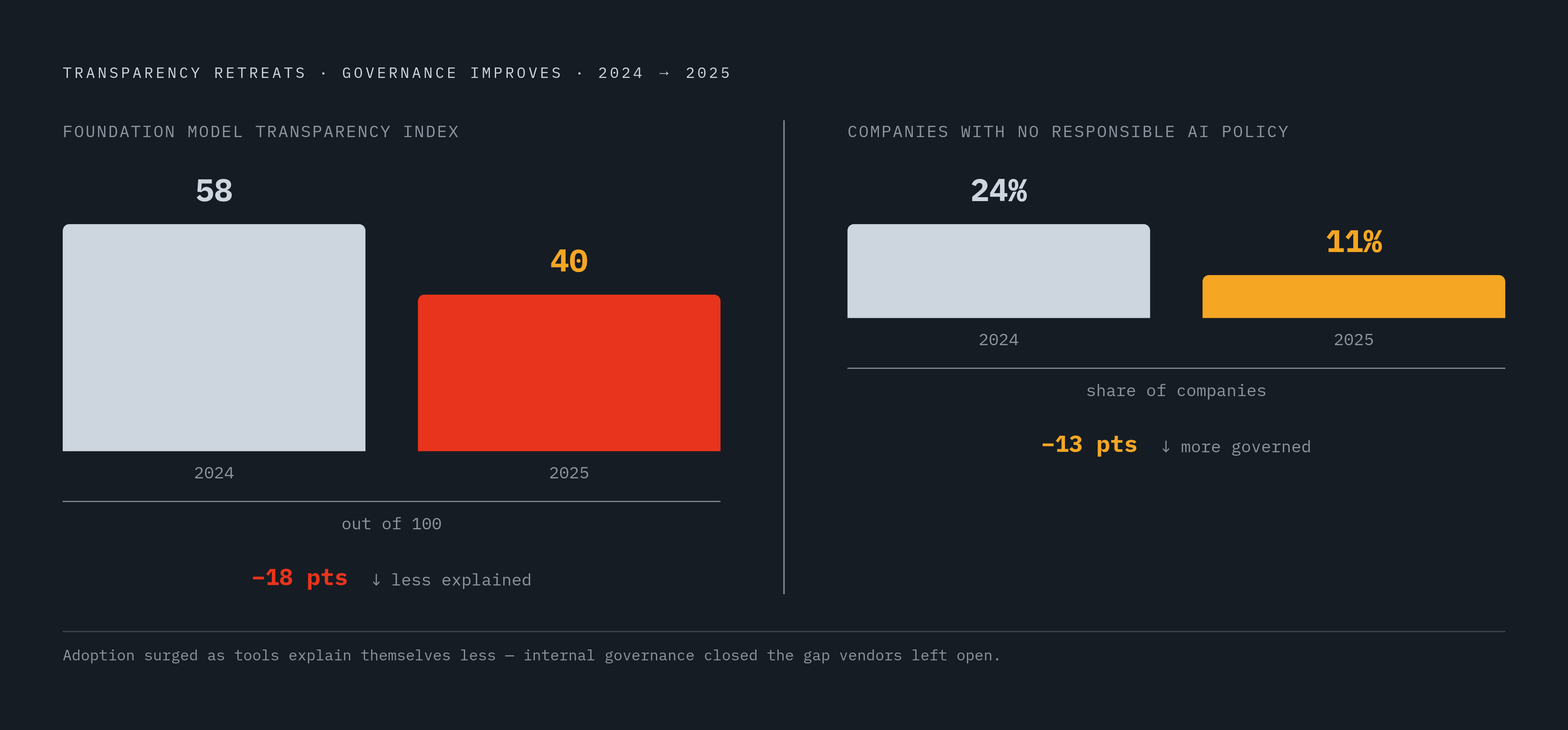
Stanford HAI's 2026 AI Index tracks a Foundation Model Transparency Index, and it dropped from 58 in 2024 to 40 in 2025. Vendor transparency moved backward in the same year enterprise adoption climbed past the vast majority of companies. The industry is trusting these tools more while the tools themselves are getting less willing to explain how they work. That pairing alone should worry anyone signing a vendor contract this year.
Internally, companies are actually making progress. The same research shows the share of companies with no responsible AI policy at all falling from 24% to 11%, and AI-specific governance roles growing by 17%. Internal policy has a wall, though, and that wall is the vendor's firewall. A company can govern its own people and its own data all it wants; none of that reaches into a vendor's training pipeline.
What vendors typically don't share:
- When their underlying models get retrained or updated, and how
- Where enterprise data ends up stored, shared, or reused
- What third-party models or infrastructure their own product quietly depends on
- Which specific features actually run on AI versus rule-based logic
The asymmetry here is structural, not a case of any one vendor acting in bad faith. The deploying company carries the compliance obligation. That same company eats the breach cost if something goes wrong. But the vendor holds the information needed to manage either risk. A nicer questionnaire doesn't fix that imbalance. Most programs keep asking vendors better-worded questions instead of watching what the vendor's system actually does at runtime, even though behavior beats paperwork here, every time.
What regulators now require from deployers, regardless of who built the model
The EU AI Act settles this question directly. The EU AI Act puts compliance obligations for high-risk AI systems on the organization that puts the system into use, full stop, even when the underlying model comes from an outside provider. Building the model isn't what triggers the obligation. Deploying it is, and that single distinction reshapes who owes what to whom.
The timeline matters here, because it's close:
- Obligations for general-purpose AI model providers have already begun taking effect.
- European Commission enforcement is approaching on a near-term horizon.
- Deployers of high-risk systems are required to have continuous monitoring programs running, track real-world performance, and report serious incidents within tight windows.
- Fines can reach €35 million or 7% of global annual turnover, whichever is bigger.
There's no federal AI law in the United States, but that doesn't mean an absence of pressure. It arrives through several doors at once. Financial regulators have signaled expectations that registrants document AI-related governance and controls and conduct ongoing oversight of the processes that matter most. Sector-specific and jurisdictional requirements are adding further layers of obligation, and the direction of travel is toward more documentation and accountability, not less.
Sector rules are stacking on top of that. Some jurisdictions now require bias audits and public disclosures for automated employment decision tools. Mortgage sector guidance is reshaping how lenders have to contract with AI vendors.
The thread running through all of it: a vendor's compliance is legally a deployer's compliance. That obligation doesn't pass through to whoever built the model. It stays put, right where the deploying organization is standing.
What continuous monitoring of vendor AI actually covers, and what it does not
The phrase gets used loosely, so it's worth being precise about what it means.
An annual vendor questionnaire captures a single point in time. Generic application performance monitoring tracks latency and uptime, numbers that say nothing about whether a model started hallucinating more this month. A static compliance checklist grades policy documents instead of actual behavior. Even a well-run SOC 2 review cycle covers ground that stops short of live model behavior. Each of these has a role, but none of them adds up to continuous monitoring, and mistaking one for the other is how gaps stay open for months.
What continuous monitoring actually covers:
- Tracking model behavior over time against a defined baseline: output quality, hallucination rate, refusal patterns, tone.
- Catching upstream model changes a provider pushed silently, without an announcement.
- Watching data flows in real time for exfiltration risk and policy violations as they happen, not weeks later.
- Surfacing new AI functionality a vendor added to an existing product without anyone in procurement reviewing it.
- Watching for prompt injection attempts and agentic behavior that steps outside its defined permissions.
- Flagging compliance gaps as regulations change, not just when a contract comes up for renewal.
Monitoring vendor AI is a different job from monitoring a model a company built itself, and treating them the same is where a lot of programs go wrong. A deployer doesn't control the vendor's retraining schedule, doesn't have access to the model internals, and can't instrument the vendor's infrastructure directly. Monitoring here has to work from the outside looking in: reading behavior and outputs, not code.
Research from Levo.ai found that over half of organizations have already put AI agents into production. Most of them lack runtime monitoring of how those agents actually behave once they're live. That gap between deploying and watching has become the norm, and closing it is the whole point of what comes next.
The tools and platforms enterprises are using to close the gap
The market splits into a few distinct groups, and knowing which one solves which problem matters more than any ranked list would.
AI observability and model monitoring platforms. Tools in this category are built around tracking model performance, catching drift, and explaining model decisions. They work well when a team has direct access to the model it's watching. The catch: they need instrumentation that's usually unavailable when the model sits behind a vendor's API rather than inside a company's own infrastructure.
AI governance and compliance platforms. Platforms in this category focus on policy alignment, bias monitoring, and keeping an audit trail intact. These tend to be built around governing models a company owns, rather than watching how a vendor's black box behaves out in the wild.
Traditional TPRM platforms extending into AI. Vendor risk platforms are starting to bolt on AI-specific assessment modules. Mostly, that means stretching the same questionnaire-based approach into new territory, not adding real runtime behavioral monitoring. This is where the biggest gap sits: continuous behavioral monitoring of vendor AI is still mostly absent from conventional TPRM tooling, and bolting a survey onto the problem doesn't fix it.
Dedicated AI risk intelligence platforms. A newer category has come up specifically to combine vendor risk review with real-time detection of AI-specific threats, built for companies that deploy vendor AI rather than build models from scratch. The core capability is continuous monitoring of vendor AI assets across a company's full ecosystem: catching prompt injection attempts, data exfiltration risk, and silent model changes before any of it turns into a compliance breach or a business continuity problem. This category tends to serve TPRM, InfoSec, Privacy, and Legal teams directly, and some of these platforms are already running inside Fortune 50 companies and major law firms. What sets it apart is a design built for third-party AI surfaces from the ground up, addressing gaps that model-monitoring tools and AI-augmented TPRM tools tend to leave open.
Whatever a team ends up evaluating, four questions cut through the noise fast:
- Can it watch AI behavior it doesn't control, meaning vendor APIs, plugins, and agents, not just internally built models?
- Does it catch runtime threats like prompt injection and data exfiltration, or only performance drift?
- Does it map to actual regulatory obligations, like EU AI Act Article 26 or SEC guidance, or just to generic security frameworks?
- Can it catch new AI functionality a vendor quietly added to a product that was already under contract?
Building the monitoring program: what enterprises need to have in place
Start with an inventory, not a policy. Nobody can monitor what hasn't been catalogued, and skipping this step is the most common mistake in the field. The first real move is a full audit of every vendor AI asset already running in production, including AI features quietly tucked inside products that were never marketed as AI products.
Someone inside the organization needs to own this. EU AI Act Article 26, along with the state frameworks following its lead, puts the compliance burden on the deploying company, which means a specific person or team needs to answer for ongoing compliance on each high-risk vendor AI system. Accountability spread across five teams is accountability nobody actually holds.
Baselines need to get set at the moment of deployment, not months later once something already feels off. What does acceptable output look like on day one? Without an answer written down early, drift has nothing to be measured against, and proving something changed at all becomes close to impossible.
A handful of contract terms are worth pushing hard for before signing anything:
- Advance notice of model updates or retraining, in writing
- Clear commitments on where data gets processed and stored
- Audit rights, plus defined incident reporting obligations
- AI-specific addenda tied to whatever regulatory frameworks actually apply
Reassessment can't run purely on the calendar either. The annual review cycle catches what everyone already expected to check. What actually needs a trigger is the stuff nobody scheduled: a silent model update, a new AI feature rolled into an existing product, a shift in how the vendor sources its own third-party dependencies. Those are the events that move the needle, and none of them wait for the twelve-month mark to show up.