Continuous Monitoring Platforms for Third-Party AI Vendor Risk
Annual vendor reviews cannot keep pace with AI systems that change weekly or daily.
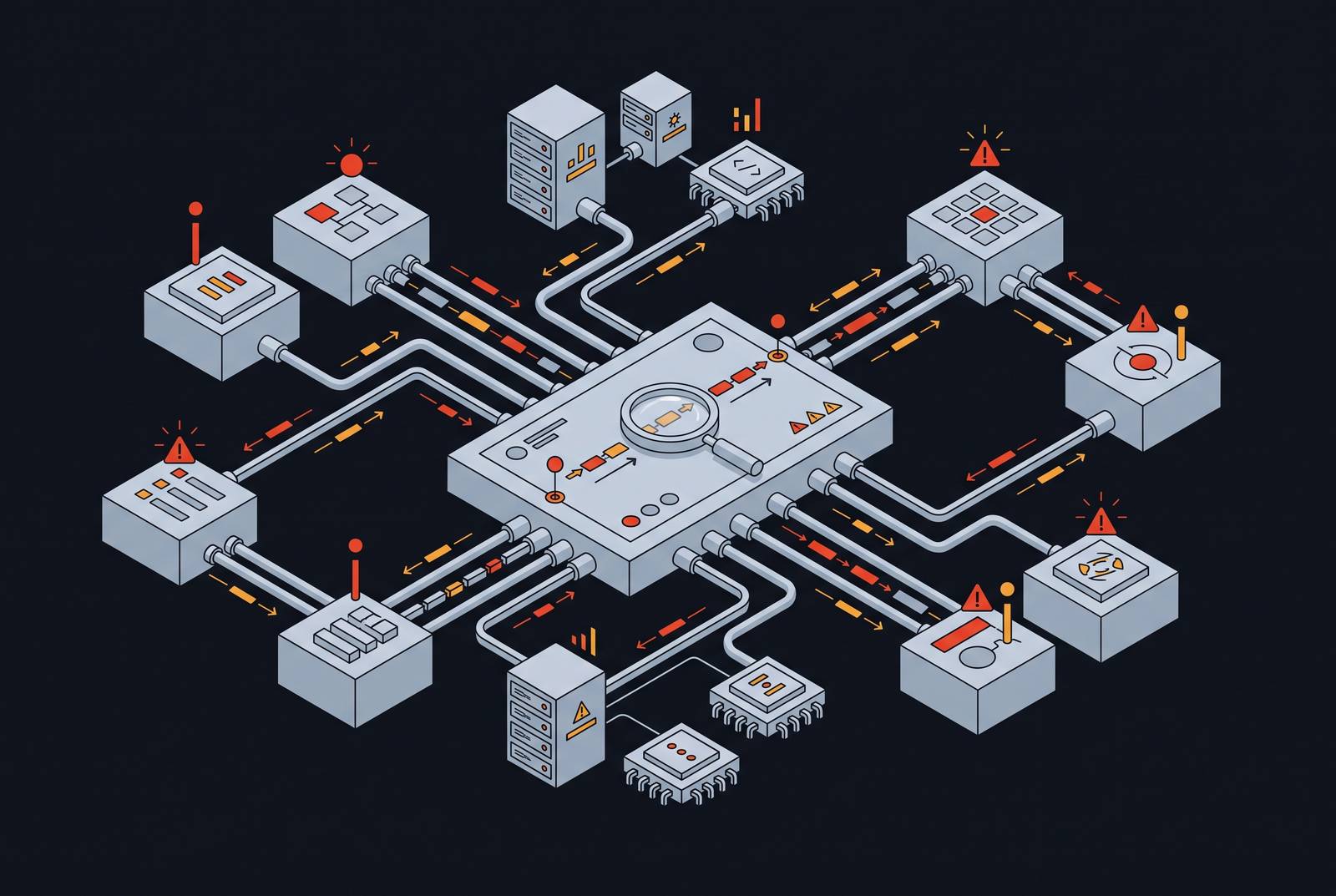
Third-party AI vendors don't sit still long enough for annual reviews to matter. A model gets swapped, a sub-processor changes, an agentic feature flips on, and none of that appears in a questionnaire filed three months ago. This piece works through why point-in-time vendor assessment breaks down against AI, and what a monitoring setup actually needs to catch in real time.
Traditional third-party risk management was built for a world that moved slowly. Controls didn't change much month to month, so a quarterly or annual review captured something close to the truth. AI vendors don't hold still like that. Sprinto's Vendor Category Landscape 2026, which looked at 16 vendor categories and 201 vendors, found a meaningful share of them now carry elevated runtime control dependency: exposure shaped by configuration, user behavior, integration depth, and AI-driven automation that shifts weekly, sometimes daily. Not quarterly. The hard part isn't operational, it's evidentiary. A review that closed last month has nothing to say about exposure that changed this week.
The specific ways AI vendors expand the third-party attack surface beyond what generic TPRM covers
A standard questionnaire was never built to catch four gaps that appear here, and most vendor risk programs still don't ask about any of them. That's the real failure. Not that the questionnaire is outdated, but that nobody rewrote it once the vendor's product started changing itself weekly.
Start with silent model updates. A vendor swaps out the underlying model version, no SLA trigger, no notification, and the risk profile of the tool changes without a single signal reaching the enterprise that depends on it. Then there's sub-processor opacity: inference chains that run three or four tiers deep through hosting and processing infrastructure nobody discloses up front. DORA's requirements actually address assessing these chains, but most vendor questionnaires stop well short of ever reaching them.
Third is data ingestion into shared models. Customer data gets pulled into training or fine-tuning pipelines shared across tenants, and there's no perimeter signal for that. It is at the intersection of a privacy problem and an IP problem, with nothing built to trip an alarm on either side.
Fourth, and probably the fastest-moving, is agentic capability expansion. Vendors quietly turn on autonomous, multi-step task execution inside tools that were sold as something narrower. Gartner projects that 40% of enterprise applications will carry task-specific AI agents by the end of 2026, up from under 5% in 2025. Most of that rollout happens without a revised risk assessment anywhere near it.
Shadow AI piles on top of all four. A significant share of employees at large organizations report using AI tools their employer never approved. IBM's data adds weight: 13% of organizations reported a breach involving AI models or applications, and among those compromised, 97% had no AI access controls in place. Third-party involvement in breaches doubled year-over-year to 30%, so AI vendor exposure is a significant concern, not a niche one. It's inside a supply-chain attack trend that's already accelerating on its own, and the two are feeding each other.
Monitoring gaps from agentic AI and shadow AI across the vendor stack
Agentic AI governance stopped being a future problem sometime around early 2025. Gartner logged a 1,445% surge in multi-agent system inquiries between Q1 2024 and Q2 2025, and that number alone tells you where enterprise deployment is actually heading, whether or not the governance caught up with it.
Multi-agent systems bring cascading permission chains and behaviors that emerge only after deployment, not before. A single foundation model provider can supply multiple AI tools spread across different business units, and that shared dependency creates concentration risk that neither the enterprise nor any individual vendor has fully mapped. Most security teams asked to draw that dependency graph today run out of visibility quickly.
The non-human identity gap is the one most programs are least prepared for. Seventy-six percent of organizations don't fully govern or monitor non-human identities, a category that includes AI agents and service accounts alongside the usual API keys. According to Netwrix 2026, only 20% of organizations fully monitor or govern employee use of shadow AI. That gap has teeth: organizations where AI significantly expanded the number of identities touching their data reported a 43% breach rate over the prior year, against just 11% where AI hadn't changed access patterns. A four-to-one spread like that signals a real pattern. It's what happens when nobody's watching who, or what, has a key to the building.
Regulatory requirements for third-party AI monitoring and current deadlines
Regulators have started writing "continuous" directly into the text, not leaving it as a best practice.
DORA, now in force across EU financial services, is the clearest example. Article 28(4) requires a pre-contractual assessment of third-party arrangements, which lines up directly with the sub-processor opacity described above. Further provisions go beyond initial assessment and require ongoing monitoring, not an annual checkbox. In November 2025, a group of EU financial oversight bodies published their first list of designated Critical ICT Third-Party Providers: 19 of them, including Amazon Web Services, Google Cloud, Microsoft, Oracle, SAP, and Deutsche Telekom. Those providers now answer to direct EU oversight: annual risk assessments, on-site inspections, mandatory reporting. EU guidance has also made clear that generative AI and large language models need to fold into DORA's ICT governance and TPRM frameworks, not sit off as some separate category.
The EU AI Act timeline moved this year, and that changes when the pressure actually lands. The European Parliament approved amendments on June 16, 2026, pushing the Annex III high-risk AI compliance deadline from August 2, 2026 out to December 2, 2027. The Council gave final approval on June 29, 2026, and the regulation entered into force on July 27, 2026. Article 50 transparency obligations still took effect on schedule, August 2, 2026, and general-purpose AI obligations have been live since August 2025. The extension buys implementation time. It doesn't lower the bar, and deployers still own the penalties if a third-party model shows bias in production, deadline extension or not.
On the US side, NIST AI 600-1, the Generative AI Profile released in July 2024, establishes a framework that organizations have applied to supply-chain and third-party AI risk assessment. The Treasury Department's Financial Services AI Risk Management Framework runs 230 control objectives across the full AI lifecycle, built on NIST's structure, with a dedicated section for third-party risk. California's Generative AI Training Data Transparency Act (AB 2013) requires covered developers to publish a summary of training data: sources, data types, whether IP or personal information is involved, processing details, dates. That's a disclosure obligation enterprises now need to chase down and verify inside vendor contracts, not take on faith because a vendor's marketing page says so.
SOC 2 CC7, ISO 27001 A.5.22, and DORA Article 28 all push toward ongoing visibility instead of a point-in-time snapshot. Different regulators, different starting points, same destination. When that many frameworks converge on one answer without coordinating, that's usually a sign the old model actually broke, not that everyone just got trendy at once.
What a continuous monitoring architecture must do for AI vendor risk
Start with what doesn't require the vendor's cooperation. Infrastructure configuration, open ports, compromised credentials, patching velocity, botnet infections, DNS health: these are externally observable, and they give independent verification that a vendor's self-reported controls can't offer. That's the foundation. But a generic security rating sitting on top of it still won't catch what makes AI vendor risk different, and mistaking one for the other is the most common way these programs fail.
A monitoring setup has to do five specific things for AI:
- Detect model version changes, catching the moment a vendor silently swaps the underlying model
- Map sub-processors and fourth parties, surfacing the downstream infrastructure dependencies questionnaires routinely miss (a single failure at the fourth-party level can cascade across an entire supply chain at once)
- Discover shadow AI by pulling signals from SSO, IdP logs, finance and expense data, OAuth grants, contracts, MDM records, and browser telemetry, catching tools that never touch procurement
- Track non-human identities, including AI agents and service accounts, not just human user access
- Flag runtime configuration drift, catching an already-approved vendor's integration changing behavior with no new contract event behind it
Scale gets underestimated constantly. Only about one in three organizations continuously monitors all its third-party relationships for cyber risk. The rest run on assessment cycles with multi-month gaps between checks, and most breaches involving a vendor happen in exactly the window nobody was watching. Any architecture built for this has to cover a growing vendor portfolio without demanding a matching headcount increase, so automated alerting, tiered escalation, and evidence-based remediation stop being nice-to-haves. They become the whole point of the system. Regulatory frameworks increasingly require organizations to catch and respond to material changes as they happen, not write them up after the fact, and manual triage simply doesn't hold once the vendor count climbs into the hundreds.
How the main continuous monitoring platforms approach AI vendor risk
Three platforms illustrate three different starting points: discovery, automation at volume, and fourth-party depth for regulated industries. None of them do the same job, and picking the wrong one for the actual problem in front of you wastes a budget cycle finding that out the hard way.
Torii leads with multi-source shadow AI discovery. It pulls from SSO, IdP logs, finance feeds, expense data, OAuth grants, contracts, MDM, and browser extension data, and it catches AI tools that bypass procurement, the ones nobody filed a request for. New AI vendors get auto-scored on SOC 2 status, ISO certifications, data residency, breach history, and DPA coverage at the moment of discovery, not weeks into a questionnaire cycle that may never finish. Browser-level DLP blocks users from pasting sensitive data into unsanctioned models, and the AI Dashboard ties risk back to spend, surfacing overlapping copilot subscriptions and runaway token usage along the way. Torii rates three stars across Shadow AI Discovery, Framework Mapping, and Continuous Monitoring in its own comparison, with G2 reviews at 4.5 out of 5 across 302 reviews and Capterra at 4.9 out of 5 across 26. It fits organizations whose real problem is visibility: knowing what's deployed before there's anything left to assess.
SecurityScorecard takes the automation angle through TITAN AI, launched March 23, 2026 at the RSA Conference. It handles questionnaires, evidence collection, and vendor follow-ups, with the vendor citing up to a 95% reduction in manual effort. SecurityScorecard counts more than 3,300 organizations as customers, including 70% of the Fortune 100, and has been recognized by CISA. In May 2026, the company finished acquiring Driftnet, a firm known for global internet scanning and threat intelligence, which stretches its reach into supply-chain threat detection. TITAN AI rates three stars for Continuous Monitoring, two for Shadow AI Discovery, and one for Framework Mapping. TITAN AI fits organizations buried in assessment volume who need the workflow automated, but it's the wrong tool for anyone whose main gap is finding unsanctioned tools before they become a problem.
Bitsight built its name on externally-validated security ratings, a model it's run since 2011, and it now monitors more than 40 million organizations. Forrester named it a Leader in its Wave for Cybersecurity Risk Ratings Platforms, and Forrester named it a Leader in its Wave for Cybersecurity Risk Ratings Platforms. The platform emphasizes automated workflows and pre-populated risk profiles to reduce vendor assessment time. What sets it apart is native fourth-party mapping, which matters most in regulated industries, where concentration risk assessment is a compliance requirement under DORA, NERC CIP-013, and OCC guidance, not something a team can choose to skip. That makes it a strong fit for heavily regulated enterprises that need fourth-party visibility and ratings independent enough to stand up as audit evidence. It's a weaker choice for a team whose actual bottleneck is shadow AI discovery, since that was never what its architecture was built to look for.
Discovery, automation, and regulatory depth are three entry points into the same shift. They're three entry points into the same shift: AI vendor risk moves too fast for a review cycle to keep pace, so the monitoring either runs continuously or it isn't monitoring at all, just paperwork with a later filing date attached to it.
Sources
- Continuous Vendor Monitoring and Fourth-Party Risk for Regulated Industries in 2026
- 8 AI Vendor Risk Management Tools for 2026 | Torii
- Continuous Vendor Risk Monitoring in 2026: Why Static Reviews Fall Short | Sprinto
- Vendor Risk Management in the Age of AI: 2026 Guide | Compyl
- securityscorecard.com
- netwrix.com
- itecsonline.com