Insecure Output Handling in LLM Applications
Model output is untrusted data that requires validation before reaching any system.

LLM output is not a safe, trusted function return value. It is, structurally, externally influenced data that is about to touch a browser, a database, or a shell. Developers who sanitize user input but treat model output as "inside" the application stack are making the exact mistake that enables insecure output handling.
That framing gap is the entire problem. The developer habit of treating LLM output as "inside" the application stack, rather than as data whose content was shaped by forces outside the developer's control, is the root of insecure output handling. OWASP draws the line precisely: insecure output handling is not about whether the model's response is accurate or appropriate. That is overreliance. This is about what happens to model output before it reaches downstream systems. The distinction matters because the mitigations are different and both are necessary.
The prompt-control implication follows directly. Because whatever enters the context window shapes what the model generates, an attacker who can influence the prompt, even indirectly, gains indirect access to every system that consumes the output without validation. That is not an exotic edge case. It is a structural property of every LLM pipeline.
How Prompt Injection Turns the Model into an Attack Relay
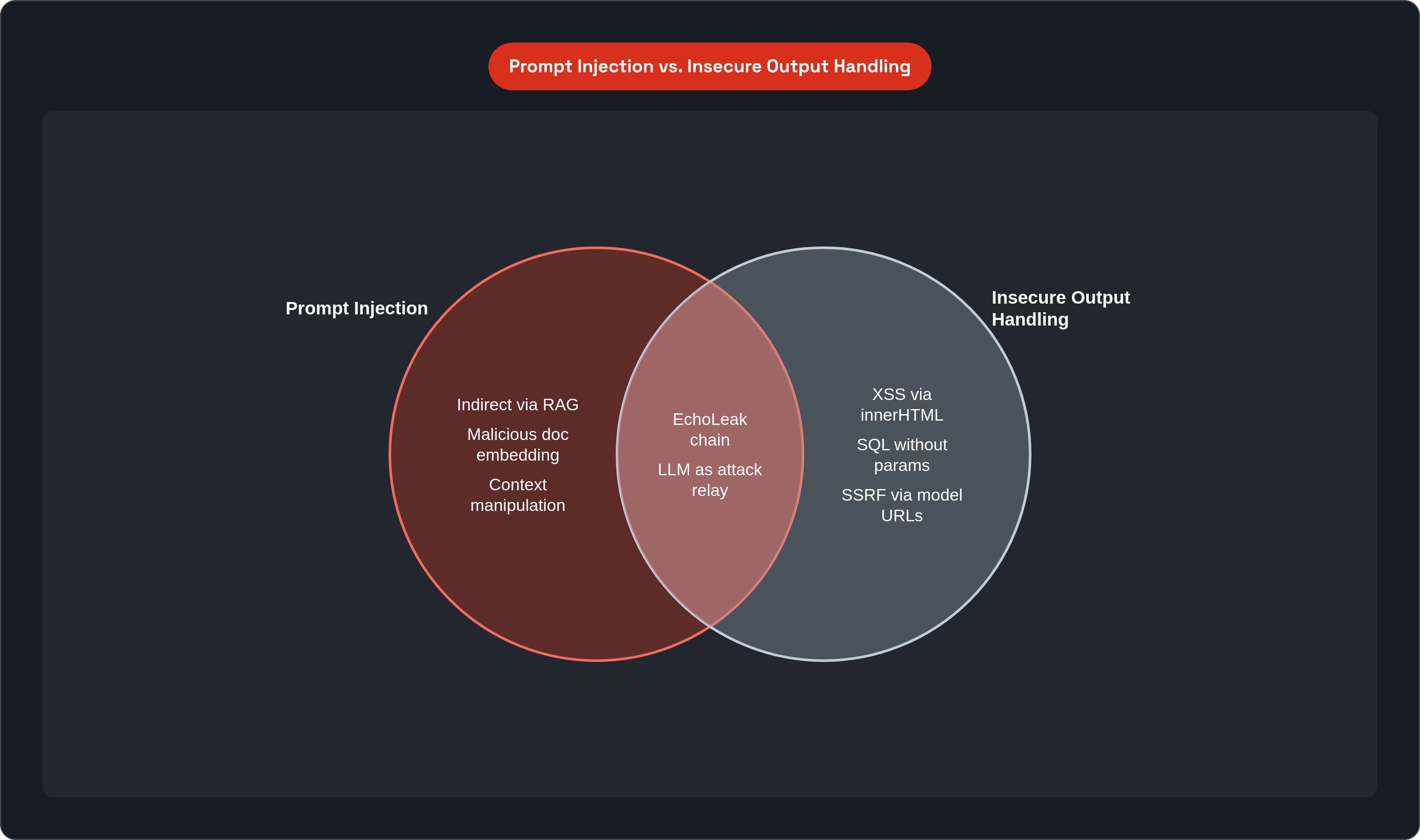
The mechanics are a two-step sequence. First, the attacker influences the prompt to shape what the model generates. Second, the application passes that output, unvalidated, into a downstream system that executes it. The model is not compromised in any technical sense. It simply cannot distinguish between generating helpful content and generating malicious content; it processes sequential context without security judgment. That distinction is important because it means the fix is never in the model itself.
Direct injection is the obvious case: the attacker controls the user-facing prompt field. Indirect injection is the version that keeps me up at night. Malicious instructions are embedded in retrieved documents, emails, web pages, or database records that enter the context window via RAG or tool calls. The model assigns retrieved content the same implicit authority as intentional system instructions, because it processes context sequentially without a trust hierarchy. Natural language cannot be sanitized as strictly as structured inputs, which is precisely why this attack surface resists easy closure.
The right mental model is laundering. The AI layer introduces plausible deniability. The attack arrives looking like model output, not attacker input. By the time it reaches the downstream system, its origin in attacker-controlled content is invisible to the application.
CrowdStrike's 2026 Global Threat Report documented threat actors injecting malicious prompts into legitimate generative AI tools at more than 90 organizations in 2025. That number matters because it closes the argument that this is theoretical. Once threat actors are operationalizing a technique at that scale, the question is not whether it will be attempted against your system but whether your output handling is prepared.
Once the model can be made to write arbitrary content, everything depends on where that content lands.
XSS and Client-Side Execution When LLM Output Reaches the Browser
Web interfaces that display LLM responses using innerHTML or equivalent methods interpret whatever markup the model produces. This is the rendering problem, and its most underappreciated vector is Markdown.
Many chat interfaces render Markdown for readability. That is a reasonable product decision. But Markdown renderers that allow raw HTML pass through <script> tags or javascript: hrefs embedded in model output. The ChatGPT Plugins XSS pattern from 2023 illustrates the chain: a plugin fetches external content, the model summarizes it, the web interface renders the summary with a JavaScript method that interprets HTML, and attacker-controlled markup executes in the user's browser. Each step is individually defensible, but the composition is not.
A 2024 demonstration went further. Researchers showed that long-term memory poisoning could force Markdown image tags with embedded data in a way that exfiltrated all user input and output. This matters because it reframes XSS-class output handling failures not just as script execution risks but as data theft mechanisms operating silently across sessions.
CSRF follows naturally from any successful script execution. Once code runs in the browser under the application's origin, it can forge authenticated requests to any endpoint the user's session can reach.
Validation at this sink requires HTML-encoding all LLM output before insertion into the DOM. If Markdown rendering is necessary, use a renderer that strips raw HTML and restricts link schemes to https://. Content Security Policy adds meaningful defense-in-depth, but as we will see in the EchoLeak case, a permissive CSP can itself become an attack vector rather than a barrier.
SQL Injection and Remote Code Execution When LLM Output Drives Backend Operations
The SQL sink is an application that lets an LLM construct queries and passes them directly to a database without parameterization. This is not a hypothetical architecture. CVE-2023-32785, identified by the NVIDIA AI Red Team in LangChain's SQLDatabaseChain, was a production framework component in active use. The vulnerability was not obscure; it was a direct consequence of passing model output into a query string without treating that output as untrusted.
The code execution sink is, if anything, more severe. CVE-2023-29374 (CVSS 9.8) allowed prompt injection in LangChain's LLMMathChain to execute arbitrary Python via exec(). The NVIDIA AI Red Team found and verified this in LangChain versions at or below 0.0.131. The MathGPT case from the same period illustrates the collateral damage: a GPT-3-based math tutor exposed API keys through server environment variables when prompted to execute import os; os.system('env'). Code-execution sinks do not just hand an attacker compute. They leak secrets.
Path traversal is a code-adjacent sink that deserves its own mention. In pre-0.4.3 versions of Auto-GPT from 2023, the executepythoncode function did not sanitize the LLM-supplied filename, allowing path traversal to overwrite arbitrary Python files outside the designated workspace and achieve arbitrary code execution from there.
The NVIDIA CVE cluster is instructive because it came from a single audit of one widely-deployed framework. All three vulnerability classes, including RCE, SSRF, and SQL injection, emerged from the same root cause: LLM output passed directly to a powerful downstream function without an intervening trust check. The framework was not unusual. The design pattern was ordinary. That is the point.
Validation at these sinks requires parameterized queries without exception; LLM output must never be interpolated into SQL strings. Avoid exec() and eval() patterns with LLM-generated content wherever possible; when they are unavoidable, sandbox strictly with allow-lists. Treat every LLM-generated file path as untrusted: canonicalize it and confine it to an allowed directory.
SSRF and Internal Network Exposure When LLM Output Constructs URLs or File Paths
Server-Side Request Forgery from LLM output arises when an application uses model-generated content to construct a URL or file path that it then fetches or opens. CVE-2024-0440 in AnythingLLM is a clean example: attackers manipulated the model into generating internal URLs, including file:///etc/passwd and http://localhost:8080/admin, which the application fetched, exposing internal systems and files directly.
CVE-2023-32786, again from the NVIDIA AI Red Team's single audit of LangChain, found SSRF in APIChain.fromllmandapidocs. The same team, the same codebase, the same audit window, three vulnerability families. One design pattern produced all of them.
The distinction from classic SSRF is worth dwelling on. In classic SSRF, the attacker supplies a URL directly via a form field, which is relatively straightforward to catch with input filtering. In LLM-mediated SSRF, the URL is generated by the model in response to manipulated context. The application never sees a user-supplied URL. It sees model output that it trusts. The attacker's fingerprints are on the prompt, not on the fetch request.
Validation here requires never using raw LLM output to construct a URL or file path without explicit validation. Maintain an allow-list of reachable hosts and schemes; deny everything else at the network layer. Most importantly, separate the model's expressed intent from the actual fetch operation, with a validation layer between them that evaluates the constructed URL against policy before anything reaches the network.
How the 2025 LangChain Serialization Flaws Exposed a Less Obvious Output Sink
CVE-2025-68664 (CVSS 9.3) and CVE-2025-68665 (CVSS 8.6) point at a sink that most developers never consider: the serialization functions that process LLM response objects, not just the text content those objects contain.
In LangChain Core, dumps() and dumpd() do not escape dictionaries with lc keys when serializing free-form dictionaries. The attack vector runs through LLM response fields like additionalkwargs or responsemetadata. These fields are populated by the model and processed in streaming operations. They are controllable via prompt injection. The JavaScript counterpart, CVE-2025-68665, shares the same root cause across a different runtime.
What makes this category insidious is the gap between where developers apply scrutiny and where the vulnerability actually lives. A developer who carefully sanitizes the displayed text of a response, who HTML-encodes the content string before rendering it, may never consider that metadata fields in the same response object are equally model-controlled and equally capable of carrying injected content into a serialization operation treated as internal infrastructure.
Serialization and deserialization pipelines are historically treated as plumbing, not as trust boundaries. These CVEs make the argument that every field the model populates, not just the human-readable content, is a potential injection point. The trust boundary must extend to the full response object.
EchoLeak: What a Zero-Click Exploit in Microsoft 365 Copilot Reveals About Agentic Output Handling
CVE-2025-32711 (CVSS 9.3), disclosed in June 2025 by Aim Security and peer-reviewed in AAAI 2025 proceedings, is the clearest demonstration I have seen of what output handling failures look like at enterprise scale in a production agentic system.
The attack chain requires no user interaction. The attacker sends one crafted email. Copilot ingests the email as context; malicious instructions in the email body become part of the model's prompt. The model is directed to access internal files and exfiltrate their contents. Four bypasses are chained in sequence: evading Microsoft's Cross Prompt Injection Attempt classifier, circumventing link redaction using reference-style Markdown syntax, exploiting auto-fetched images, and abusing a Microsoft Teams proxy permitted by the content security policy.
Each bypass exploits a trust assumption in output handling at a different layer of the pipeline. The classifier assumes it can identify malicious instructions as text. The link redaction assumes that rendering-time reference syntax is equivalent to direct link injection. The CSP assumes that allowed-origin fetches are safe. None of these assumptions holds when the output flows through multiple rendering and fetch operations in sequence.
EchoLeak matters as a landmark for at least two reasons. It is the first documented instance of prompt injection weaponized for concrete data exfiltration in a production AI system at enterprise scale. And it demonstrates that no single control is sufficient when output passes through multiple downstream systems, each with its own interpretation of what the output contains.
Microsoft issued a server-side patch in June 2025, with no customer action required and no known in-the-wild exploitation confirmed at the time of disclosure. But the interval between deployment and patch is exactly the operational risk window that threat actors are learning to map.
The developer tool surface deserves a parallel mention. CVE-2025-53773 (CVSS 9.6) involved hidden prompt injection in GitHub Copilot pull request descriptions that enabled remote code execution. VS Code and Copilot Agent Mode created and wrote files to disk without user approval, with no in-memory diff step for review. The model escalated its own privileges by modifying its environment. The output did not just reach a sink; the output became the environment.
Why Agentic Architectures Turn Output Handling Failures into Multi-Step Compromises
In a conventional chat interface, bad output is displayed. In an agentic system, bad output is acted upon. The model calls tools, writes to systems, queries APIs, or transacts on behalf of users. The surface area of a single output handling failure expands proportionally to how many downstream operations that output can trigger.
Gartner projects that up to 40% of enterprise applications will integrate with task-optimizing AI agents by end of 2026, up from less than 5% in 2025. Cisco's State of AI Security 2026 found that 83% of organizations plan to deploy agentic AI, but only 29% feel ready to do so securely. The gap between those two numbers is the operational risk window, and the deployment curve is widening it.
The RAG amplification path is where this gets genuinely difficult to defend. When retrieval feeds an autonomous agent, every poisoned document in the retrieval corpus becomes a potential real-world action, not just a misleading response. PoisonedRAG, presented at USENIX Security 2025, demonstrated that a small number of carefully crafted documents among millions can achieve a 90% attack success rate. Poisoned documents operate at the embedding level and evade human inspection entirely. The model does not distinguish between system prompt instructions and retrieved context; both carry implicit authority when they appear in the context window.
Chain reactions compound the problem. One agent's output becomes another agent's input. Each handoff without a validation step is another opportunity for injected content to propagate and escalate across the system. The GitHub Copilot case shows the self-modification risk at its extreme: an agent that can write to its own environment can escalate its own privileges without any additional attacker action.
The structural defense is human-in-the-loop checkpoints. The direct tension is that reduced human oversight is often the explicit design goal of agentic systems; the capability that makes them valuable is the same capability that makes an output handling failure consequential.
Why Traditional Input Validation Techniques Don't Transfer Cleanly
The core problem is that classic input validation operates on a defined structure. A URL field takes a URL. A query parameter takes a string of bounded type and length. A form field's acceptable range can be enumerated or expressed as a regular expression. You can write a validator that covers the space of legitimate values because that space has a shape.
LLM output is natural language. Its legitimate range of content is essentially unbounded. A model generating a product recommendation, a legal summary, and a Python code snippet for a Jupyter notebook integration is doing three things that look identical at the transport layer: producing a string of text. The validation logic appropriate for rendering that string as HTML is completely different from the logic appropriate for passing it to a database or a shell, and neither is straightforward to implement against natural language content.
The context-dependency is the technical wall that prevents transfer. Traditional input validation is generally context-independent: sanitize the URL regardless of where it came from or where it is going. Output validation for LLM responses requires knowing not just what the output is but what every downstream system will do with it, and validating against each of those interpretations separately. A response rendered in a browser needs HTML encoding. The same response passed to a SQL builder needs parameterization. Passed to a serializer, it needs field-level scrutiny of metadata. Passed to an agent tool, it needs intent parsing against a policy.
The mental model shift required is this: the LLM is not a trusted subsystem returning structured data. It is a natural language interface to whatever the user wants to say, shaped by context the developer may not fully control. Treating its output with the same suspicion developers have learned to apply to form inputs is not paranoia. It is accurate threat modeling, applied to a surface that did not exist before this generation of tooling. The work of getting there is less about new techniques than about recognizing that the instinct to trust output that originates "inside" the stack was always a category error.