Monitoring Third-Party LLM Deployments for Backend Instruction Probing You Do Not Control
Watch the API boundary for drift, exfiltration, and hijacked instructions.
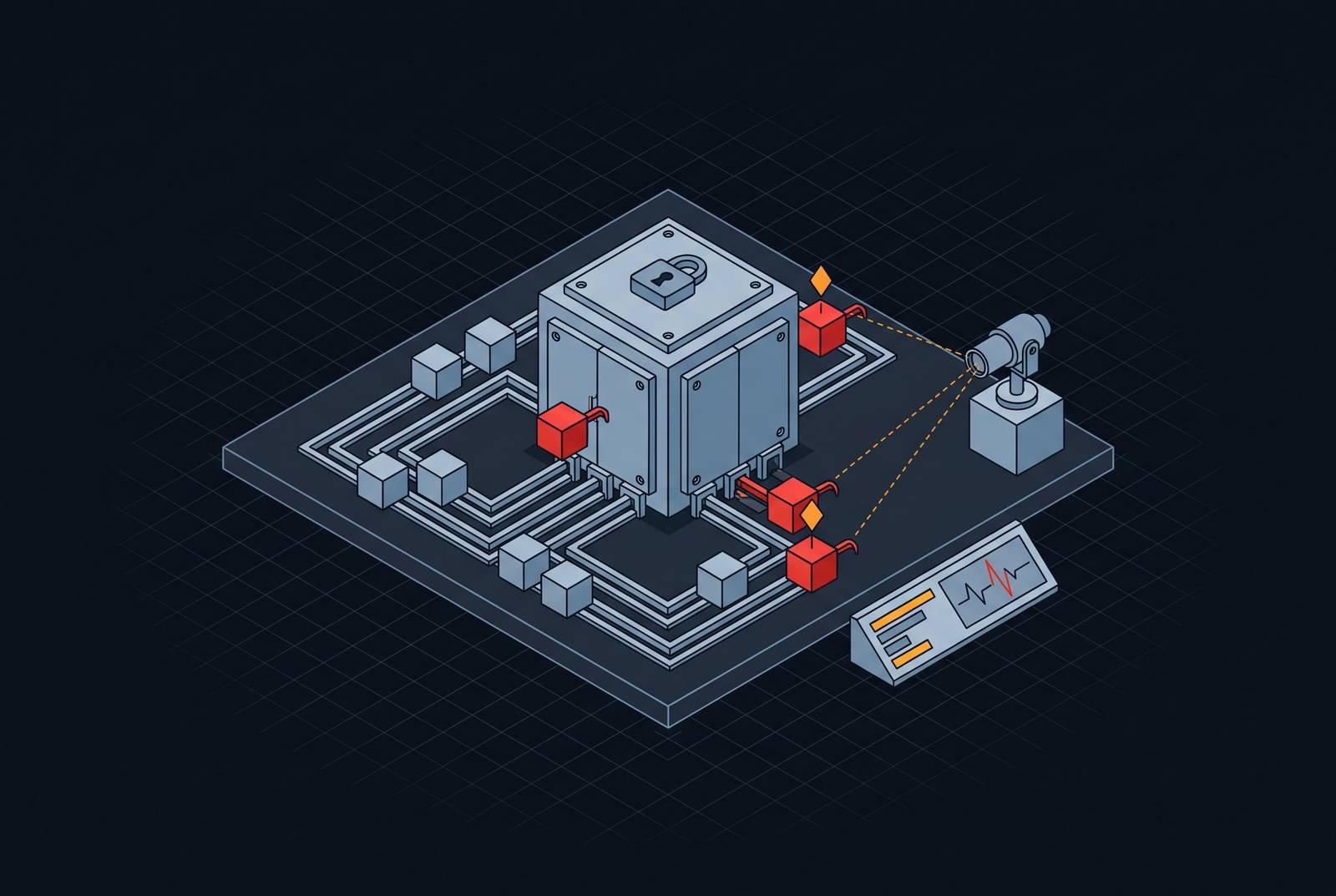
Detecting system prompt probing and data exfiltration in a third-party LLM deployment requires monitoring responses, outbound API calls, and connector behavior against a defined baseline. Observable changes caused by manipulation of hidden instructions make the API boundary the permanent monitoring layer when the vendor controls the backend, and detection needs contractual rights behind it.
Why third-party LLM deployments create a monitoring problem that is structurally different from traditional vendor risk
Traditional software governance rests on versioned artifacts that can be audited. A third-party model can change behavior without a customer-visible code commit, diff, or notification. A team may therefore face different production outputs while its own application remains untouched. The change arrives without its explanation. That separates responsibility for the result from control over what caused it.
Openlayer's July 2026 analysis describes this as a structural asymmetry. The vendor controls the inputs that shape the model, while the deployer absorbs its behavior in production. Does choosing a reputable frontier-model vendor transfer that responsibility? It does not remove the deploying organization's governance obligations. NIST AI RMF GOVERN 6 makes the organization responsible for third-party AI risk, so it must still watch how the system it buys behaves, even if the vendor has a good reputation.
What backend instructions actually are and why the deployer never sees them
A vendor-controlled system prompt sets the model's persona, constraints, and permissions. Retrieval pipelines supply context from external material, while fine-tuning shapes behavior through the model's weights before deployment. These are different mechanisms. Together, however, they influence what the model treats as relevant, permitted, or expected. In an opaque deployment, the customer cannot inspect these influences at runtime or see every change to them.
A standard MSA may not require notice when a vendor migrates base models, changes retrieval, or fine-tunes on another dataset. Openlayer describes the broader condition as “opacity is the default,” with vendors often withholding training-data provenance, evaluation methods, and known failure modes. The customer inherits the consequences of those choices. Those vendor choices can cause performance degradation, bias shifts, and new attack surfaces in the customer's deployment without the vendor explaining them.
Some instruction sources sit closer to the deploying organization. Repository files such as.cursorrules, CLAUDE.md, and.github/copilot-instructions.md function as de facto system prompts for coding tools. These files affect what the model trusts, but they rarely go through a formal review. This distinction becomes critical when a model reads material that an attacker can influence.
How adversaries probe and manipulate hidden backend instructions through indirect prompt injection
Indirect prompt injection places malicious instructions inside content an LLM retrieves, including web pages, documents, emails, and logs. Unlike a direct jailbreak, it does not depend on the attacker addressing the model through its user interface. The model encounters the payload while performing another task. The trust boundary fails when the model treats external content as an instruction to act.
An AI-initiated API call may use a legitimate destination while sending information that should not leave the workflow. Persistence makes the problem harder to contain. The ZombieAgent attack exploited ChatGPT's connector integrations and long-term memory to achieve zero-click indirect prompt injection that persisted across sessions. Looking at the current user prompt would not explain how the model was influenced earlier.
The 2026 incidents show how varied the entry points are. GrafanaGhost, disclosed April 7, 2026, used hidden instructions in logs to cause data exfiltration through Markdown rendering. Reprompt, CVE-2026-24307, enabled single-click exfiltration from Microsoft Copilot Personal through a specially crafted URL parameter, without a user-entered prompt. Vertex AI “Double Agent,” dated March 31–April 1, 2026, exposed the role of default permission scoping in credential exfiltration. These examples show why monitoring must assess whether the AI's resulting action fits its authorized task, beyond checking whether a user submitted suspicious text.
How MCP servers and agent connectors multiply the backend instruction attack surface
The Model Context Protocol connects agents to tools and services, giving untrusted material more places to shape how an agent behaves. Each server that is connected adds another dependency and another path for updates. In April 2026, Ox disclosed a systemic design flaw in Anthropic's official MCP SDKs that enabled arbitrary command execution. The potential exposure included internal databases, API keys, and chat histories. Anthropic described the behavior as “expected” and declined to modify the protocol's architecture, leaving developers to implement safeguards.
Updates introduce a separate problem for vendor assessment. An email-server MCP package pushed an update that silently blind-copied every agent-sent email to an attacker-controlled domain. Its malicious behavior was absent at installation review. This is the supply-chain rug-pull pattern, in which a previously assessed dependency changes after approval. A questionnaire cannot detect behavior that does not yet exist.
The broader infrastructure record reinforces the need to watch these dependencies after deployment. CISA added vulnerabilities affecting Langflow, LiteLLM, n8n, Ray, and MLflow to its Known Exploited Vulnerabilities catalog throughout 2026. Those additions show infrastructure exposure but do not prove that every affected system suffered instruction hijacking. The distinction is important for accurate incident analysis. Connector security must account for both software vulnerabilities and changes in what a connected service tells an agent to do.
Why coding agents (Claude Code, Copilot, Codex) are a specific high-privilege target for instruction hijacking
Coding agents combine access to repositories with credentials and privileged execution environments. Claude Code, GitHub Copilot, Gemini CLI, and Amazon Q are typically authenticated with long-lived API keys stored in predictable local file paths. Their usefulness depends on substantial access. That makes instruction hijacking more consequential than a misleading answer in an isolated chat, because the agent may act with permissions the attacker does not hold.
Elad Meged of Novee Security disclosed at Black Hat USA 2026 on August 5, 2026, that a GitHub issue opened by an account without repository privileges was sufficient to reach CI runner secrets in the vendors' own repositories for Claude Code, Gemini CLI, and OpenAI Codex. The issue supplied the entry point. What the agent chose to trust gave that low-privilege content a path into a high-privilege environment. A deployment review focused only on who could commit code would miss that route.
Repository instruction files should be treated as deployment configuration, with the same review discipline. Their contents influence how an agent interprets its work. At the same time, reviewing those files does not reveal the vendor's full instruction-trust model. Local configuration controls and observation of agent actions address different parts of the exposure.
How do you detect system prompt probing and data exfiltration at the API boundary?
Boundary monitoring detects behavioral evidence. Response drift includes changes in output distribution, tone, refusal rates, or capability that are statistically significant. Such changes can signal a backend update without identifying its cause. A deviation is therefore grounds for investigation. Baselining behavior before and after announced vendor changes helps distinguish expected shifts from unexplained ones.
Exfiltration monitoring needs more than a destination check. Relevant signals include elevated outbound data volumes, unexpected endpoints, and tool invocations that do not fit the declared use case. Structural anomalies can also expose misuse. Markdown rendering of exfiltration payloads, encoded data in URL parameters, or unusual response formatting may reveal a channel that otherwise looks like normal output. These signals are especially useful when malicious instructions reach the model through retrieved content.
What can this establish about system prompt confidentiality? Outputs alone cannot recover the hidden system prompt or retrieval context, so they cannot prove that every confidential instruction remains undisclosed. They can reveal anomalies consistent with probing or manipulation. Openlayer's platform applies pre-deployment tests and blocks non-compliant outputs at the API boundary at runtime. Teams must first define normal behavior, both to test for the behavior they expect and to enforce limits during use.
What governance frameworks require for monitoring vendor AI — and where the gaps remain in 2026
NIST AI RMF GOVERN 6 addresses policies and procedures for third-party AI risks, including contingency planning for failures in high-risk third-party systems. It does not place every vendor-model obligation under that heading. The Generative AI Profile inventory actions and MANAGE 3 cover related work, including how to monitor pre-trained models. Keeping those distinctions intact makes a control mapping more useful than a broad claim of framework alignment.
Other frameworks help classify what monitoring finds. The 2026 OWASP release includes Appendix A mappings to NIST AI RMF, MITRE ATLAS, and CWE. MITRE ATLAS version 2026.10, released in October 2026, tracks adversary tactics and techniques for AI-enabled systems on a monthly cadence. Classification is not a runtime monitoring design. NIST's Center for AI Standards and Innovation launched its AI Agent Standards Initiative in February 2026, with initial deliverables expected later that year, leaving organizations to operationalize agent oversight while that work develops.
The US Treasury's February 2026 Financial Services AI Risk Management Framework introduced 230 voluntary control objectives, which recommend that teams document vendor due diligence and keep monitoring. The OCC, Federal Reserve, FDIC, and NCUA announced proposed interagency third-party risk guidance on September 11, 2026. The CSBS AI Supervisory Framework also devotes a nonbank supplement to third-party and vendor AI risk. Voluntary controls, proposals, and supervisory expectations make waiting for complete agent-specific guidance a weak governance position.
What contracts must require to give monitoring programs a foundation to stand on
A detected anomaly creates a question for the vendor. Without investigation, audit, and exit rights, the customer may lack the leverage to obtain an answer or act on it. The contractual foundation should begin with advance notification of base-model migrations, retrieval-pipeline changes, and fine-tuning updates. A training opt-out should explicitly prohibit organizational data from being used for general model improvement. Sub-processor disclosure should expose the inference hosts and logging infrastructure beneath the main agreement.
The recommended terms include a 24-hour breach notification SLA, rights to audit fairness data and model evaluation methodology, and liability and indemnification carve-outs for AI-specific failures. Data deletion and exit rights complete that foundation. These provisions give different findings different routes to resolution. They do not give the customer direct control over the vendor's backend.
OpenAI's enterprise API terms from 2025 retain data for a short period for abuse monitoring even when training use is disabled. “Enterprise API” therefore does not mean “no data retention.” Contracts must distinguish training use from retention and account for subprocessors and logging infrastructure. Separately, repeating a vendor's performance claim in a product page or RFP response makes it the deploying organization's representation, bringing vendor overstatement into first-party accountability.
How to build a continuous monitoring program for vendor LLM deployments you do not control
A working program starts with an inventory of deployments and their connections. An undiscovered deployment cannot receive a baseline or meaningful oversight. For each identified deployment, the recommended starting point is normal response distribution, refusal rates, and structural output characteristics before go-live. Tracking subsequent deviation creates a reference for detecting silent changes. The baseline must describe the actual use case rather than a general expectation that the model will behave well.
The next layer is API and connector telemetry. Logging should cover outbound calls initiated by or attributed to the LLM, including tool invocations, MCP server calls, and external API requests. Teams can use that record to check destinations, volumes, and encoded parameters. Instruction-source files also need version control and alerts when they change, and teams need to watch for updates to MCP servers and agent plugins. File integrity and connector version tracking cover changes that response analysis alone cannot explain.
Tool selection should follow those monitoring needs. Generic third-party risk management questionnaires cannot show how a model behaves at runtime, while AI risk intelligence platforms are built to track vendor changes and AI-specific threats. Openlayer offers 100+ pre-built tests for pre-deployment evaluation and runtime output blocking at the API boundary. Evaluation coverage and runtime enforcement should be judged separately from connector telemetry and file-integrity coverage.
Finally, findings need a defined governance route. A behavioral change should activate model-change investigation, an anomalous outbound call should engage incident-notification provisions, and a supply-chain update should prompt sub-processor disclosure review. This joins technical evidence to contractual response. Because direct visibility into vendor-controlled backend instructions will never be available, the boundary is where the continuous monitoring program must live.