Cloud LLM API Logging and Audit Trail Requirements
Regulators now require LLM systems to log prompts, outputs, and policy decisions—not just API calls.
Cloud LLM APIs generate a different kind of log than the systems most compliance teams grew up auditing. A traditional API log tells you an endpoint got called, what status code came back, how long it took. That's useful for debugging, but it's legally thin. When the "endpoint" is a large language model, the call itself carries a prompt that might contain a patient's diagnosis, a customer's social security number, or a contract clause someone shouldn't have pasted in. This piece walks through what a real audit trail needs to contain, why agentic systems break the old logging playbook, and where the actual compliance line sits.
Start with what's different. A conventional request log captures endpoint, status, latency, size, the mechanical facts of a transaction. An LLM call adds layers that didn't exist before: natural-language input that may embed PII or confidential business context, an output that's probabilistic and can shift based on model version or temperature, and a set of policy decisions happening mid-call. Was the input scanned for PII? Did a toxicity filter fire? Which guardrail policy was active, and what did it decide?
None of that shows up in a standard access log. And that's the gap regulators are increasingly built to notice.
The compliance obligations that make LLM audit trails legally mandatory
The EU AI Act is the clearest place to start, because Article 12 doesn't leave much room for interpretation. High-risk AI systems have to be designed with automatic event logging built in. Automatic is the operative word: a human writing up notes after the fact doesn't satisfy it. The logging has to be generated by the system itself, and it has to run for the system's lifetime, from deployment through decommissioning, not just for whatever release happens to be current.
Deployers carry their own obligation on top of that. They have to retain logs for at least six months and hand them over to supervisory authorities on request. Here's the part that catches organizations off guard: buying a high-risk AI system from a vendor doesn't transfer that obligation away. Under Article 25, the organization integrating the model into its own operations picks up the Article 12 logging duty, regardless of who built the underlying system.
The enforcement date for high-risk systems is August 2, 2026. There's a European Commission Digital Omnibus proposal floating around that would push this to December 2027, but it hasn't passed into law. Until it does, August 2026 is the date that matters. Penalties for failing record-keeping obligations run up to tens of millions of euros or a significant percentage of global annual turnover, whichever is higher. And the technical standards meant to guide implementation, prEN 18229-1 and ISO/IEC DIS 24970, are still in draft. Organizations are being asked to comply with a legal mandate before the industry has finished writing the instruction manual.
HIPAA takes a narrower but equally firm stance. Any AI-assisted access to protected health information needs an audit record. That trigger fires in more places than people expect: a model receiving PHI directly in a prompt, PHI showing up in retrieval-augmented context passed to the model, or model output feeding a decision about a specific patient. Each access event needs a timestamp, the identity of who accessed it, what action was taken, and a reference to what PHI was touched. Retention runs six years. Systems that rely on someone stitching logs together manually after an incident don't meet the bar; HIPAA expects the record to already exist in a usable form.
SOC 2 asks for complete, tamper-evident logs of who accessed what, when, and how. It wasn't written with AI agents in mind, but the logic extends naturally: for an agent, that means logging not just the final result but the full chain, which agent made the call, what reasoning path the LLM took, what parameters went in, what came back. Encryption obligations extend to every intermediate state in that pipeline, including an agent's working memory, which is a detail a lot of teams overlook because working memory doesn't feel like "data" in the traditional sense.
GDPR adds its own wrinkle. Trace payloads, meaning the actual inputs and outputs stored for observability, count as user data. That means your observability store inherits whatever residency obligations apply to your primary datastore, and if a user requests erasure, that request has to be honorable inside the trace store too. Which is awkward, because a lot of these logs are designed to be immutable. It's also worth checking where LLM-as-a-judge evaluation calls send your trace content: if you're using a third-party model to grade your own model's outputs, you've just transferred that content to another provider's infrastructure.
NIST's AI Risk Management Framework rounds this out by naming traceability as a core trait of trustworthy AI, with its Measure and Manage functions calling for ongoing monitoring of systems already in production, not just at launch.
Taken together, these frameworks are converging on the same underlying demand. A request log tells you what was called. Only a decision-level audit trail tells you what the request actually contained, who made it, which policy applied, and what happened as a result. That's the distinction examiners are trained to look for.
What a compliance-grade LLM audit trail must actually contain
So what does "decision-level" actually mean in practice? Four properties separate a compliance-grade audit trail from basic logging.
It has to be immutable, meaning entries can't be edited or deleted once written. It has to be complete, recording who made the call, what model handled it, which data category was involved, and which enforcement decisions fired along the way. It has to be tamper-evident, which usually means each entry carries a cryptographic trace ID or hash so any alteration gets caught on inspection; hash chaining and digital signatures are the standard tools here. And it has to be exportable, streaming out to a SIEM or external compliance system rather than sitting locked inside a vendor's dashboard where nobody outside the platform can reach it.
Auditors tend to expect seven categories of information per call. Model identity comes first: provider, model name, version identifier, deployment endpoint, and whatever system prompt or fine-tuning was applied, since each of those can silently change model behavior between releases without anyone noticing. Request metadata follows: timestamp in ISO 8601 format, event type, user or session identity, source application or agent ID.
Then input and output. Ideally you log the full prompt and full response, but when that content would create secondary PHI or PII exposure just by sitting in the log store, a cryptographic hash of the content is the accepted substitute. Guardrail decisions need their own record: was PII detected, what toxicity score came back, what did the content filter decide, which policy version was active, what enforcement action fired. Operational metadata, token counts, latency, cost per call, rounds out the practical side. And chain-of-custody fields, event ID, previous hash, current hash, an optional digital signature, are what emerging academic frameworks point to as the mechanism that makes tampering detectable after the fact.
Here's the distinction worth sitting with. A request log answers whether something was called and whether it succeeded. A decision-level audit trail answers what the request contained, who made it, which policy applied, what enforcement fired, and which security events got raised along the way. Security investigations and regulatory examinations need the second kind. Most teams, when they first build LLM logging, only have the first.
Immutable storage isn't exotic technology at this point. AWS S3 Object Lock, Azure Blob immutable storage, append-only SIEM ingestion, these all work. The design principle that matters is that whatever process writes an entry should never have the permission to modify or delete it afterward. On the architecture side, the pattern that's emerged looks like this: platform-native logs feed in the AI application's actions, an observability layer captures the LLM-level tracing, a SIEM correlates across both for investigation, and long-term archival flows from the SIEM into a data warehouse for retention that doesn't cost a fortune to maintain over years.
How agentic AI architectures break conventional logging assumptions
Everything above assumes a fairly clean shape: one prompt goes in, one response comes out, log it, done. Agentic AI throws that assumption out.
A single agent action can span multiple LLM calls, several tool invocations, database queries, and outbound API requests, all chained together to accomplish one task. And each step in that chain might involve a different model version, a different confidence threshold, a different set of inputs entirely. Picture an agent that pulls a patient record in one tool call, summarizes it in a second LLM call, and writes that summary to a downstream system in a third. That's three distinct logging surfaces for what is, from the user's point of view, one logical action.
Multi-agent setups make this harder still. Many enterprise AI projects now involve more than one agent working in sequence or in parallel, which means the audit chain has to survive agent-to-agent handoffs without losing track of who did what. If agent A hands a task to agent B, does the audit trail preserve the provenance of that handoff, or does it start fresh at agent B like the first half never happened?
A properly governed agent audit trail has to record each individual LLM call inside the agent's loop, complete with its own request and response pair and model ID. It has to log every tool invocation: which tool got called, what parameters went in, what came back out. Guardrail decisions need to be captured at every step of the loop, not just checked once at the final output. Any human approval or override in the loop needs an identity and a timestamp attached to it. And incident-level events, things like a guardrail triggering, drift getting detected, an incident opening or resolving with an assigned severity, need their own structured record. All of it should tie back to a single parent trace ID that links every sub-call to the session where it started.
One more piece worth naming directly: permission scope. Organizations have already run into agents that exceeded the access they were supposed to have, at a scale that got attention. The audit trail needs to record what access an agent requested, what it was actually granted, and whether that match held up. When it doesn't, that gap is exactly the kind of thing a security team needs to catch quickly rather than discover during a post-mortem.
Gartner's prediction that 40% of organizations deploying AI will adopt dedicated AI observability tools by 2028 tracks with this shift. Governance pressure, not developer convenience, is the driver behind that number. Debugging was always a nice-to-have. Proving what an autonomous system did, to a regulator or an internal auditor, is becoming a requirement.
What cloud providers' native logging tools actually cover — and where they stop
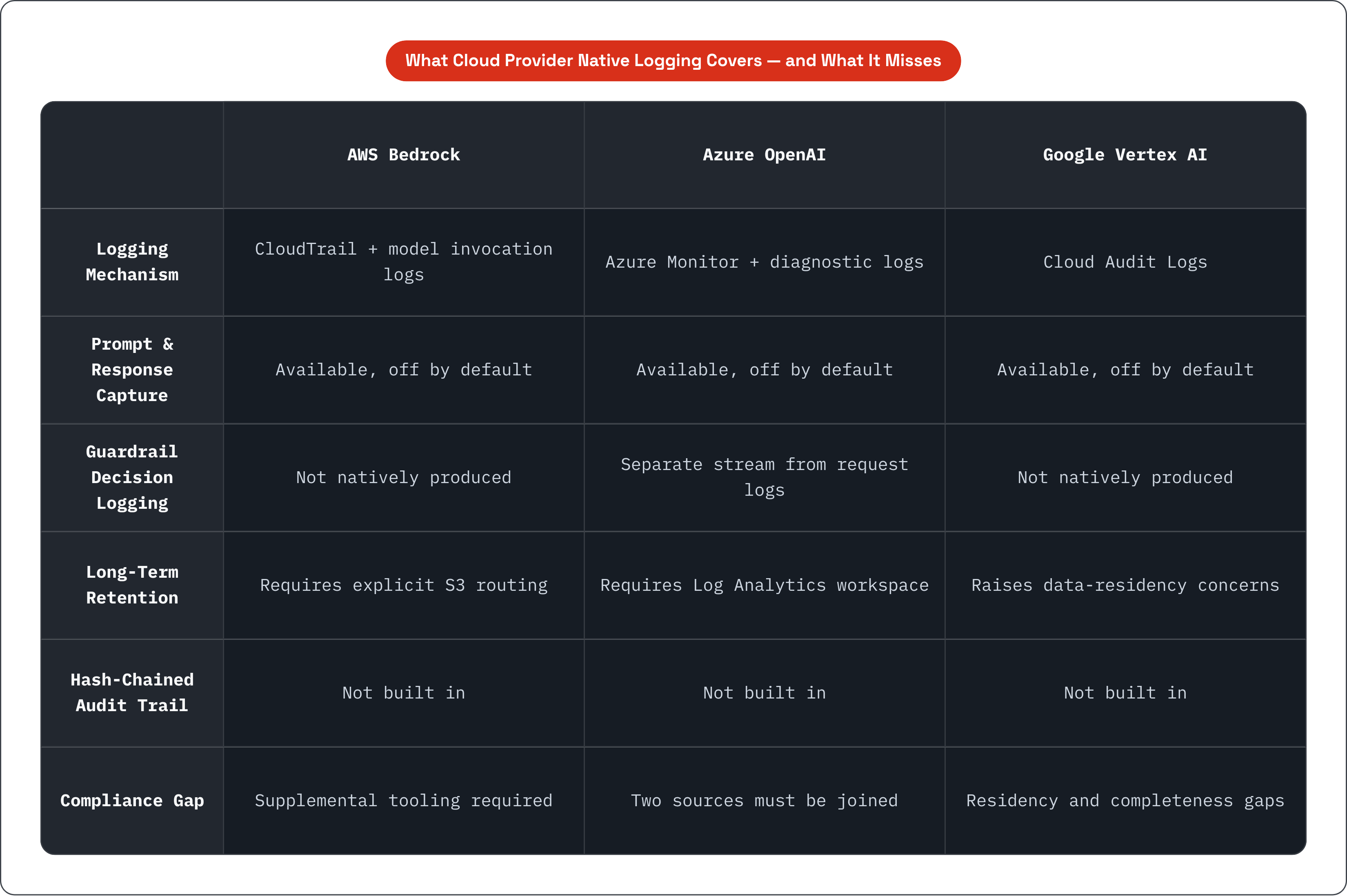
Every major cloud provider gives you something here. None of them give you everything.
AWS Bedrock pairs with CloudTrail to log API-level management events: who called which Bedrock endpoint, when, under which IAM identity. Model invocation logging, which captures the full prompt and response payload to S3, exists too, but it's off by default and has to be turned on deliberately. Even once it's running, Bedrock doesn't natively produce guardrail-decision fields, policy-version records, or the hash-chained chain-of-custody structure that compliance frameworks are asking for. That takes supplemental tooling.
Azure OpenAI works through Azure Monitor and diagnostic logs. Diagnostic settings pick up request metadata, response codes, token usage, and the model deployment ID. Content filtering decisions, Azure's built-in guardrail layer, get logged as a separate stream, which means teams have to join two data sources just to reconstruct what actually happened during a single call. Long-term retention isn't automatic either; it requires routing logs to a Log Analytics workspace or a storage account with a retention policy explicitly configured, because the default window is short.
Google's Vertex AI follows a similar pattern through Cloud Audit Logs. Admin Activity and Data Access logs cover the API calls and access events. Prompt and response payload logging is available, but again, not on by default, and turning it on raises its own data-residency questions depending on where those logs end up stored.
The gap is consistent across all three. These native tools were built for operational observability and access control, which is a different job than compliance-grade auditing. They don't generate the seven-field decision-level record on their own. They don't natively deliver the immutability, exportability, or hash-chaining that HIPAA, SOC 2, and the EU AI Act effectively require. And if your organization runs Bedrock and Azure OpenAI at the same time, which plenty do, you end up with two fragmented log streams and no built-in way to unify them.
So native provider logging is a floor, not a ceiling. It's a necessary starting point. It was never designed to be a complete compliance posture on its own.
Building the logging architecture above the cloud provider layer
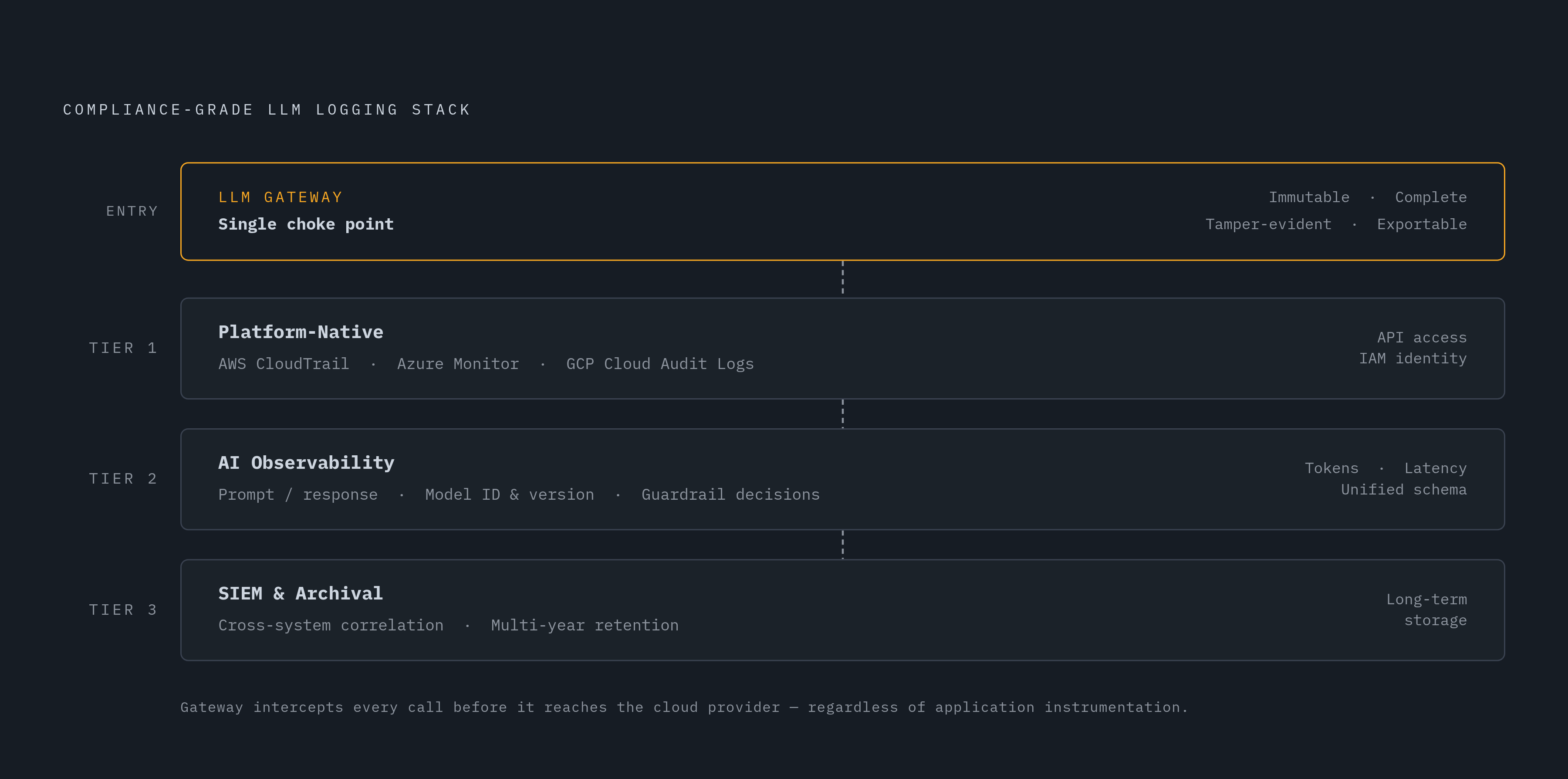
The teams that get this right tend to converge on the same three-tier structure, whether they arrived there through hard experience or by studying someone else's incident report.
Tier one is the platform-native layer: AWS CloudTrail, Azure Monitor, GCP Cloud Audit Logs, handling API access events and IAM identity. Tier two sits above it: an AI observability layer that captures LLM-specific trace data, prompt and response pairs, model ID and version, guardrail decisions, token counts, latency, all normalized into one schema regardless of which cloud provider generated the call. Tier three is the SIEM and long-term archival layer, correlating events across systems for investigation and exporting older data into a warehouse where multi-year retention doesn't strain the budget.
The structural piece that ties this together is the LLM gateway. It sits between the application and the cloud LLM provider, intercepting every call before it reaches the model and enforcing policy on the way through. Critically, it writes the complete, tamper-evident audit record at that interception point, before the response ever makes it back to the application. That matters because it produces the four compliance properties, immutable, complete, tamper-evident, exportable, at a single architectural choke point instead of depending on every application team to instrument their code correctly. One team forgetting to log something doesn't leave a hole in the record if the gateway is doing the logging regardless.
Logging alone doesn't cover everything, though. When the LLM itself is a vendor asset, a third-party model, a plugin, a connector, the audit trail needs to capture which vendor model version was actually active, what data-handling commitments that vendor made, and whether the model's behavior has drifted from what was originally specified. This is where traditional vendor risk assessment starts to look outdated. Point-in-time reviews, the kind where you check a vendor's security posture once a year and call it done, don't catch a model that silently changed behavior three months after the review. Real-time detection of model drift, prompt injection exposure, and data exfiltration signals is a different discipline, and it's one that generic SIEM tooling wasn't built to handle.
On implementation, immutable storage comes down to a few concrete decisions. Route final audit records into append-only storage, S3 Object Lock in WORM mode or Azure Blob immutability policies are the common choices. Hash-chain the entries as they're written so tampering shows up on read. And separate write credentials from read credentials; the process generating logs should never hold the permission to delete them.
That last point runs into a real tension with GDPR's right to erasure. An immutable log and a user's legal right to have their data deleted are, structurally, pulling in opposite directions. The practical resolution most teams land on is hashing or tokenizing the PII fields at write time, so the underlying personal data can be erased on request while the structural record, the fact that an event happened, which model handled it, what decision got made, stays intact. Whatever approach gets chosen, it belongs in the privacy impact assessment before the system goes live, not as a footnote discovered during the first erasure request.
What the LLM observability market's growth trajectory signals about where logging requirements are heading
Put the regulatory timeline next to the market's build-out, and a pattern emerges. Gartner's forecast that 40% of AI-deploying organizations will run dedicated observability tooling by 2028 isn't happening in a vacuum; it's happening because the EU AI Act's enforcement clock is ticking toward August 2026, HIPAA's six-year retention window doesn't forgive gaps, and SOC 2 auditors are getting more literate about what an AI system actually needs to prove.
One might argue this is just the market catching up to demand that already existed. That's fair, but it undersells what's changing underneath. Early LLM logging was built by engineering teams solving debugging problems: why did this call fail, why was latency high, why did the model hallucinate. What's being built now is closer to legal infrastructure, records built to survive a regulator's request, a breach investigation, or a lawsuit years after the fact.
The direction is toward more granularity, not less. Agentic systems are pushing audit requirements down to the level of individual tool calls inside a single user action. Multi-model deployments are pushing for cross-provider normalization, because no compliance officer wants to explain to an examiner why the Bedrock logs and the Azure logs don't speak the same language. And the vendor-risk dimension, tracking not just your own system's behavior but a third-party model's drift over time, is starting to look less like a nice-to-have and more like table stakes.
None of this is settled yet. The technical standards behind Article 12 are still drafts. The observability tooling market is still consolidating around what "complete" actually means. But the trajectory is consistent enough to read: organizations that treat LLM logging as an afterthought bolted onto existing infrastructure are going to find themselves rebuilding it under deadline pressure, probably right around the time an examiner asks for records that don't exist yet.