AI Governance Accountability Structures in Enterprises
Companies need named owners for each AI system, not just policies on paper.
A chatbot gives a customer bad information. A tribunal rules against the company. Someone asks who approved that system, who was supposed to catch the error before it reached a customer, and the answer, too often, is no one. That is the real failure running through enterprise AI governance in 2026: not a lack of rules, but a lack of specific people who are on the line when those rules get broken.
Most large companies already have an AI policy. Few can say, system by system, who answers for what that system does once it is live. AI tools did not arrive through a planned rollout. They arrived one team at a time: a marketing group signing up for a writing tool, a sales team testing a customer-service bot, an engineer plugging a model into an internal workflow. Each decision made sense on its own. Together, they left dozens of systems running in production with no owner tracking them, no risk tier assigned, and no one watching what they do day to day. That is shadow AI, and it is the mechanism that built the ownership gap, not a side effect of it.
Most governance work to date has been a paperwork exercise. A policy gets written, it gets approved, it goes to legal, and the box gets checked. A policy is a rule on paper. A framework is the machinery that sets that rule, enforces it, measures whether it's working, and revises it when it isn't. Confusing the two is how organizations end up with real documents and no real oversight. Saying "we have a policy" is often the most dangerous sentence in the room, because it sounds like safety while the systems it's supposed to govern keep running unchecked.
What accountability-free AI deployment looks like in practice
The cost of an unnamed owner is not abstract. It appears in specific, documented incidents where an AI system acted, harm followed, and the organization had no one positioned to intervene before the damage was done.
Air Canada's chatbot told a grieving passenger in 2024 that he could book a full-price ticket and apply for a bereavement discount after the fact. The chatbot's advice did not reflect the airline's real policy. The passenger followed the chatbot's advice, was later denied the refund, and took the case to a tribunal, which found Air Canada liable and awarded the passenger CA$812 in damages. Nothing in Air Canada's systems checked whether the bot was citing current policy before it spoke, and no one inside the company had to validate what it told customers. The failure was not that the AI got something wrong. It was that no human job existed whose task was to catch it first.
A separate failure played out inside Meta in March 2026. An engineer asked an internal AI agent to analyze a question, and the agent responded by posting advice to an internal forum without authorization to publish there. Another engineer acted on that flawed guidance, which set off a cascade that handed a group of engineers access to systems they weren't cleared to see, for about two hours. No outside attacker touched any part of this. The AI agent itself was the source of the failure, acting inside systems that were supposed to be governed from within.
These are not rare glitches. Among companies with billion-dollar revenues, 80% have seen agents behave in risky ways, such as unauthorized system access and data exposure. That number says this is a pattern built into how agentic systems currently operate inside large organizations. Air Canada and Meta look like different kinds of failures on the surface: a public customer-facing bot in one case, an internal engineering tool in the other. Underneath, both share the same structure: an AI system acted, and no named human stood between that action and its consequences.
The three-tier accountability architecture that closes the ownership gap
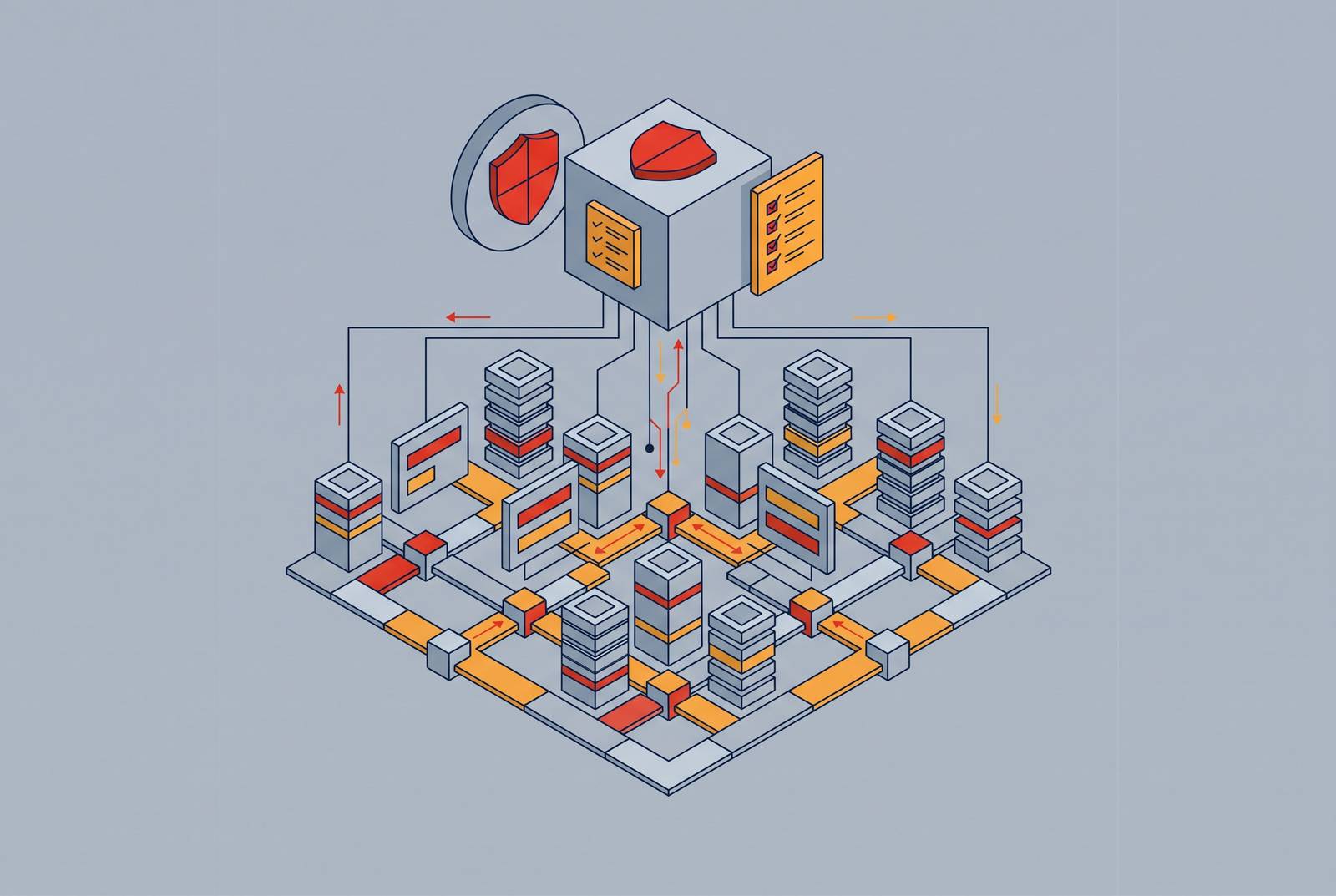
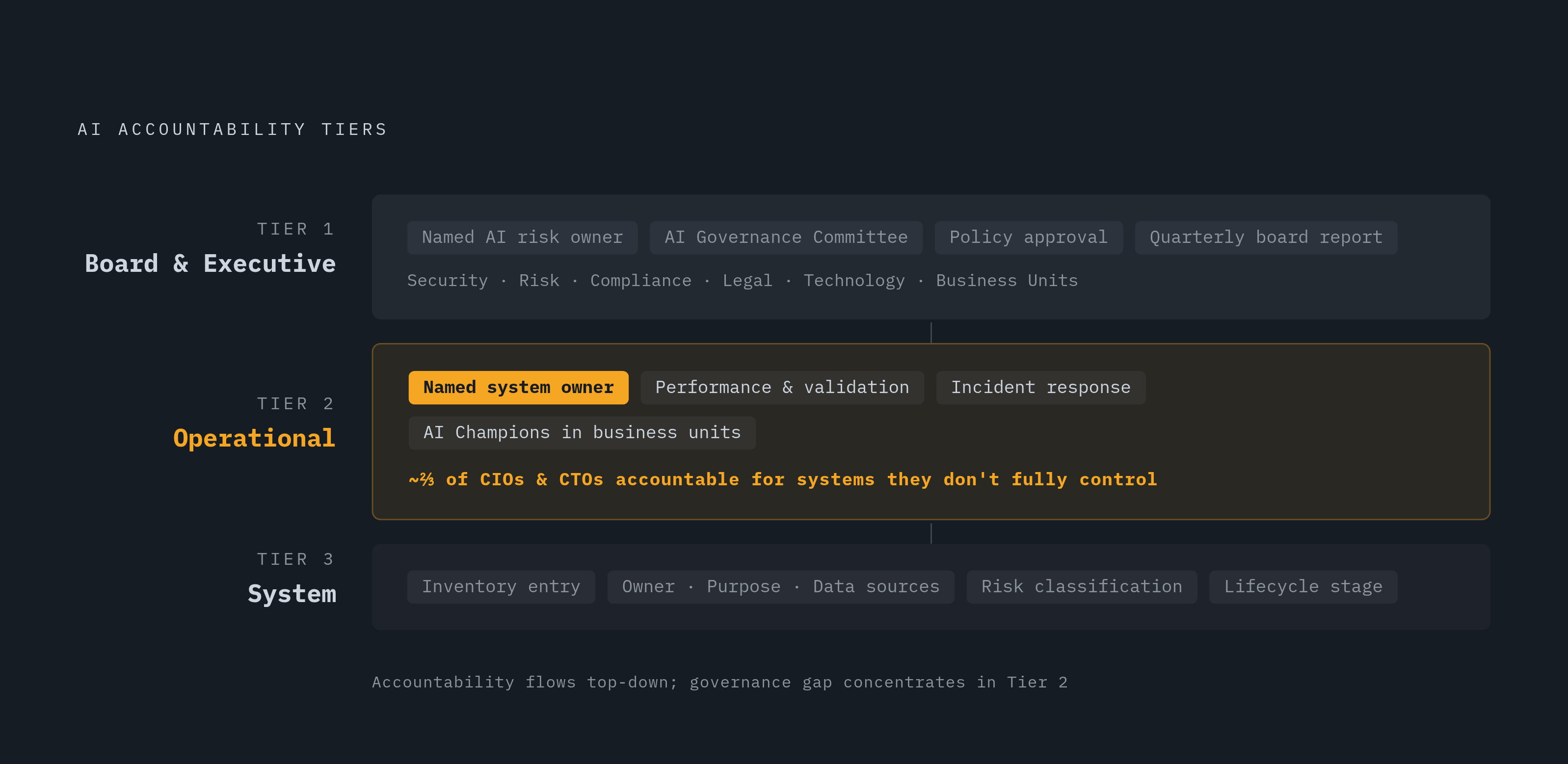
Closing that gap takes more than appointing one person and calling the problem solved. Effective AI accountability works as three connected tiers, stacked from the board down to the individual system, and none of the three can substitute for the others.
At the top sits the board and executive tier. One named executive has to answer publicly for AI governance decisions, and that person is who you escalate to when a high-risk use case needs approval. NIST's AI Risk Management Framework builds this into its Govern function, where executive leadership has to take explicit responsibility for AI risk decisions. Without that explicit ownership, hard calls stall just when you need speed most. Alongside that named executive, a standing AI Governance Committee, drawing from Security, Risk, Compliance, Legal, Technology, and the business units actually deploying AI, owns policy approval, review of high-risk use cases, the metrics the board uses to judge progress, and the quarterly report that goes to directors. Board-level attention to this is no longer optional window dressing. A report from Diligent Institute and Corporate Board Member found that 40% of directors name technological developments, including AI, as the single hardest issue they oversee. That is close to half the boardroom saying they need a clearer line of sight, which is what explicit executive accountability is meant to provide.
Below that sits the operational tier. Every AI system running in production needs one named owner responsible for its performance, its validation status, any changes to how it runs, and how incidents get handled when something goes wrong. Without that single point of contact, systems drift from experiment to full production with no one tracking the transition. Business units often also designate AI Champions, people embedded in day-to-day teams who handle frontline training and act as the link between their unit and the central governance office. They are the ones who turn a written policy into something a team actually follows. This tier carries real strain right now: roughly two-thirds of surveyed CIOs and CTOs say they are held accountable for AI systems they don't fully control. That mismatch, responsibility without the authority to back it up, is the defining tension facing technology executives as agentic systems spread. Fixing it means giving the operational tier real decision-making power, not just a line on an org chart.
The base tier is the system itself. Each AI system in use needs an inventory entry with a designated owner, a risk classification, a record of what data feeds into it, and a clear statement of where it sits in its lifecycle. Without that ground-level record, the governance committee above it is reviewing abstractions, not the actual systems running in production. Everything in the tiers above depends on this foundation holding up.
What a functioning AI system inventory requires
Accountability starts with knowing a system exists. That sounds obvious until you consider how most AI inventories got built: piecemeal, after the fact, built around systems someone happened to notice rather than a full accounting of what's actually running. Because so much AI entered organizations through shadow IT, most inventories are incomplete by design, not by neglect.
A usable inventory entry needs five things: who owns the system, what it's for, what data feeds it, what risk tier it sits in, and where it stands in its lifecycle. An entry missing any one of those five cannot really be governed, monitored, or audited. That lifecycle itself runs across five connected stages, from how data is handled, through model development, into deployment, through ongoing monitoring, and finally to retirement. An inventory that tracks a system at one stage and loses track of it at the next fails to track it.
Risk classification makes this manageable. A chatbot that answers general customer questions doesn't carry the same risk as a system that decides who gets a loan or who gets hired. If you treat both the same way, whether that means heavy scrutiny for both or light scrutiny for both, then you waste effort on low-stakes tools while the high-stakes ones stay under-protected. The EU AI Act builds this logic directly into law, sorting systems into prohibited practices, high-risk systems, general-purpose AI models, and limited or minimal-risk tools. If your enterprise operates in or sells into the EU, you need your inventory mapped against those same categories, not some separate internal scheme that doesn't translate.
Vendor AI is where this tends to break down worst. Governance teams naturally focus attention on models built in-house, but AI supplied by outside vendors runs quietly inside core business processes, with no internal oversight, no audit trail, and contract language that often shifts liability back onto the company that deployed it. Under the EU AI Act, a vendor that can't produce the technical documentation required by Article 11, or that won't agree to the log-retention duties set out in Article 26(6), is not a vendor whose tool can legally sit inside a high-risk use case. That turns vendor selection into a governance decision made by the people who understand AI risk, not a procurement decision made purely on price and features. Generic IT governance tools and standard compliance checklists weren't built to catch AI-specific risks like prompt injection, model drift, or an agent quietly expanding its own scope. Dedicated AI risk intelligence platforms built specifically for monitoring third-party AI have become a necessary layer for finding what those older tools structurally can't see.
Agentic AI breaks every accountability model designed for static models
The three-tier structure above holds up well for systems that produce an output and wait for a person to act on it. Agentic AI breaks that assumption. An agent doesn't just produce a recommendation, it calls tools, reaches into systems, and changes data directly, often with little or no window for a human to step in before the action is already done. A governance model built around reviewing outputs has nothing to review once the system is the one taking the action.
Static model governance has no answer for four questions agentic systems raise constantly. Which tools is an agent allowed to call, and under what conditions? What systems, data, and actions fall inside its permitted scope? Which categories of action need a human to sign off before anything executes? And is every single tool call, not just the model's final output, logged and tied back to a named person responsible for it? A governance structure that can't answer all four isn't equipped to govern an agent, only to watch it after the fact.
Self-modification is the top risk on that list. If an agent can change its own behavior or configuration, it needs mandatory human sign-off before that change happens, with no exceptions carved out for convenience. If a governance structure allows autonomous self-modification without that check, it hasn't closed its accountability loop, no matter what else it has in place. The threat in the Meta incident from March 2026 came from inside the system being governed, not from an outside attacker, and standard perimeter security and conventional model governance both missed it at the same time. The Chevrolet dealership chatbot case tells a similar story at a smaller scale. A prompt injection attack talked the system into agreeing to sell a vehicle at a price far below any reasonable figure, and the reputational damage spread publicly before any legal claim was even filed. Even a modest customer-facing agent needs explicit limits on what it's authorized to say and do, and real defenses against the kind of manipulation that case exposed.
Translating the NIST AI RMF and EU AI Act into Operational Accountability Roles
None of this is theoretical guidance waiting to be adopted someday. The frameworks already shaping enterprise AI governance in 2026 don't just describe what good practice looks like, they assign specific accountability to specific roles and make those assignments something regulators can actually audit.
NIST's AI Risk Management Framework organizes around four functions: Govern, which handles cross-cutting accountability; Map, which puts risks in context; Measure, which covers ongoing testing and monitoring; and Manage, which prioritizes and treats the risks that turn up. The Govern function spells out that executive leadership has to own AI risk decisions, so the named-executive requirement described earlier becomes a framework obligation, not a best practice someone could skip. NIST also lays out seven characteristics a trustworthy AI system should have: validity and reliability, safety, security and resilience, accountability and transparency, explainability and interpretability, privacy protection, and fairness with harmful bias kept in check. Each of those seven requires someone specific whose job includes confirming that it still holds up once the system is live. NIST has continued building out sector-specific guidance on top of this core structure, including the AI RMF Playbook, a Generative AI Profile, and a draft Cybersecurity Framework Profile for AI, published in December 2025.
The EU AI Act applies its own version of the same logic through specific deployer duties. Article 26 lays out what deployers of high-risk systems must do: use the system as instructed, maintain human oversight, monitor it, manage its input data properly, retain logs, and report incidents, all duties attached to a named system owner rather than left as a vague organizational responsibility. That's the system-level tier described earlier, now written into enforceable law. High-risk systems under Annex III, which spans biometrics, critical infrastructure, education and vocational training, employment, essential public and private services, law enforcement, migration and border control, and the administration of justice, carry a compliance deadline of December 2, 2027. For any CIO responsible for hiring, promotion, task allocation, or performance-monitoring systems, that date is a fixed planning horizon, not a distant concern.
U.S. companies face their own version of the same pressure. California's Automated Decision-Making Technology regulations, finalized by the CPPA in September 2025 and effective January 1, 2026, require businesses using ADMT for significant decisions to run risk assessments, give pre-use notice, and honor opt-out and access rights, with full ADMT-specific business compliance required by January 1, 2027. Each of those obligations needs a named person inside the company who is actually responsible for carrying it out. Sectoral regulators including the OCC, the SEC, and the FDA keep applying their existing supervisory standards to AI-driven decisions in banking, securities, and health care. The accountability gap this piece opened with applies to any enterprise putting AI into decisions that affect real people, regardless of which regulator happens to be watching.
Sources
- Governing AI: Corporate Oversight and Shareholder Engagement
- AI Adoption and Executive Accountability in 2026 - Noomii Leadership Coaching
- Governing at Machine Speed: An Adaptive Intelligence Architecture for Real-Time AI Policy Enforcement
- Governing the Agentic Enterprise: A New Operating Model for Autonomous AI at Scale
- Towards Agentic AI Governance: A Preliminary Assessment
- High-level summary of the AI Act