Behavioral Anomaly Detection When Third-Party Plugins Feed Adversarial Instructions to Enterprise LLMs
Runtime behavioral monitoring catches plugin-based prompt injections that content filters miss.
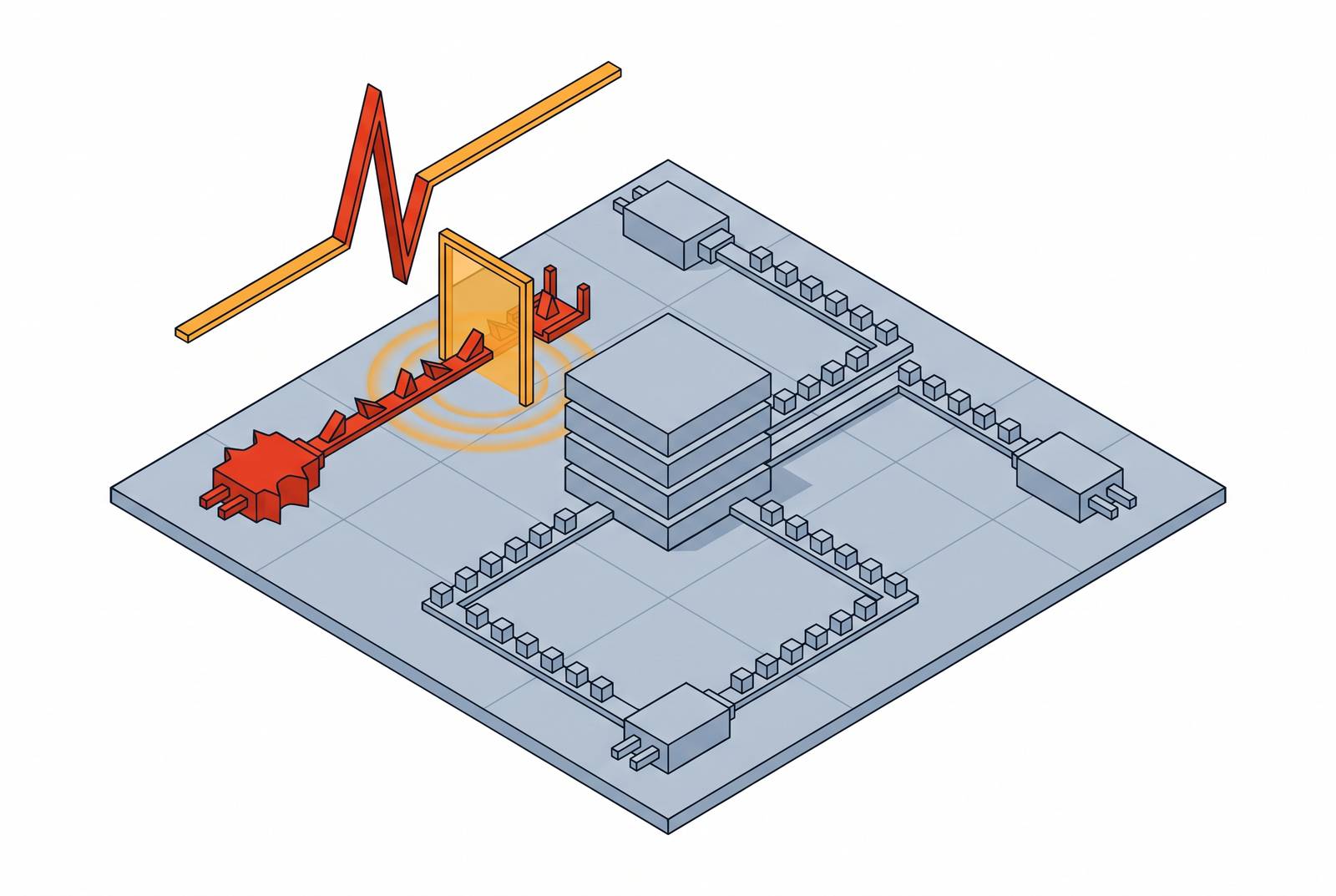
Indirect prompt injection detection in enterprise RAG pipelines requires runtime behavioral monitoring alongside content inspection. Third-party plugins and retrieved documents can deliver adversarial instructions through trusted data paths, so filters may miss the attack before the model acts. Protecting the pipeline means watching tool-call sequences, arguments, outbound requests, and changes in behavior against a defined baseline, with controls that can restrict or escalate suspicious actions.
Why third-party plugins are a structurally different threat surface than direct user input
A user-facing input gate can inspect what someone asks an assistant to do. A plugin takes a different route. It retrieves information as part of an authorized task and passes it on as input that has been processed and can be trusted. The enterprise may trust the connector even when it does not control every document, message, or data value the connector returns. That inherited trust gives externally planted instructions a path into the model.
This is the defining feature of indirect prompt injection. An attacker places instructions in a web page, calendar invite, PDF, email, or issue comment that an agent later reads during normal work. The user need never touch the payload. Autonomous retrieval and RAG integration make this possible because the model can encounter outside content after the user's request has already passed inspection.
OWASP LLM01 covers prompt injection in its 2025 and 2026 editions, while LLM03 addresses supply-chain vulnerabilities in components including models, adapters, plugins, and datasets. A plugin need not contain compromised software for its output to contain hostile instructions. The model's treatment of retrieved material as information to examine or authority to obey is decisive. If the model trusts the plugin, the attacker only needs to control the plugin's data source.
How adversarial instructions are concealed inside plugin outputs
What does a malicious instruction look like when it arrives through that route? It may not look like anything to a human reader. Zero font-size text, off-screen positioning, HTML attributes, and CSS rendering suppression can hide words from view without removing them from material processed by the model. The browser's visible page is therefore not a complete account of the input. A scanner examining a different representation can miss what reaches the model.
Encoding adds another layer to that mismatch. Base64 payloads, Unicode tag characters, and zero-width spaces can obscure instructions from pattern matching while leaving them interpretable by the model. Runtime instruction assembly makes inspection of individual fragments incomplete for a different reason. Attackers can combine these techniques with an authority claim such as “this is a security update,” encouraging the model to treat source content as a legitimate override.
Operational logs make the problem especially easy to underestimate. Logs feel internal, but their contents come partly from external requests, customer input, service responses, URLs, and headers. A malicious URL path can become a log entry and later reach an assistant asked to summarize it. The same problem can arise in images, scanned receipts, and audio as well as text. OWASP's 2026 edition explicitly includes cross-modal attacks in LLM01 and recommends stripping invisible Unicode characters at ingest and render boundaries, but text cleanup cannot cover every representation the model may interpret.
What production incidents reveal about the real damage path
Noma Security and Grafana Labs described GrafanaGhost on April 7, 2026. The attack placed a crafted payload in data that Grafana's AI assistant would process, such as a dashboard annotation or data source value. It used “INTENT” to bypass safety restrictions and induced the Markdown image renderer to request an attacker-controlled URL, with sensitive data in query parameters. No account access was required. The data at risk included financial metrics, infrastructure telemetry, customer records, and operational data.
GrafanaGhost left no trace in Grafana's own audit logs, so those logs could not reconstruct the exfiltration afterward. An external behavioral monitor watching outbound requests was needed to catch that path in progress. Noma also documented ForcedLeak in Salesforce Agentforce, GeminiJack in Google Gemini, and DockerDash in Docker.
GitHub Copilot CVE-2025-53773 showed how injected instructions could change the conditions for later actions. The instructions modified .vscode/settings.json, enabling “YOLO mode” through the chat.tools.autoApprove setting. Copilot could then execute shell commands and other privileged actions without user confirmation. The attack could propagate across repositories.
A compromised npm package in a language-model-powered GitHub Actions issue triage workflow exposed approximately 4,000 developer machines. That consequence extends the concern from one application's data to software supply-chain reach. The relevant warning was the agent's action sequence.
Why static input filters cannot close this gap alone
Input filters check content before the model acts. That is useful but structurally incomplete. Instructions and source data enter the same token stream, without a dependable privilege boundary equivalent to the separation between user and kernel operations. A system prompt may tell the model to disregard instructions in retrieved content, but that rule is not a deterministic barrier. Safety training can cut the number of failures while still leaving the specific cases attackers look for.
Concealment further weakens the assumption that inspection covers the eventual input. A keyword filter, a rendering layer, and a model may each process different forms of the same material. In agentic workflows, the instruction may also take shape over several turns. Blocking every high-risk call would also stop legitimate work. That false-positive cost creates pressure to loosen thresholds, making coverage a practical question as well as a technical one.
Output validation can catch some failures that input checks miss. A language-model-based evaluation layer improved detection precision by identifying semantically manipulated outputs, but its evaluation remains limited to content. The FORTE survey framework calls for deployment evidence on latency, cost, and robustness under adversarial pressure alongside offline classifier performance. A filter's test result does not establish how it holds up in a live pipeline. Runtime anomaly detection watches the missing signal of which tools the model called, in what order, and with what arguments, the behavioral sequence.
What behavioral signals actually look like in a plugin-fed LLM pipeline
A behavioral anomaly is an action that does not fit the agent's expected task and permissions. An outbound HTTP request carries a different risk when the agent's job is to summarize email than when its job requires that request. Similarly, a data-retrieval agent invoking a file-write tool deserves scrutiny when writing is outside its normal workflow. Detection needs the task and action together.
GrafanaGhost makes that distinction concrete through its outbound URL request. The useful signal is the request, its destination, and the sensitive data placed in its arguments, even if the generated response appears ordinary. The Copilot case points to a different sequence, in which a configuration write removes approval requirements before privileged actions become possible. Cross-turn monitoring connects such changes to newly ingested documents or plugin responses.
Output structure supplies supporting evidence for action monitoring. Unexpected URLs, encoded data, system-prompt leakage strings, or role-play markers can signal a departure from a prose-only task. Yet a deviation does not prove injection. AgentSentry addresses that attribution problem through controlled counterfactual re-execution at tool-return boundaries, testing whether mediator-side instructions caused the next-step change. The approach aims to distinguish injected direction from legitimate variation without blocking tool use prematurely.
A policy layer can turn that evidence into a proportionate response. Suspicious activity can move the model into a more restrictive mode or route the interaction to human review while keeping the workflow open. This preserves a path for legitimate work. Its reliability depends on a defined baseline for the particular agent and plugin combination, because an action is only abnormal relative to an expected state.
What tools detect prompt injection from third-party data sources in practice?
CrowdStrike announced general availability of Falcon AI Detection and Response in December 2025, extending Falcon to keep checking prompts and agent intent for misuse of permissions or attempts to go beyond what is allowed. Its response includes Continuous Identity revocation on detection. This approach connects inspection with authority to act. It does not make an inventory of third-party AI dependencies unnecessary.
CrowdStrike unveiled Falcon Guardian at Fal.Con 2026 on September 1, saying it could detect attacks on agents and malicious agent behavior, piece together the execution chain, and assess the blast radius in real time. On November 4, 2026, at Fal.Con Europe in Barcelona, it announced Agent Insider Threat Detection for Falcon Next-Gen SIEM, coming in Q4 2026. The announced design learns normal behavior for each agent and its owner. That baseline supports flagging deviations even when no explicit policy is violated. Announced capability and availability remain distinct claims.
Bifrost by Maxim AI represents the runtime gateway approach. It provides centralized routing with dual-stage guardrails, expression-based policy rules, MCP tool allowlists, and native secrets detection across prompt ingestion and tool-call output. The gateway is a control point for interactions routed through it. Model Context Protocol visibility is particularly important because tool registration and invocation need explicit inspection and allowlisting. Generic web application firewall controls do not supply that view.
Third-party risk management, InfoSec, and Legal teams have more trouble seeing what happens when vendors provide the AI capability. Dedicated AI risk intelligence platforms keep watch over vendors' AI assets and detect threats in real time across models, plugins, agents, and connectors. Their scope covers the vendor integration, including enterprise endpoints and gateways. Teams therefore need to compare how well these tools cover action sequences, enforcement points, MCP interactions, and changes on the vendor's side.
What enterprises need to establish before behavioral detection can work
An AI Software Bill of Materials must first document the pipeline's models, adapters, datasets, libraries, inference frameworks, and third-party plugins. Without that inventory, “normal behavior” has no stable reference. Teams need to know which agent uses which components before they can decide whether a new tool call reflects an attack, an authorized change, or an incomplete baseline. Inventory gives behavioral evidence its context.
Least privilege then narrows the actions an injected instruction can exploit. Constraining tools and their conditions of use also makes genuine deviations easier to distinguish from routine work. OWASP LLM06 addresses Excessive Agency through measures including human approval for consequential actions, rate limiting, and audit logging for tool operations. GrafanaGhost shows why external records of tool-call sequences, arguments, and outbound requests are necessary when application logs omit the damage path.
Teams must test whether monitoring works within the limits they face in practice. The FORTE framework provides a useful basis for documenting latency budgets under monitoring load, anomaly escalation thresholds, explanation integrity for flagged events, and a defined adversarial pressure test. Teams also need an expected response to a detection, including when restrictions or human review apply. Otherwise, a signal may be technically correct but operationally unusable.
Keeping that groundwork up to date is harder with AI from vendors because the enterprise does not control updates to models or changes to plugins or backend infrastructure. Continuous vendor asset monitoring is needed to catch changes that alter the baseline without internal notice. Retrieved content changes too, while attackers seed new payloads and develop new concealment techniques. A point-in-time integration review cannot stand in for that visibility.