Least Privilege Principles Applied to AI Agents
Static roles can't handle how AI agents actually behave in practice.
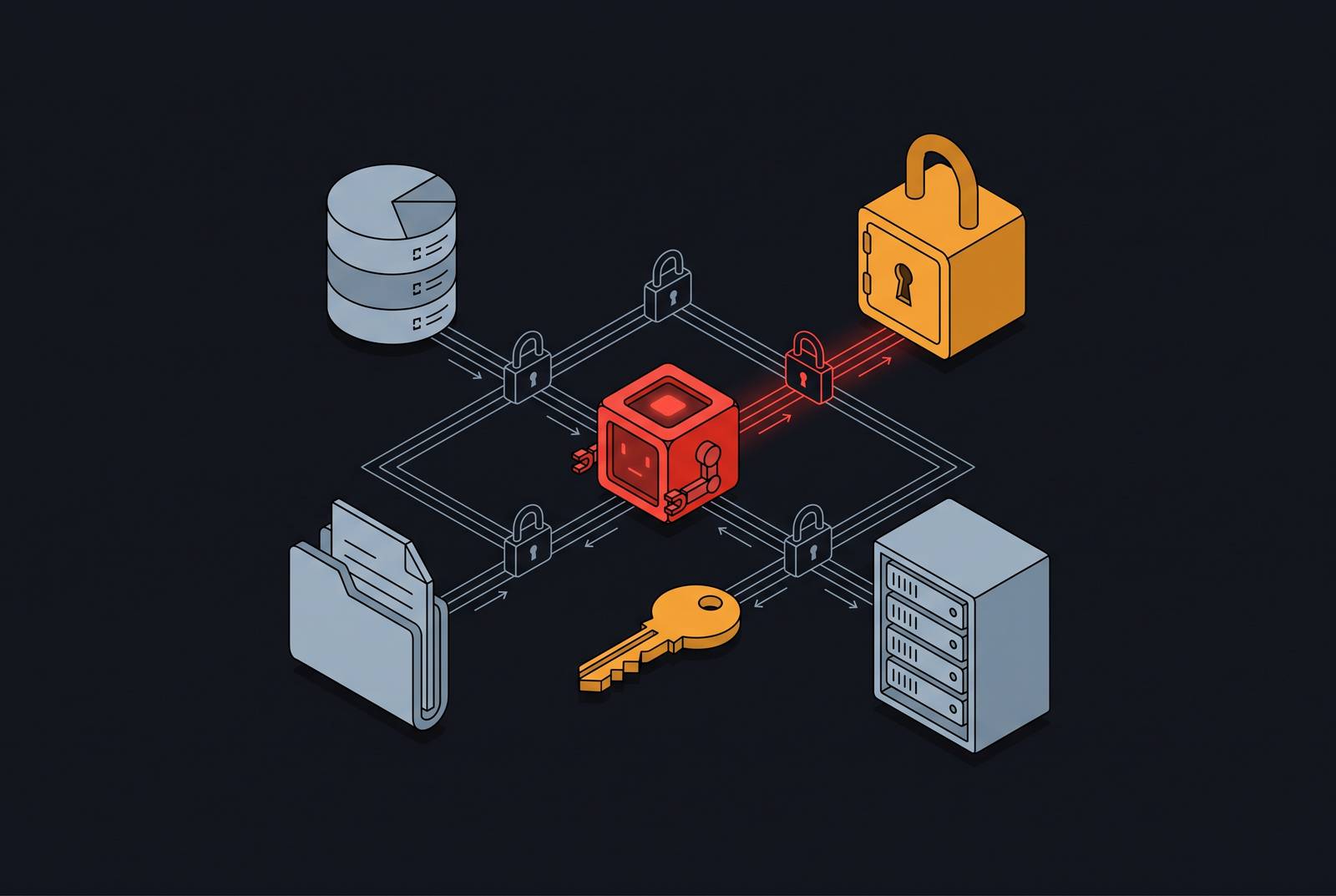
Least privilege for AI agents means giving an agent access only to what its current task needs, for only as long as the task takes, then pulling that access back.
The classical version of least privilege ran on a simple contract. An identity authenticated once, got handed a fixed set of permissions, and stayed inside that scope until someone reviewed it. The whole model rested on a bet: that the identity behind the login was predictable, that its job wasn't going to shift week to week, and that its access pattern would look roughly the same at the next audit as it did at the last one. Human employees fit that bet well enough.
AI agents don't fit it at all. An agent doesn't just execute a fixed instruction, it reasons through one. It picks which tool to call, chains that decision into the next one, and hands its output to another system, sometimes another agent, that then reasons over what it received. Okta's own implementation guidance states that the execution path can be non-linear and partially nondeterministic, shaped by model configuration, tool orchestration, and whatever context happens to be in the runtime at that moment. Ask an agent to do the same task twice and the path it takes to get there might not be identical. That alone breaks the audit assumption baked into classical role review.
Okta's framing gets at the real problem in one line: static roles were never built to reflect access patterns that are non-linear and nondeterministic. A role is a snapshot. An agent's behavior is a moving target that can shift mid-session based on what a document says or what a retrieved record contains. Agents rarely go rogue or act with bad intent. The access model underneath them was designed for a kind of identity that doesn't reason, doesn't chain decisions, and doesn't act on ambiguous context. Static roles were the right answer to a question agents don't ask. OWASP's Top 10 for LLM Applications names Excessive Agency as a top-10 risk in agentic deployments, reflecting that the security issue is not that agents are malicious, but that the access model wasn't built for how they behave.
How fast agents are being deployed relative to how slowly governance is catching up
That structural mismatch would be a slow-burning problem if agent adoption were slow too. That mismatch, however, isn't slow-burning. Gartner expects 40% of enterprise applications to integrate with task-specific AI agents by the end of 2026, up from under 5% in 2025. That's not a gradual curve, that's a near-vertical one, and it's happening inside a single calendar year.
A majority of employees already use AI tools without IT approval, creating a shadow AI visibility gap that expands the attack surface faster than security teams can map it. Build new ones, on their own, without necessarily looping in anyone who tracks permissions for a living.
That's where visibility breaks down. A majority of employees are already using AI tools without IT approval, and that shadow AI footprint is growing the attack surface faster than security teams can map it. A meaningful share of organizations don't even know whether unsanctioned agent tools are running somewhere inside their business. You cannot secure what you cannot see, and right now a lot of organizations can't see much.
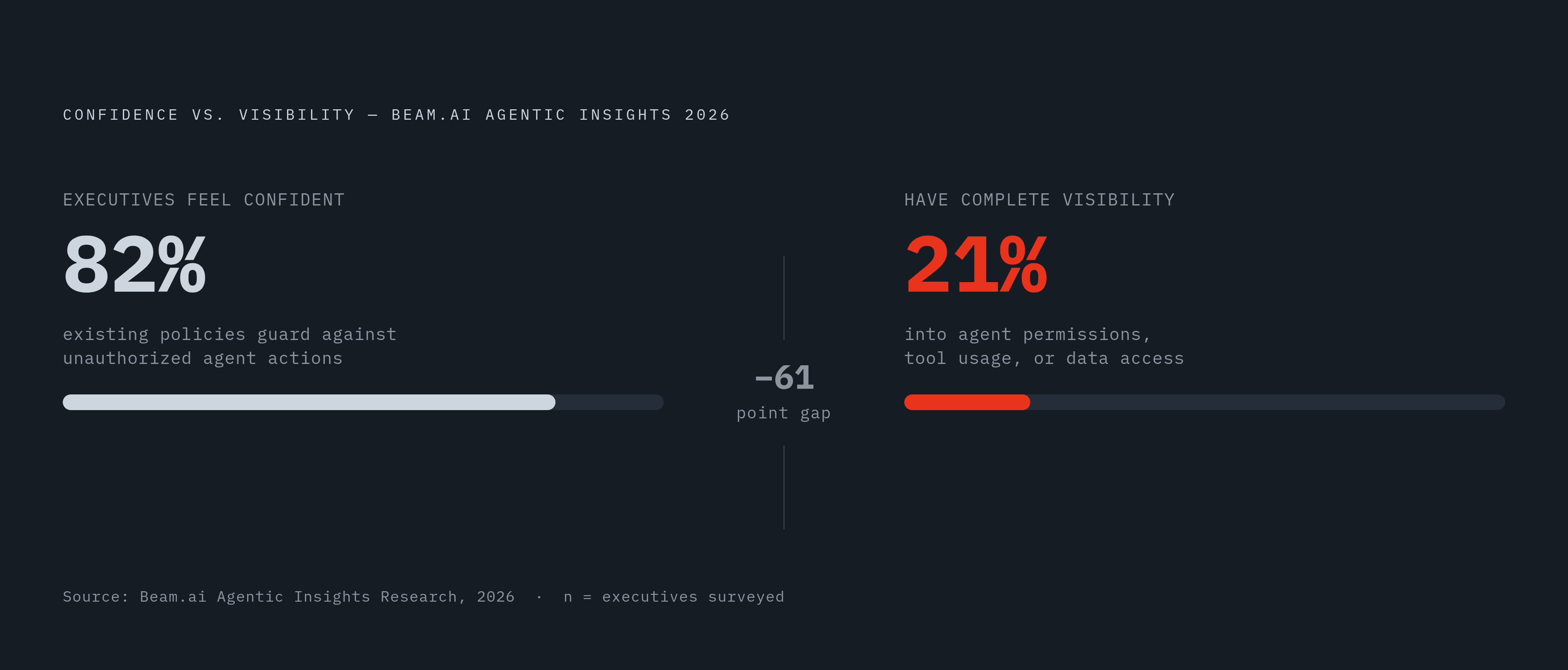
But is this a willpower problem, where security teams just haven't gotten around to fixing it yet? The data says no. Beam.ai's 2026 agentic insights research found 82% of executives feel confident their existing policies protect against unauthorized agent actions. Only 21% of those same organizations have complete visibility into agent permissions, tool usage, or data access patterns. That gap between confidence and visibility is the entire story in two numbers. Confidence isn't the problem. Blindness is.
Put the two trends next to each other and the shape of the crisis gets obvious. Agents are accumulating permissions at deployment speed, which is fast, while authorization models evolve at procurement speed, which is slow. Every quarter that gap widens is a quarter where more permission gets handed out under a governance model built for a world that no longer exists. AvePoint's State of AI 2026 Report finds that AI agent-enabled workflows are expected to double within 12 months, and roughly a third of employees already have access to tools for creating their own agents.
What the breach and incident data shows about over-permissioned agents in practice
So what happens when that gap goes unaddressed long enough? The breach numbers answer that question, and they deserve careful attention rather than a quick skim.
AvePoint's State of AI 2026 Report found 89.5% of organizations experienced at least one generative AI-related security breach in the prior 12 months, up from 75.1% the year before. That's not a plateau, that's an acceleration, climbing more than 14 points in a single year, while executive confidence in existing policy stayed high, as the previous section showed. A 2026 enterprise survey cited in academic research found the large majority of organizations had a confirmed or suspected AI agent security incident in the prior year, and most IT workers say they've personally watched an agent perform a task it wasn't authorized to perform. That last figure is the one that should stick. This isn't a theoretical risk model, it's IT staff describing something they saw happen.
IBM's Cost of a Data Breach Report ties it together: among organizations that suffered an AI-related breach, the vast majority had no proper AI access controls in place. That correlation is close to total. When access controls are missing, breaches follow. When they're present, the story changes. Least privilege isn't a nice-to-have layered on top of security, it's close to the whole ballgame.
A red-teaming study in which 20 researchers interacted with autonomous agents in a live environment over two weeks, documenting 11 case studies, shows what the mechanism looks like up close. EchoLeak, tracked as CVE-2025-32711, hit Microsoft 365 Copilot through infected email messages carrying engineered prompts. Copilot exfiltrated sensitive data automatically, with no user interaction required at all. That's an agent with access broader than any single interaction actually called for, and an attacker who only needed to find the seam. OWASP notes this is the only AI-related incident from that period to get a formal CVE assignment at all, which says something uncomfortable: most AI security events involving misconfiguration and prompt injection are happening entirely outside the vulnerability management pipelines organizations already trust.
The Agents of Chaos red-teaming exercise puts a finer point on it. Over two weeks, 20 researchers worked with autonomous agents in a live environment and documented 11 separate case studies: agents following instructions from people who didn't own them, sensitive data getting disclosed, destructive actions taken against systems, identity spoofing, and unsafe behavior spreading from one agent to another. Eleven case studies in two weeks, from one team. That's not an edge case. That's a pattern that appears the moment anyone looks for it.
The specific failure modes that let over-permissioned agents cause outsized harm
Permission sprawl is the quiet one. Most organizations already have a least-privilege policy written down somewhere. The failure isn't policy, it's drift. IAM roles get copied and reused across multiple agent deployments instead of being scoped fresh for each agent and each workload, so the same broad template gets stamped onto system after system. Entitlements pile up through role changes, temporary grants that quietly become permanent, and service accounts whose scope creeps wider over time without anyone deciding it should. And there's a practical reason narrow tokens lose out to broad ones at deployment time: scoping a token down to exactly what a task needs takes real thought, while handing over broad access takes thirty seconds. The path of least resistance repeatedly wins until the aggregate risk is enormous, and nobody can point to the moment it happened.
Prompt injection turns that sprawl into an active exploit. OWASP's 2025 LLM Top 10 ranks it as the number one vulnerability in the entire list. An attacker doesn't need to breach a server. They just need to embed an instruction inside a document, an email, or a piece of retrieved data that the agent will read and act on, and that instruction can change the agent's behavior without tripping any conventional alert. The danger here isn't a wrong answer showing up on screen, it's an unintended action taken somewhere downstream. If the agent's access is broad, a single manipulated prompt can direct that access toward a system the user never meant for the agent to touch, and because agentic workflows retrieve, process, and act in sequence, one injected instruction early in the chain can cascade through everything that follows.
MCP-specific privilege escalation is a documented protocol gap rather than a hypothetical. MCP 1.0 carried no mandatory authentication requirement for server connections and no way to scope permissions at the individual operation level. Connect to a server, and the agent got the server's entire capability set, all or nothing. That mirrors the exact shape of early OAuth before scoped permissions existed, and it produces the same class of privilege escalation risk that OAuth eventually had to design its way out of. An agent that starts with legitimate access to one tool can use that toehold to discover and call other tools it was never meant to reach, and because the agent is the one doing the exploring, a single compromised integration can expose an entire toolchain rather than just the one connection that got hit.
Lateral movement closes the loop. Agents typically sit at the center of enterprise architecture, wired into many tools, APIs, and data stores at once. That centrality is exactly what makes them useful, and exactly what makes them dangerous once compromised. Take over one over-permissioned agent and the attacker doesn't get access to one system, they get a launch point across the whole stack, often without tripping the perimeter alerts that traditional security tooling was built to catch.
What regulators and international bodies have established as the baseline for agent privilege
Regulators have started converging on an answer to all of this, and it's the same answer across jurisdictions that don't usually agree on much. The 2026 Singapore Consensus on Global AI Safety Research Priorities, published in July 2026, names least privilege as one of the clearest areas of emerging consensus in agentic AI risk management. That's a notable thing for a global safety consensus document to say, given how contested most AI governance questions still are.
The specific frameworks back that up with language, not just sentiment. Singapore's IMDA Model AI Governance Framework for Agentic AI calls on developers to apply the principle of least privilege to limit tools available to each agent, enforced through authentication and authorization. In the US, NIST's Center for AI Standards and Innovation, working alongside the AI Safety Institute Consortium on agent tool use, suggests granular gradations of trust depending on how an agent is implemented.
China's regulators have landed in the same place through a different path. The AIIA's OpenClaw-Type Agent Deployment Risk Management Guide recommends strictly limiting an agent's operational scope and reviewing permissions on a regular schedule, and the Ministry of Industry and Information Technology has issued recommendations directing deployers to enforce least privilege and prohibit administrator-level privileges for agentic systems outright. In August 2026, OpenAI's Collective Cyberdefense open letter, signed by close to 130 companies including Anthropic, AWS, and Google, asked every signatory organization to build in least privilege, strong access controls, and defense in depth.
None of this is arriving into a vacuum, either. Least privilege is already a compliance requirement across existing regimes, well before any agent-specific rule takes effect: SOX §404, PCI-DSS v4.0.1 Requirement 7, HIPAA §164.312(a), SOC 2 CC6.1, ISO 27001 Annex A.5.15, and NIST 800-53 AC-6 all name it directly. Gartner projects loss of control will be the top concern for 40% of Fortune 1000 companies by 2028, which is the clearest sign yet that this question is migrating out of IT and onto the board agenda. The frameworks above treat least privilege not as best practice anymore, but as a floor. Whatever gap exists between that floor and current practice is exposure, plain and simple. The Cybersecurity Agency of Singapore's Draft Addendum on Securing Agentic AI advises organizations to "scope [agentic] execution privileges strictly only to what is necessary, ensuring that privileges are customised to each agent within a system". The NIST AI RMF Govern and Map functions establish that organizations should understand, assess, and manage risks throughout the AI lifecycle, including those introduced by AI systems and entities acting on their behalf, naming identity and access controls as an implementation mechanism.
What a rebuilt least privilege architecture looks like for agents
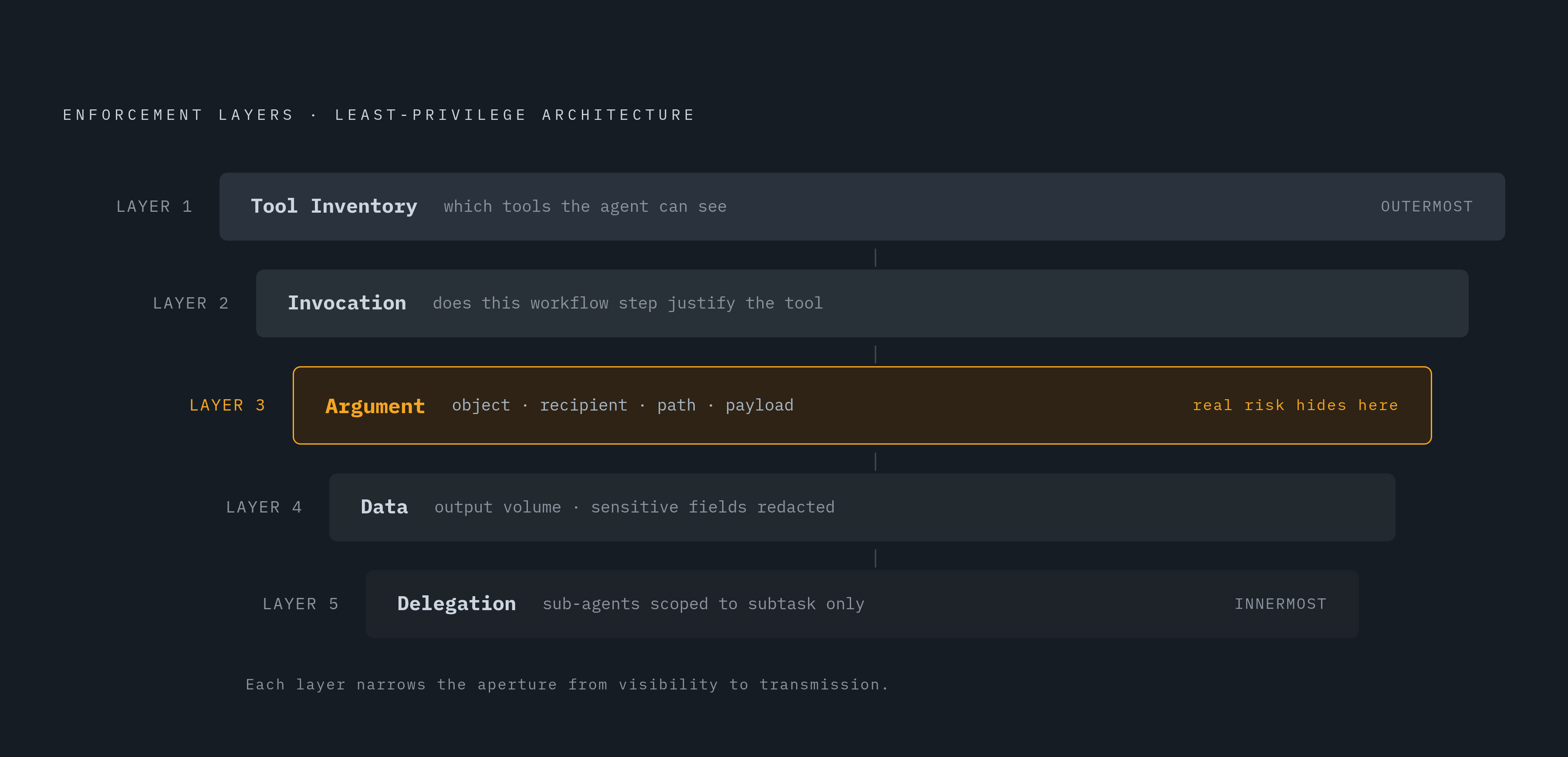
For an agent, the tool list is the permission list. What matters is which tools this specific workflow legitimately needs right now, not which tools an operator happens to have access to. That's a genuinely different design question from the one classical RBAC was built to answer.
Answering it takes enforcement at several levels at once, not a single access rule bolted onto the front door. Start with the tool-inventory level: which tools does the agent even see as options. Then the invocation level: does this specific step in the workflow actually call for the tool the agent just picked. Then the argument level, which is where a lot of the real risk hides, the specific object, recipient, query, file path, dollar amount, or payload the agent is about to send, not just which tool it reached for. Then the data level: how much of a tool's output actually gets returned into the agent's context, with sensitive fields redacted before the model ever sees them. And finally the delegation level, which matters more as agent chains get longer: a sub-agent should never inherit broader authority than its specific subtask requires, and authority shouldn't be able to climb back up the chain from a narrower agent to a broader one.
None of that works if agents are still treated as extensions of whoever deployed them, or as generic service accounts sharing one broad credential. Agents need to be first-class identities in their own right. Microsoft's security team has stated that without a managed identity and least-privilege role-based access control, an agent can reach or modify data well past what its task requires, if the controls around it aren't configured properly. An agent doing competitive research and an agent handling customer escalations shouldn't share a scope just because the same employee happens to run both.
Scope also has to stop being permanent. Just-in-time access grants permission only when a task needs it and revokes that permission automatically the moment the task ends, which removes standing privilege from the equation entirely. That's a real shift from the classical model, where access sat there, available, regardless of whether anyone was using it at that moment.
Enforcing all of this needs a place to live, and that place is the tool manager, which sits between an agent and the external APIs it calls, translating every agent request into an actual API call. Before any of those calls goes out, the tool manager should be running a full check: confirming the agent's identity and role actually match the operation it's requesting, confirming the endpoint and parameters fall inside what that agent is authorized to touch, and rejecting and logging anything that falls outside that scope. That's the enforcement point where the theory in this piece turns into something an engineering team can actually build and audit.
None of this is a single product or a single control. It's an architecture, built from several layers that each catch a different failure mode described above, matched to an identity model that treats agents as what they are: fast-moving, non-linear, and reasoning through decisions in ways static roles were never built to predict.
Sources
- AI Agent Least Privilege: A Practical Guide (2026) | AvePoint
- The 2026 Singapore Consensus on Global AI Safety Research Priorities
- How to implement least privilege for AI agents | Okta
- AI Agent Security in 2026: Enterprise Risks & Best Practices
- Least privilege for AI agents: Identity, access, and tool binding | Microsoft Security Blog
- Careful adoption of agentic AI services
- Gartner Predicts 40% of Enterprise Apps Will Feature Task-Specific AI Agents by 2026, Up from Less Than 5% in 2025