PII Exposure in LLM Application Logs
Logging AI prompts captures personal data companies didn't mean to store.
LLM application logs have become one of the easiest ways for personal data to leak out of a company, and almost nobody in InfoSec or Privacy signed up for that risk. The reason is structural: the same prompts and completions that make an AI system debuggable are the same prompts and completions most likely to carry a name, an account number, or a diagnosis. Traditional log management was built for status codes and timestamps, not free-text human language, and that mismatch is now the blind spot enterprises are least prepared to close.
I've spent enough time in security reviews to know the instinct here. Someone on the platform team says "we need better observability," turns on prompt and completion logging, and moves on to the next ticket. Nobody's being careless. They're doing their job. But every time that switch flips, the PII surface gets wider, because users don't type into a chatbot the way they fill out a form. They type the way they'd talk to a coworker who already knows the context, which means account numbers, symptoms, legal facts, and internal deal terms show up in plain text, sitting in a log line that was never designed to hold them.
The specific points in an LLM pipeline where PII enters logs
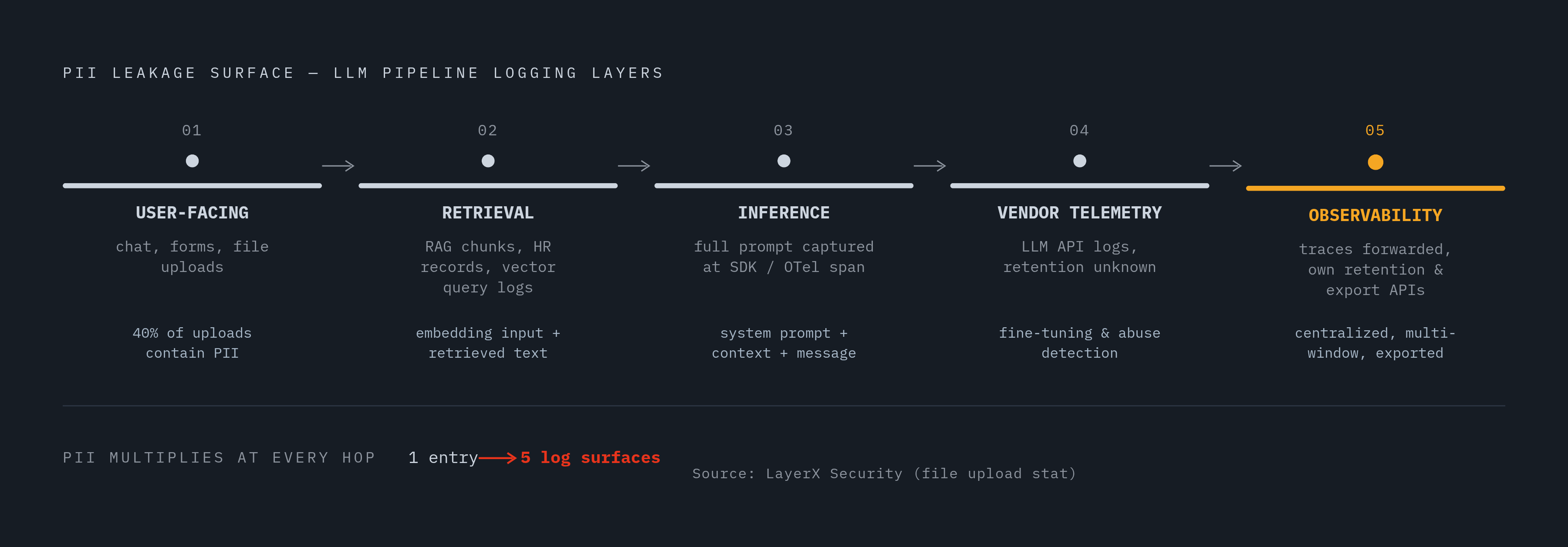
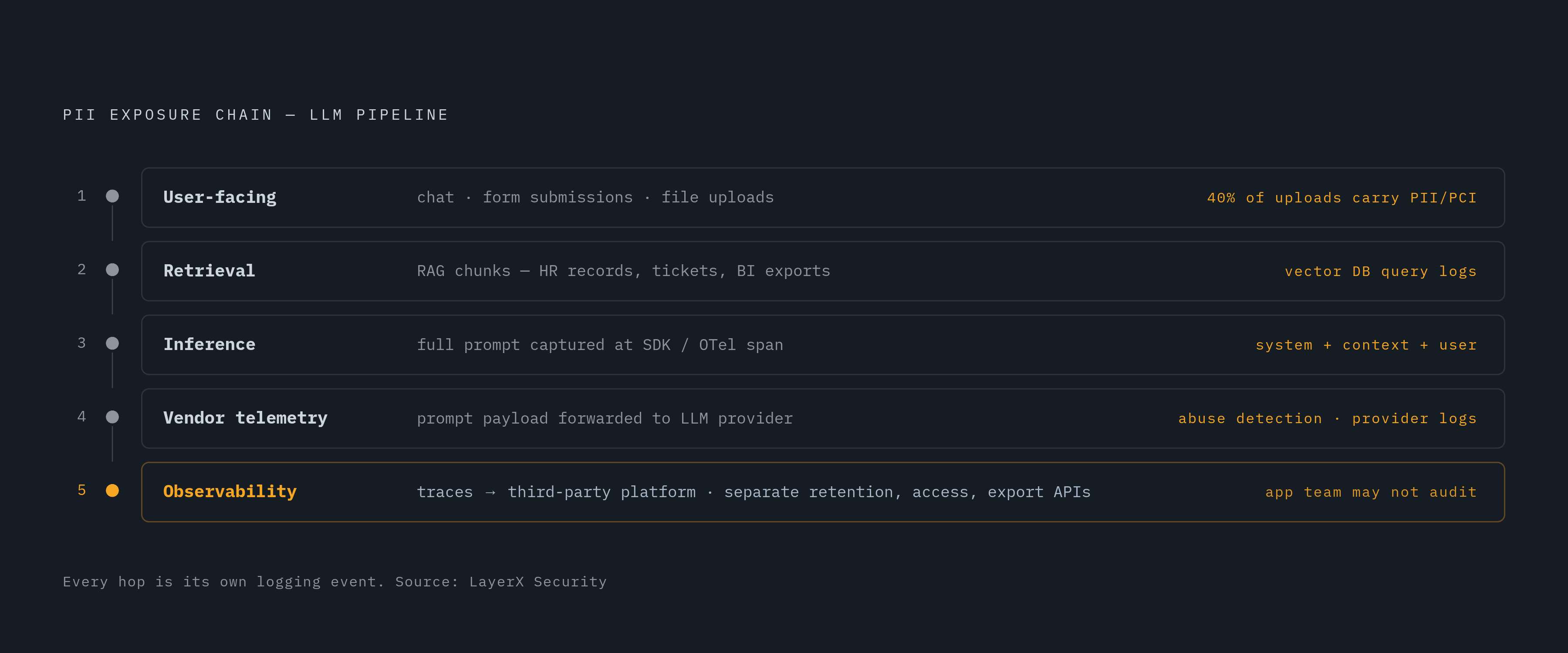
There isn't one entry point. It's a chain, and each hop along that chain is its own separate logging opportunity.
Start at the user-facing layer. Chat messages and form submissions carry names, account details, health information, whatever the user thinks is relevant to get a good answer. File uploads make this worse: LayerX Security found that 40% of files uploaded to AI chatbots contain PII or PCI data. That's not an edge case, that's four in ten uploads.
Move to the retrieval layer. Retrieval-Augmented Generation systems pull document chunks into the context window before the model ever sees the prompt, and those source documents often come from internal tickets, HR records, or BI exports, none of which were classified with "might end up in an unstructured log entry" in mind. Vector database query logs then record both the embedding input and the retrieved text, doubling the exposure.
Then there's inference itself. The full prompt, system instructions plus retrieved context plus the user's actual message, gets sent to the model API and often logged at the SDK or OpenTelemetry span level. OpenTelemetry's AI instrumentation can capture prompts and completions inside spans once content capture is turned on, and teams that flip that switch frequently do it before any retention policy exists to govern what they just captured. On top of that, completions themselves can occasionally reproduce memorized PII from a model's training data, which means the risk isn't confined to what the user typed.
Vendor telemetry is the layer most teams forget entirely. Third-party LLM API providers receive the full prompt payload, and their own logging, fine-tuning, and abuse-detection systems may hold onto it well beyond what the enterprise assumes. Companies broadly report they don't have full visibility into every third party touching their personal data, and LLM API forwarding just adds another link to that already-unclear chain.
Last stop: the observability platform. Traces and structured log fields get forwarded to centralized systems, and those systems have their own retention windows, access controls, and export APIs. Once PII reaches that layer, it's sitting in a third system with its own attack surface, one the original application team may not even have write access to audit.
How PII persists once it is in logs — the retention and propagation problem
Logs exist to persist. That's the entire point of them, and it's exactly what turns a momentary lapse into a long-lived liability. A log entry captured during a debugging session six months ago doesn't age out on its own; it sits there until someone with authority over retention decides otherwise, and most retention windows are set for operational convenience, not for privacy compliance.
Propagation makes this worse. Log aggregation pipelines copy data across regions and cloud environments, sometimes crossing jurisdictional lines without anyone flagging it. Exported archives, whether for analytics or for training a new model, carry that same PII into storage systems with entirely different access rules. Backup and disaster recovery copies create still more instances, and those copies are rarely part of any deletion workflow.
Then there's shadow AI, which compounds all of it. IBM's 2025 Cost of a Data Breach Report found that shadow AI incidents, meaning employees routing sensitive data through personal LLM accounts outside company controls, added an average of $670,000 per incident. Those logs sit entirely outside enterprise retention and deletion governance, because the enterprise doesn't know they exist.
Samsung's experience is the clearest real-world example. Within less than 20 days of employees getting access to ChatGPT, three separate incidents occurred: source code submitted, an equipment-identification program submitted, and a recorded meeting transcript submitted. Three different data types, three separate paths into a vendor's logging system. A 2023 survey found that 68% of employees using ChatGPT at work did so without their employer knowing. That's the propagation problem in one number: it's mostly invisible to the people responsible for stopping it.
What OWASP's reclassification of sensitive information disclosure signals about industry awareness
OWASP moved Sensitive Information Disclosure from position 6 in its 2023 LLM Top Ten up to LLM02 in the 2025 edition. The stated reason is that LLMs now need broader access to organizational data to be useful, which widens the exposure surface almost as a side effect of doing the job well. When the industry's own security taxonomy reclassifies something as a top-tier risk, that's worth sitting with for a second. This isn't a fringe concern anymore.
The taxonomy breaks the risk into three modes. Training data extraction is when a model reproduces memorized PII in response to a targeted or manipulated query. Inference-time leakage is sensitive data included in the prompt at runtime, which is the logging risk this whole piece is built around. Output handling failures happen when a completion carrying sensitive content gets forwarded downstream without any sanitization step.
This isn't theoretical. A 2025 study mapping 100 real GitHub Security Advisories against the OWASP LLM Top 10 found LLM02 showing up in 17 of them. Confidentiality exposure is turning up in actual open-source vulnerability disclosures, not just in threat models.
What OWASP's framework doesn't tell you is where in the pipeline any of this happens. It describes the failure modes well. It doesn't map them onto the actual logging chain, which is the gap worth filling if you're the one responsible for closing it.
The DeepSeek database exposure as a case study in log-layer risk
In January 2025, Wiz Research found a publicly accessible ClickHouse database belonging to DeepSeek. No authentication required. Full database control through an HTTP interface, arbitrary SQL queries executable straight from a browser.
Here's the detail that matters for the argument I'm making: the exposed table was named log_stream. What got exposed wasn't a model and it wasn't a user database. It was a logging system, over a million lines of it, containing plaintext chat history, API keys, backend service details, and operational metadata. That's exactly the set of fields observability systems are built to capture by design. The DeepSeek incident wasn't a novel attack technique; it was a demonstration of what happens when the thing everyone agrees to log turns out to be sitting behind a door nobody locked.
It wasn't isolated either. NSFOCUS Xingyun Lab reported that between January and February 2025, five major LLM-related data breaches broke out globally, each leaking chat history, API keys, or credentials. DeepSeek was the most visible one, not the only one.
The regulatory tail on this matters too. If EU or US resident data was present in that exposed log stream, the incident created potential GDPR and CCPA liability on the spot. A misconfigured logging database became a cross-jurisdictional compliance event in the space of a headline. The lesson isn't that DeepSeek was uniquely sloppy. It's that log data carrying PII inherits every access-control risk of whatever database happens to hold it, regardless of who built that database or how careful they normally are.
How agentic and multi-agent architectures multiply the logging exposure
Agentic systems break a single user request into many separate calls, and each one of those calls is a fresh chance for PII to leak into a log. One user turn might trigger tool selection, a retrieval lookup, an intermediate reasoning step, and a final synthesis step, each a distinct model call with its own logging event. If PII enters at step one, it doesn't stay there. It propagates into every downstream log entry that touches the conversation, which means redacting only the first user message accomplishes almost nothing. Redaction has to sit at every outbound call, not just the entry point.
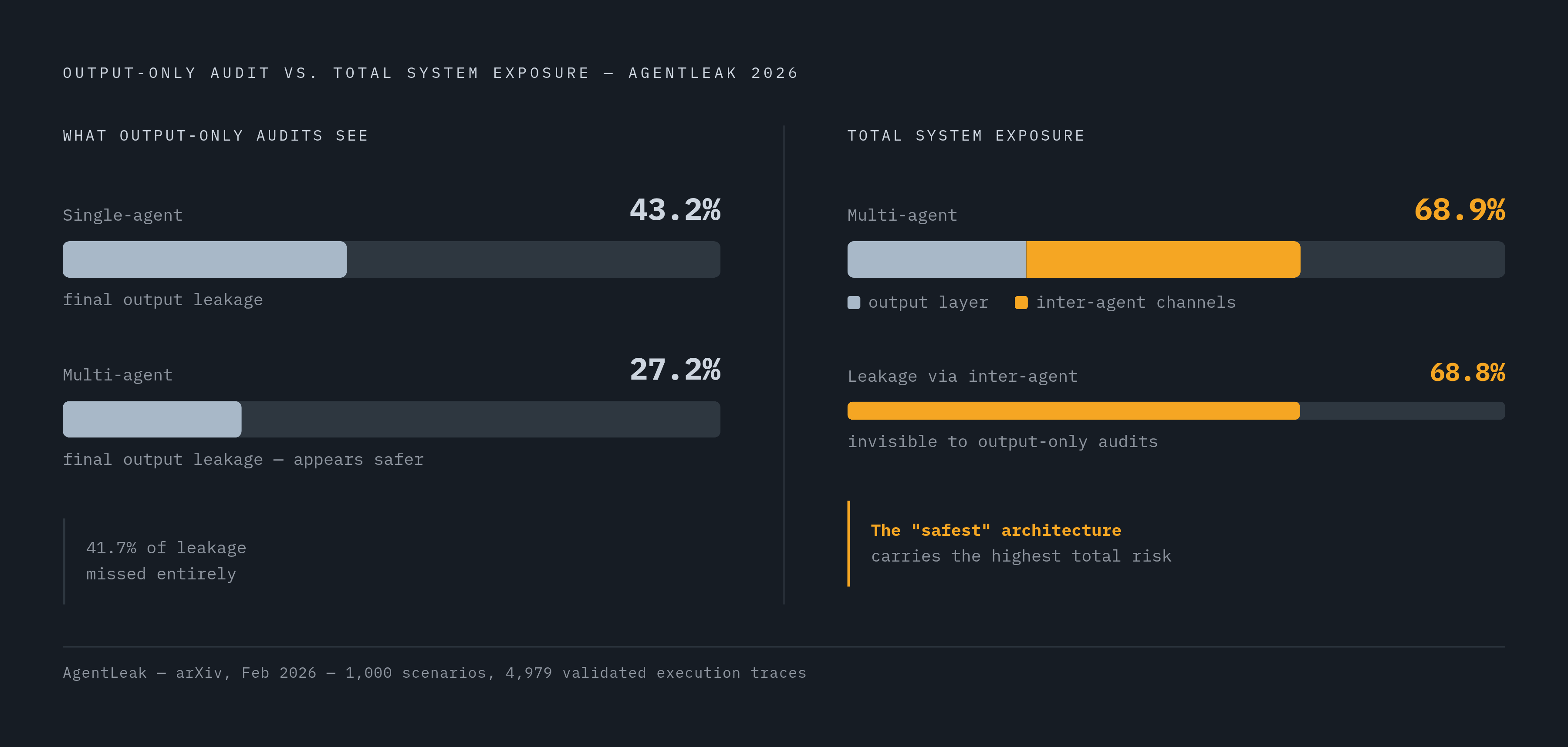
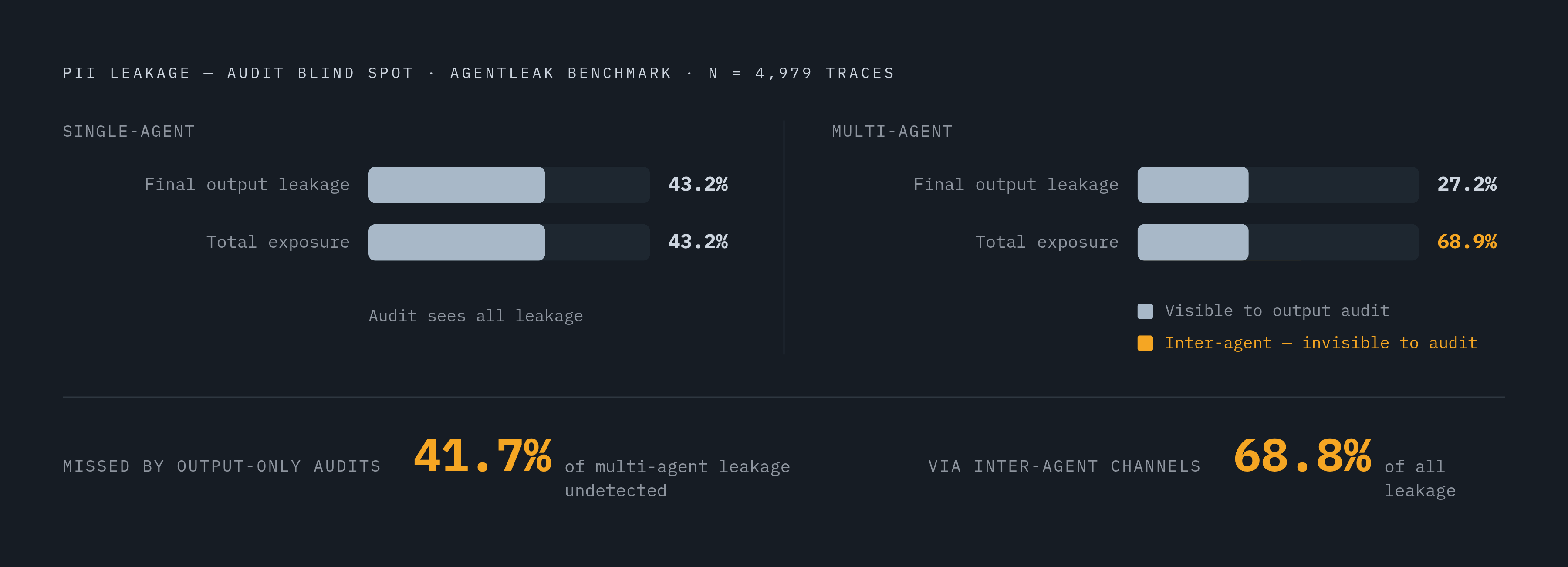
The AgentLeak benchmark, published on arXiv in February 2026, is the most thorough empirical look at this so far. Researchers ran 1,000 scenarios across healthcare, finance, legal, and corporate domains, using five production LLMs, and validated 4,979 execution traces. The findings are worth sitting with: multi-agent setups actually reduce leakage in the final output compared to single-agent systems, 27.2% versus 43.2%. But once you count the inter-agent channels, total system exposure jumps to 68.9%. That's the trade nobody's pricing in. Multi-agent architectures look safer if you only check the final answer, and they're actually riskier once you check everywhere the data traveled.
68.8% of privacy leakage in the study happened through inter-agent communication, the layer invisible to anyone auditing only outputs. And 41.7% of leakage gets missed entirely when the audit only looks at final outputs, which happens to be standard practice at most companies running these audits today.
Large Reasoning Models add one more wrinkle. Their internal "thinking" traces can leak sensitive data even when the final output looks completely clean, a pattern researchers have started calling "leaky thoughts." More compute, in other words, doesn't make the system safer by default. It can amplify the exposure. So if your audit process only checks what the model says out loud, you're systematically blind to most of what's actually leaking.
The regulatory obligations that make log-layer PII a compliance exposure, not just a security one
GDPR doesn't care about volume. The moment AI processing touches personal data, even a single name buried in a log line, you're in scope. That's a hard fact worth internalizing before you assume incidental exposure is somehow below the regulatory threshold.
For any team sending prompts to a third-party LLM API, GDPR requires a Data Processing Agreement before EU personal data gets transmitted. Most teams that turned on LLM observability never mapped their log forwarding against that requirement, which means the DPA gap and the logging gap are frequently the same gap.
Pseudonymization doesn't get you out of this either. Under GDPR Recital 26, pseudonymized data still counts as personal data if it can be re-linked to a person, and the European Data Protection Board's 2025 guidance makes that explicit. Swapping a name for a token isn't compliance. It's a speed bump.
CCPA has its own wrinkle worth knowing. Section 1798.140(o)(1)(K) brings AI-generated inferences into the definition of personal information. A profile of someone's preferences or behavior, built from their LLM interactions, counts as regulated data even if their actual name never appears anywhere in the log.
And the vendor visibility problem shows up again here. Companies broadly report they don't know every third party handling their personal data, and that gap maps almost exactly onto unaudited log forwarding to observability vendors and LLM API providers. A redaction policy sitting in a company wiki isn't a control, either; HIPAA and GDPR audits want evidence of system-level enforcement, tied to recognized frameworks like the NIST AI RMF or OWASP, with immutable logs to back it up. And when a vendor's embedded LLM logs prompt data on its own terms, the enterprise can end up liable for processing it never configured and can't even inspect.
Controls that can intercept PII before and after it enters the log pipeline
No single control covers this. The pipeline has too many entry points for any one fix to matter on its own, so the controls need to match where the leakage actually happens.
Before the model call, PII detection needs to sit at the prompt layer itself, using entity recognition built for unstructured text, medical terms, and numeric patterns like Social Security or card numbers, not a static regex list that breaks the moment language gets even slightly unusual. Redaction or tokenization needs to happen before the prompt reaches the LLM API and before any SDK instrumentation captures it. In agentic pipelines, that redaction logic has to run at every outbound call the system makes, not just the first user message. I keep coming back to that point because it's the one teams most often get wrong: they secure the front door and leave every internal hop wide open.
At the instrumentation layer, enabling OpenTelemetry content capture should be a deliberate decision, not a default. That means a sampling strategy, a redaction pipeline, and a retention policy worked out before the switch gets flipped, plus attribute-level filtering to strip prompt and completion fields before they're forwarded to a third-party observability platform.
At the storage layer, retention windows should match the shortest period defensible under whatever regulation applies, not whatever's easiest operationally. Logs containing actual content deserve a separate, more restricted storage tier from logs that only carry metadata. And deletion workflows need to reach backups, analytics exports, and any ML training set built from log data, because none of those get cleaned up automatically.
At the vendor layer, a DPA review needs to happen before any log forwarding that touches EU personal data, with contractual audit rights over how the vendor logs and retains that data. For the most sensitive workloads, self-hosted or on-premises inference removes the vendor telemetry surface from the equation entirely.
One more thing worth saying plainly: a point-in-time assessment isn't enough. Configuration drift, a new integration, an SDK upgrade, an added observability plugin, can silently re-enable content capture after you thought you'd shut it off. Continuous monitoring for new data flows and logging destinations matters more than any single audit, especially for vendor AI assets the enterprise doesn't directly control. And whatever controls you build need to produce immutable evidence. Regulators want proof at the system level, not a policy document sitting in a shared drive.
Why vendor AI assets are the log-layer blind spot enterprises are least prepared for
Most of the risk conversation inside enterprises has focused on the LLM applications teams build themselves. That's the visible surface. The bigger, less examined one is AI embedded inside vendor products: CRM plugins, productivity suites, support automation tools, legal research platforms, all of them quietly running LLM features under the hood.
These vendor components log prompt data according to the vendor's own practices, under whatever DPA exists (if one exists at all), with retention terms the enterprise never negotiated and often never saw. And here's the part that should worry any Privacy or Legal team: the enterprise usually has no visibility into what the vendor's model actually logs, where those logs live, or when the vendor quietly updates its AI stack in a way that changes the logging behavior entirely.
That's the blind spot. Not the system you built and can audit, but the one bolted onto a tool you already trusted for something else.