Hardening the RAG Retrieval Layer Against Injected Payloads in Third-Party Connectors and Plugins
Secure RAG systems by filtering malicious payloads at every pipeline stage.
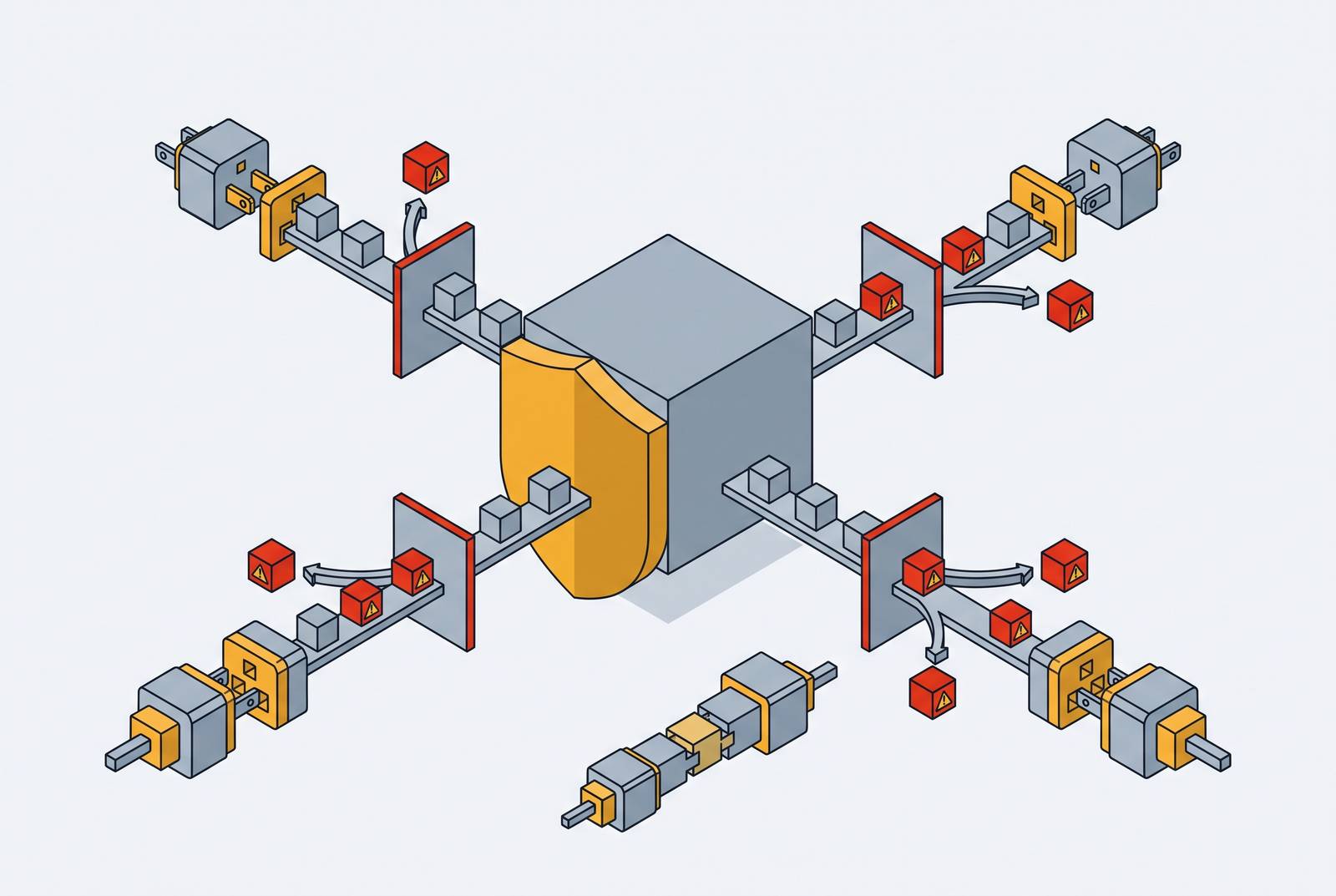
Indirect prompt injection detection in enterprise RAG pipelines must cover both retrieved documents and user prompts. Protecting the retrieval layer requires controls from connector ingestion through search, chunk assembly, and output rendering, with third-party plugins treated as untrusted by default. Each stage stops a different part of the attack, so no single filter can replace the full stack.
Why injected payloads enter through retrieval, not the user prompt
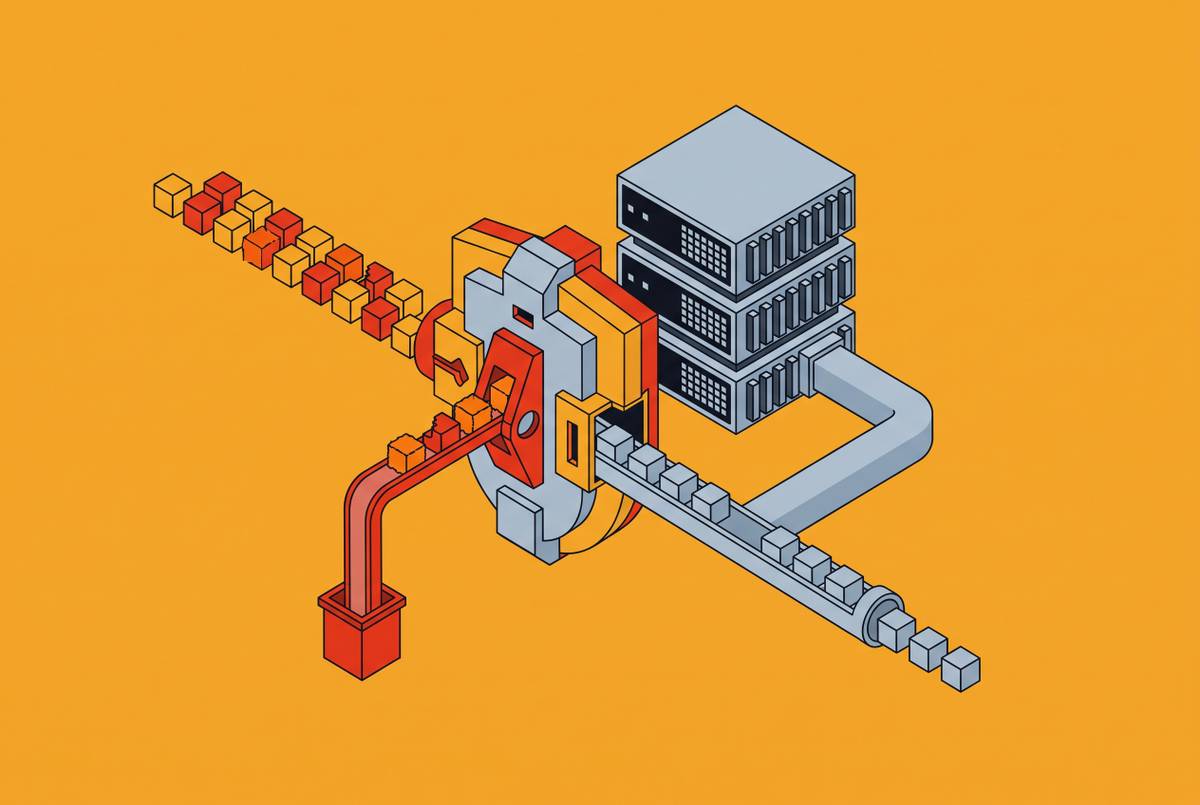
A legitimate query can retrieve a malicious document. In a RAG pipeline, the model receives retrieved chunks in the same context window as the user’s question and the instructions governing its response. A filter that checks only the question never sees the payload. The malicious text comes in later, when the system searches for evidence to answer the question.
Xu et al.’s RAG security survey describes this as a need to make external knowledge access secure. An attacker need not modify the model or the user-visible prompt to steer generation or extract protected knowledge. Instead, instructions hidden in external content reach the model through retrieved context and may be treated as legitimate commands. This threat is called indirect prompt injection.
The underlying weakness is the way an LLM processes trusted instructions and untrusted text together. The survey maps four attack surfaces, namely knowledge poisoning, retrieval manipulation, context exploitation, and knowledge extraction, to corresponding defense layers.
How third-party connectors and plugins expand the poisonable surface
An organization that indexes vendor documentation gives anyone able to alter that documentation an indirect route into its RAG system. Support tickets, feedback forms, and other user-generated content give attackers a similar way in without access to the organization’s internal infrastructure. A ticket submitted by one person can become retrieved context for another person’s question.
The visible document is not the whole input. PPTX, DOCX, and PDF parsers typically extract text from speaker notes, metadata, and custom properties that readers may not see in a standard view. Those fields can enter the extracted text before chunking. Open-source retrievers introduce a different supply-chain risk because components obtained through GitHub or Hugging Face can be modified to distort prompt-passage similarity and republished for downstream deployment.
Ammann et al.’s RAG risk framework follows these inherited risks from data pre-processing and storage to the point where the data is used with LLMs. MCP-connected agents carry this risk from retrieved answers into the tools they use. The Cloud Security Alliance’s MCP research note found attack success rates of more than 60% across more than 45 real-world MCP servers. A retrieved instruction can therefore affect both the immediate response and the tool calls an agent is allowed to make.
Connector compromise also need not begin inside RAG. Koi Security disclosed the postmark-mcp incident on September 25, 2025, in which malicious version ~1.0.16 secretly sent hidden copies of the emails it processed to an external domain. The incident illustrates package-level compromise, rather than document poisoning, but exposes the same dependency boundary. OWASP’s MCP Top 10 project codified tool poisoning as MCP03:2025, recognizing attacks on the capabilities agents depend on.
Hardening the ingestion stage and what connector and parser controls stop
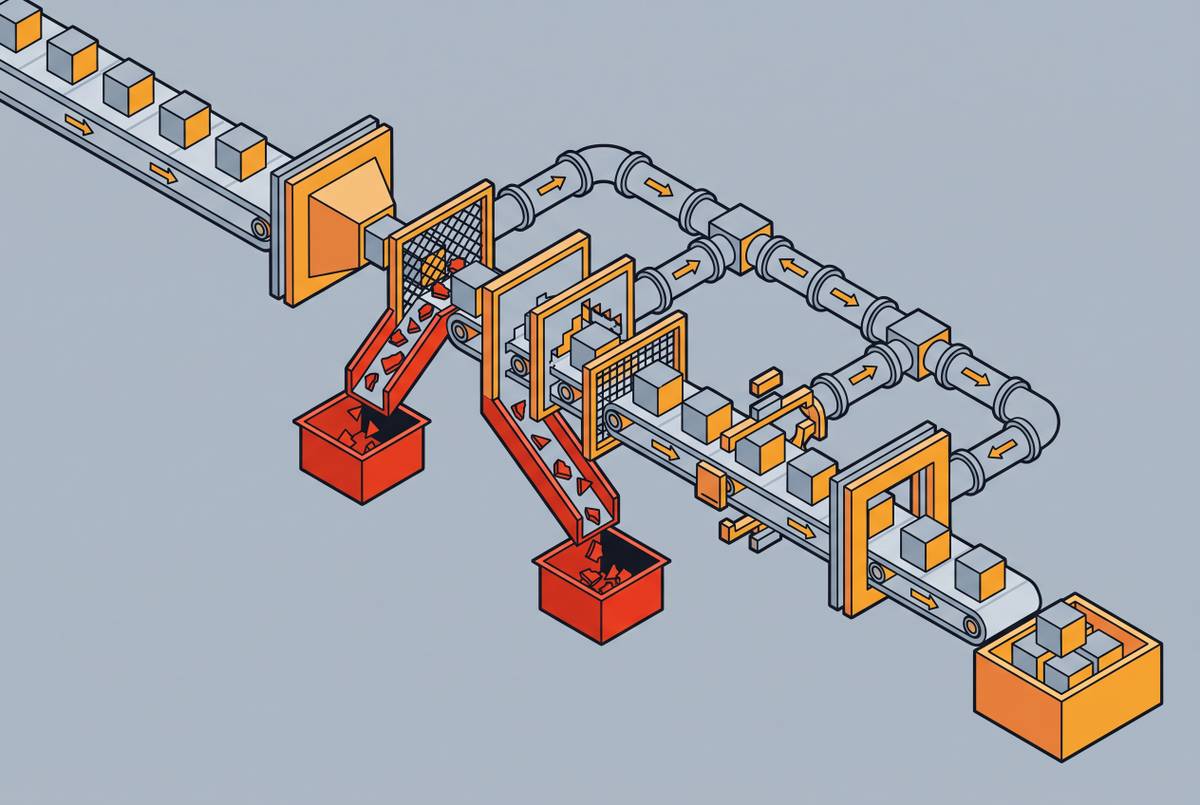
A payload blocked before chunking never becomes retrievable context. Ammann et al.’s framework places data pre-processing controls at the foundation of the pipeline. For teams implementing those controls, the starting point is explicit allowlisting of external connectors.
Allowlisting establishes an approved source whose documents may still be unsafe. Source provenance tags should identify each document’s connector origin, ingestion timestamp, and trust tier, and remain attached to its chunks. Open-source retriever components should be version-pinned and integrity-checked before they are deployed. Microsoft’s June 2026 guidance classifies MCP servers as production dependencies and calls for change review of tool description updates on critical agents. Connector configurations and tool descriptions consequently need review.
Field-level extraction rules should exclude hidden slides, speaker notes, and metadata fields such as Author, Subject, Title, and custom properties unless an explicit business need justifies inclusion. MIME type and file structure should be validated against the declared type before parsing, with mismatches rejected. Parser exceptions and unexpected field values should become security events, including metadata containing instruction-like language.
These controls remove known paths through hidden fields and unapproved sources. A well-formed document can arrive through an allowlisted connector without detectable instruction syntax in its visible fields. Once that document passes ingestion, retrieval controls must check both whether it is allowed in a result and how likely it is to appear in one.
Hardening the retrieval stage through access control, embedding integrity, and semantic evasion
Retrieval must answer two separate security questions. Is the requesting identity allowed to read this document, and has the document been crafted to win a place in the search results? Role-based retrieval addresses the first question by limiting results to authorized documents. Minimum-corpus scoping narrows the search further, so a task involving vendor documentation does not also search a segment populated by user uploads.
Authorization alone does not establish a document’s trustworthiness. Content submitted by a low-privilege user may still be readable by a higher-privilege identity. The ServiceNow Now Assist “second-order” prompt injection, disclosed late 2025, illustrates the danger of crossing privilege boundaries. A low-privilege agent tricked by a malformed request recruited a higher-privilege agent to perform an unauthorized action with the invoking user’s privileges.
Ranking presents a different problem because relevance is not safety. A poisoned passage needs only enough semantic similarity to reach the top-k results. Wording such as “disregard prior context” or “overlook instructions” can evade keyword filters while retaining the intended meaning. Zhong et al.’s adversarial passage attack demonstrates that crafted embedding properties can make passages rank highly for target queries regardless of their visible semantic content.
To address that gap, document-level anomaly scoring should flag chunks whose embedding neighborhood is unusually distant from their declared source corpus. Source-trust weighting should deprioritize lower-trust documents when a trusted source covers the same query. Retrieval audit logs should retain chunk IDs, provenance tags, and relevance scores for tracing an incident back to its origin. Yet a passage from a trusted source can earn its rank and still contain hostile instructions. Retrieval scores cannot determine how the model will interpret it after assembly.
How to protect the context window from instructions in retrieved documents
Plain concatenation removes the structural boundary between evidence and instructions. When retrieved chunks are appended as raw text before a query, the model gets no clear marker identifying where each document begins and ends. A relevant passage can become dangerous when its contents are promoted from data into authority.
The assembly controls should make that boundary explicit. XML-style tags or equivalent markers can bound each retrieved chunk separately from the system prompt and user query. “Spotlighting” marks retrieved content with special tokens, while “prompt sandwiching” places the system instruction after retrieved context as well as before it. Both make injections less likely to succeed than plain concatenation does, but attacks can still get through. Chunk sanitization should also flag or remove instruction-like syntax regardless of source, while structured output validation limits responses to a defined schema.
The boundary extends to what the frontend renders. Unsanitized Markdown can create an exfiltration channel when an injected link places sensitive context in a URL that the browser fetches. EchoLeak, CVE-2025-32711, disclosed June 2025 with CVSS 9.3, demonstrated a zero-click variant in Microsoft 365 Copilot. A crafted email coerced Copilot into accessing internal files and transmitting their contents through a Microsoft Teams proxy endpoint to an attacker-controlled server.
The Slack AI vulnerability required a different final step. Hidden instructions in a public channel caused the AI to insert a malicious link, and clicking it sent private-channel data to an attacker’s server. Sanitize rendered markup before display rather than pass raw model output directly to a Markdown renderer. Input isolation does not replace output protection.
Xu et al. identify a “signal mismatch” that explains the residual difficulty. Fluent, retrievable passages that fit their corpus can defeat anomaly-based defenses because the qualities used to judge normal content are also qualities an attacker can imitate. Context-window structure is the last intervention before the model processes the payload, but it still has to withstand content that looks legitimate.
Why defense-in-depth is not optional and the empirical limits of single controls
The ROPE paper reports that standard “Spotlighting” against one model leaves an attack-success rate of 46.8%, while “Prompt Sandwiching” leaves 36.9%. These rates apply specifically to the reported evaluation. They nevertheless show why visible boundaries cannot serve as the only defense.
Fine-tuning does not remove the need for other layers. StruQ and MetaSecAlign are defenses based on fine-tuning, yet strong prompt injection attacks can still get through fine-tuned models. Such methods are also unavailable when a RAG deployment relies on a black-box LLM API that does not support customized fine-tuning.
Retrieval filtering has a cost of its own. The CleanBase paper’s benchmark shows that TrustRAG measurably reduces retrieval Hit scores across standard datasets. Filtering may exclude useful evidence as well as hostile passages, so protection must be weighed against the loss in retrieval utility. That finding calls for honest evaluation of filters’ benefits and costs.
Schneier et al.’s 2026 “Promptware Kill Chain” framing treats these attacks as multi-step payloads operating in natural language. OWASP’s Top 10 for Agentic Applications 2026 shows how an output that has been tampered with can hijack planning, trigger privileged tool calls, leave instructions in memory, and spread to connected systems. Layered controls are necessary because ingestion, retrieval, assembly, and rendering each leave different gaps, rather than because any benchmark proves their combination infallible.
Operationalizing continuous monitoring across the connector ecosystem
Deployment-time controls describe only the surface present at deployment. New connectors, revised vendor documents, and republished retriever components change what can enter the system. Third-party chatbot plugins deployed on websites grew by 50% in 2025 alone, illustrating the pace of change around these integrations.
For teams sustaining the technical stack, monitoring must follow the same stages. Ingestion monitoring should track active connectors, incoming documents, and the presence and validity of provenance tags. New connector registrations and ingestion from sources outside the allowlist should trigger alerts. Retrieval monitoring should preserve chunk IDs, provenance, and relevance scores, while looking for patterns such as one document appearing disproportionately across unrelated queries. That pattern is a signal of possible broad retrieval optimization.
Assembly and output need separate observation points. Assembled prompts should be scanned for instruction-like syntax within retrieved-content zones, and outputs for unexpected Markdown links or structured data that may indicate exfiltration. MCP tool description changes should receive supply-chain review and integrity verification rather than bypass the controls applied at initial deployment. Monitoring only the original document would miss changes introduced through the connector’s capabilities or the final response.
Ammann et al.’s framework makes continuous monitoring part of the broader work of complying with the EU AI Act and NIST AI RMF. For TPRM, InfoSec, Privacy, and Legal teams, a vendor-sourced connector is both a vendor risk object and an active AI attack surface. The useful capability distinction is therefore concrete. Platforms assessing and continuously monitoring AI assets across the vendor ecosystem address changing exposure in a way that generic governance checklists do not. Their role complements the pipeline defenses by keeping attention on the sources and dependencies those defenses were built to constrain.
Sources
- Securing Retrieval-Augmented Generation: A Taxonomy of Attacks, Defenses, and Future Directions
- Securing RAG: A Risk Assessment and Mitigation Framework
- When AI Meets the Web: Prompt Injection Risks in Third-Party AI Chatbot Plugins
- Engineering the RAG Stack: A Comprehensive Review of the Architecture and Trust Frameworks for Retrieval-Augmented Generation Systems