ISO 42001 AI Management System Requirements
The standard certifies governance systems, not model performance or fairness.
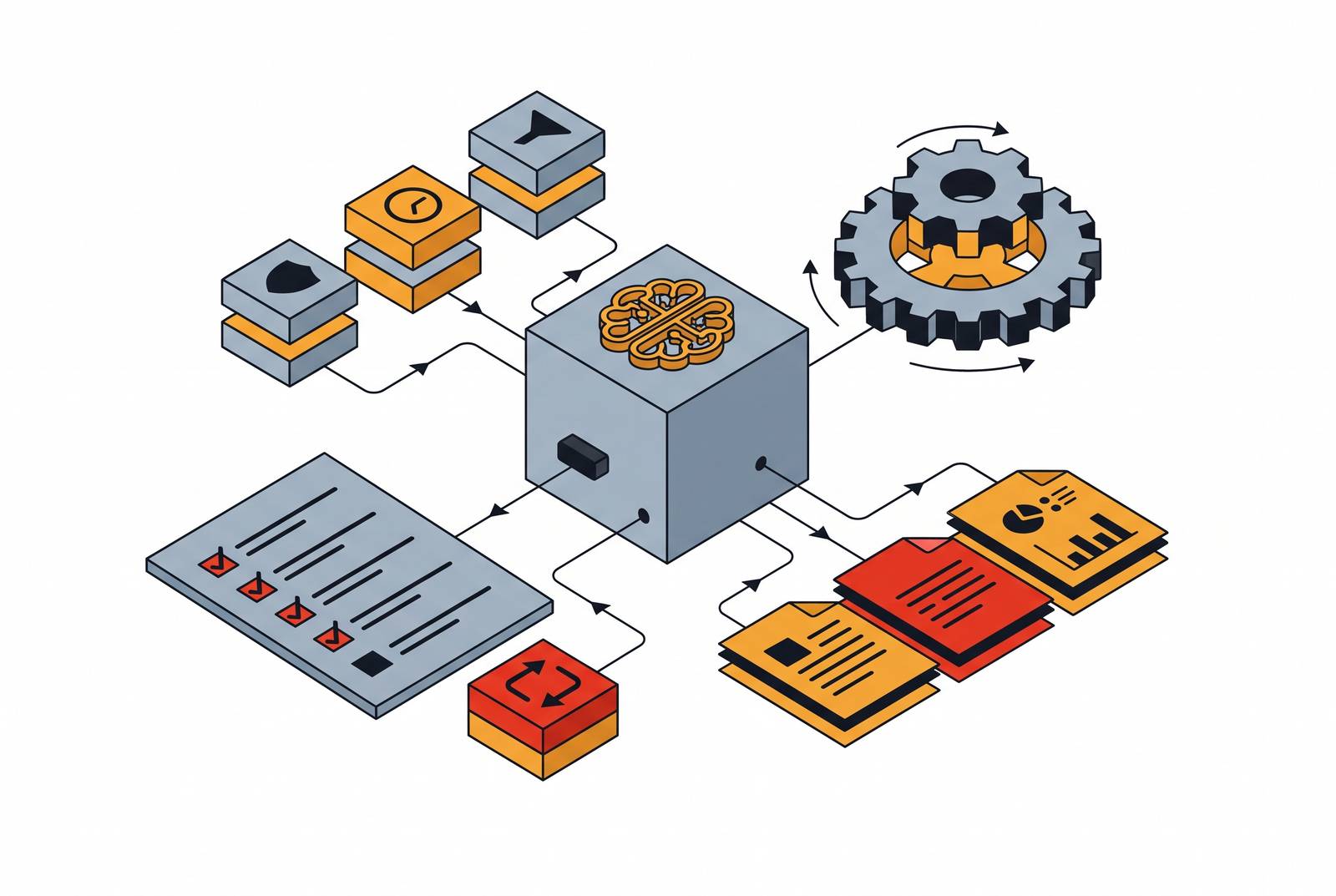
ISO 42001 certifies how an organization governs AI, not how well any individual model performs. That distinction shapes every requirement in the standard, and it is the key to understanding what certification actually delivers. This article walks through what the standard demands in practice, from scope definition through supplier management to the audit cycle.
What ISO 42001 actually governs — and what it does not
An auditor examining an organization against ISO 42001 is not checking whether a model is accurate, fair, or unbiased. The auditor is checking whether the organization operates a documented, functioning governance apparatus. The standard's full title makes this plain: "Information technology — Artificial intelligence — Management system," published as a joint ISO/IEC standard on 18 December 2023. What gets certified is that the organization has a deliberate, documented, and continually improving system for governing AI. That system covers policy, roles, risk and impact assessment, lifecycle controls, supplier management, monitoring, and corrective action. It does not cover benchmark accuracy, fairness sign-off, or any architectural mandate: the standard is technology-neutral.
The standard applies to any organization that develops, provides, or uses AI systems. A model vendor qualifies. So does a SaaS company embedding a third-party LLM, a bank running an internal credit model, or a hospital using a diagnostic tool. Size, sector, and geography do not matter. What matters is whether AI sits inside a governance boundary that someone manages deliberately.
ISO 42001 is built on the Harmonized Structure, formerly the High-Level Structure defined in Annex SL. That is the same scaffold used by ISO 27001 and ISO 9001, which means the certifiable requirements live in clauses 4 through 10. Clauses 1 through 3 cover scope, normative references, and terminology. The shared structure is practically significant: organizations already certified to ISO 27001 can reuse their management-system scaffolding and typically compress readiness timelines substantially.
Clause 4: defining the scope of what the AIMS actually covers
Scope definition is the foundational act of ISO 42001 implementation. One written as a copy of an existing information-security scope fails as an AI-specific document. Clause 4 requires the organization to understand its internal and external context, identify interested parties and their requirements, determine the scope of the AIMS, and establish the AIMS itself.
"Interested parties" reaches beyond customers. It includes regulators, employees affected by AI decisions, and the people whose data feeds the systems. The AIMS covers the AI systems the organization chooses to bring inside its boundary, not every algorithm it has ever written. The scope statement must be explicit and signed.
The common gap is telling. Organizations default to copying their ISMS scope rather than writing an AI-specific document that names the actual AI systems, use cases, and affected populations in scope. An auditor will notice the difference immediately, because a copied scope answers the wrong question.
Clause 5: what leadership accountability for AI actually looks like
Clause 5 makes top management personally accountable for the AI policy, role assignments, and resource commitments. Responsible AI governance cannot be delegated entirely to an engineering or compliance team. Top management must establish an AI policy consistent with the organization's strategic direction, assign organizational roles with documented authority levels, and commit adequate resources.
The AI system owner named under this clause must have the authority to halt a system. An auditor will check that the role description carries that authority, not just that someone holds the title. The auditor expects evidence: minutes of an executive decision or a board resolution for organizations using AI in high-risk contexts, plus role descriptions with explicit authority levels. The practical failure mode is assigning AI governance to a working group with no decision-making power and no budget line. The management review process in Clause 9 will surface it as a nonconformity, because a group that cannot stop a system and cannot fund a remediation is not accountable for anything.
Clause 6: AI risk assessment, objectives, and the impact assessment process
Clause 6 introduces the requirement that sets ISO 42001 apart from an information-security standard: the AI system impact assessment. It requires evaluating consequences to individuals, groups, and society, not just risk to the organization. The risk assessment must cover both technical AI risks and societal risks. Technical risks mean model accuracy, robustness, and security. Societal risks mean bias, discrimination, privacy, and environmental impact.
Clause 6.1.4 specifically requires organizations to establish a process for assessing the consequences an AI system can have on individuals, groups, and society. Whose applications get ranked, whose claims get scored, whose content gets moderated. Those are the questions an impact assessment forces an organization to ask before deployment.
AI objectives defined under Clause 6 must have targets, responsible owners, and measurement methods. That is an objectives register, not a statement of intent. The organization chooses the methodology and defends it to the auditor.
Clause 7: competence, awareness, and documented information for AI systems
Clause 7 creates an ongoing obligation for AI workforce development. The standard requires organizations to determine the competence needed for personnel whose work affects AI system performance and to take actions to acquire it. The AI skills landscape is evolving faster than certification programs can fill, so this is not a one-time training exercise.
The clause covers resources, competence, awareness, communication, and documented information. That is the operational infrastructure without which the policies in Clauses 4 through 6 remain aspirational. The auditor will ask for evidence of training, qualifications, or demonstrated capability for roles touching AI development, deployment, and governance.
Documented information cuts both ways. It covers the records that demonstrate the AIMS is operating: audit trails, review minutes, impact assessment outputs. For third-party datasets, licensing and terms records must be retained.
Clause 8: operating the AI lifecycle in production
Clause 8 requires organizations to execute the risk treatments and impact assessments they planned in Clause 6, and to manage AI systems across their full lifecycle in production. That means design, development, testing, and retirement, not just the point of deployment. Annex A's 38 controls are grouped into nine areas, and the AI system lifecycle category carries the heaviest load, covering controls across all those stages.
The lifecycle requirement means controls must address what happens when a model changes, when its use case expands, or when it is retired. It is not only about initial release. Keeping AIMS documentation current as models change and architectures shift is an ongoing operational burden, not a one-time project.
The answer lies in Clause 10. The continual improvement mechanism is designed for exactly this. Deploying a vendor's AI makes the deploying organization accountable for how it affects users.
Annex A supplier controls and why vendor AI creates its own accountability layer
ISO 42001's supplier management controls reflect a structural reality: an organization that embeds a vendor's AI into its product or decision-making is accountable for the outcomes of that AI, regardless of where the model was built or trained. Annex A groups its 38 controls into nine areas, A.2 through A.10, including explicit coverage of third-party AI assets. That means model APIs, embedded components, and data pipelines sourced externally.
The AIMS must maintain an inventory of AI systems with named owners. Supplier controls require assessing the governance practices of AI vendors, not just their security posture. Prompt injection, data exfiltration, and model drift introduce AI-specific attack surfaces that generic vendor risk questionnaires do not surface.
The practical gap most organizations face is that traditional third-party risk management processes were built for software and cloud infrastructure. Continuous monitoring of vendor AI assets after initial assessment is an operational necessity under Clause 8 and Annex A. Dedicated AI risk intelligence platforms exist for exactly this gap, and they become the operational tool that makes the supplier control requirement achievable at scale.
Clauses 9 and 10: performance evaluation, internal audit, and continual improvement
Clauses 9 and 10 are where a paper AIMS is exposed as such. They require the organization to generate genuine operating evidence: monitoring data, audit findings, management review minutes, and records of corrective action. Clause 10 requires handling nonconformities with corrective action and demonstrating continual improvement.
Certification is valid for three years with annual surveillance audits. Those surveillance audits specifically look for evidence that the system has been operating, improving, and responding to changes. They are not checking that the documents from the Stage 2 audit still exist unchanged. It says ISO 42001 certifies processes, not outcomes, and a paper system can pass audit and fail reality.
The annual surveillance structure and the internal audit requirement are specifically designed to surface dormant systems. ISO/IEC 42006:2025, published July 7, 2025, governs how certification bodies audit and certify ISO 42001 systems, adding a layer of quality control over the certifiers. That makes the review a governance event, not a reporting ceremony.
How ISO 42001 relates to ISO 27001, the EU AI Act, and EN 18286:2026
ISO 42001 provides the most deployable organizational AIMS framework available globally, but it does not carry legal presumption of conformity under the EU AI Act. EN 18286:2026, published July 12, 2026 as the first European standard developed in support of the Act, fills a structurally different role that ISO 42001 cannot substitute for. ISO 27001 and ISO 42001 share the Harmonized Structure, making integration natural. ISO/IEC 42001:2023 has not gone through that process and carries no such legal status under the Act.
EN 18286:2026, approved by CEN-CENELEC on July 12, 2026, addresses per-system quality management obligations that are structurally different from ISO 42001's organizational AIMS. EN 18286:2026 explicitly provides annexes mapping to ISO 9001 and to ISO/IEC 42001, meaning organizations can reuse their existing AIMS work as a foundation layer. As of the sources available, EN 18286:2026 itself still awaited the Official Journal citation required to activate the presumption-of-conformity mechanism.
The pragmatic architecture for 2026 runs three layers: ISO/IEC 42001 as the organizational AIMS, EN 18286 as the per-system quality management system for EU high-risk AI, and technical control overlays for specific risk domains. ISO 42001 is also well-positioned relative to the NIST AI Risk Management Framework, which is referenced in U.S. federal acquisitions but carries no certification mechanism. ISO 42001 provides the auditable, certifiable equivalent that procurement can rely on.
What certification actually requires in practice: timeline, audit structure, and scope decisions
The realistic path to ISO 42001 certification depends more on scope discipline and accumulated operating evidence than on documentation volume. Certification follows a Stage 1 audit for documentation readiness and a Stage 2 audit for operational effectiveness. It is valid for three years and requires annual surveillance audits.
ISO does not certify organizations directly. Certification is carried out by accredited third-party certification bodies: ANAB in the U.S., UKAS in the U.K., DAkkS in Germany. ISO/IEC 42006:2025 governs how bodies audit and certify ISO 42001 systems and is moving into accreditation programs during 2026 as demand grows.
The scope decision is the one that determines whether certification is achievable. The AIMS covers the AI systems the organization brings inside its boundary. Named organizations establish what the certified population looks like in practice. Amazon Web Services was the first major cloud service provider to achieve ISO 42001 accredited certification, announced November 25, 2024, covering Amazon Bedrock, Amazon Q Business, Amazon Textract, and Amazon Transcribe, certified by Schellman Compliance LLC. Anthropic announced certification on January 13, 2025. Microsoft holds certification covering GitHub Copilot, Microsoft 365 Copilot, Microsoft Copilot Studio, Microsoft Security Copilot, Microsoft Foundry, Microsoft Dragon Copilot, Microsoft Dragon Copilot (Radiologists), and Microsoft Copilot Health. KPMG International was the first of the Big Four's international entities to receive ISO 42001, announced December 2025, certified by Schellman. Boston Consulting Group achieved certification in January 2026. CrowdStrike certified its Falcon platform, including CrowdStrike Endpoint Security, Falcon Insight XDR, and Charlotte AI, on January 22, 2026. ServiceNow announced ISO/IEC 42001:2023 certification covering its AI agents, tools, and utilities, with statement of applicability dated August 22, 2025.
Procurement pressure is a primary driver. Security questionnaires now carry AI-specific sections, and an accredited certificate answers them once in a form procurement already trusts, rather than requiring a bespoke response per deal. If buyers are not asking, if the organization's AI surface is a single vendor API behind human review, or if the same budget would produce more risk reduction invested in making the AIMS operational rather than audited. In those cases, the foundations still matter: an AI system inventory, an impact assessment process, documented human oversight, supplier mapping. Pursue certification when a deal actually demands it.