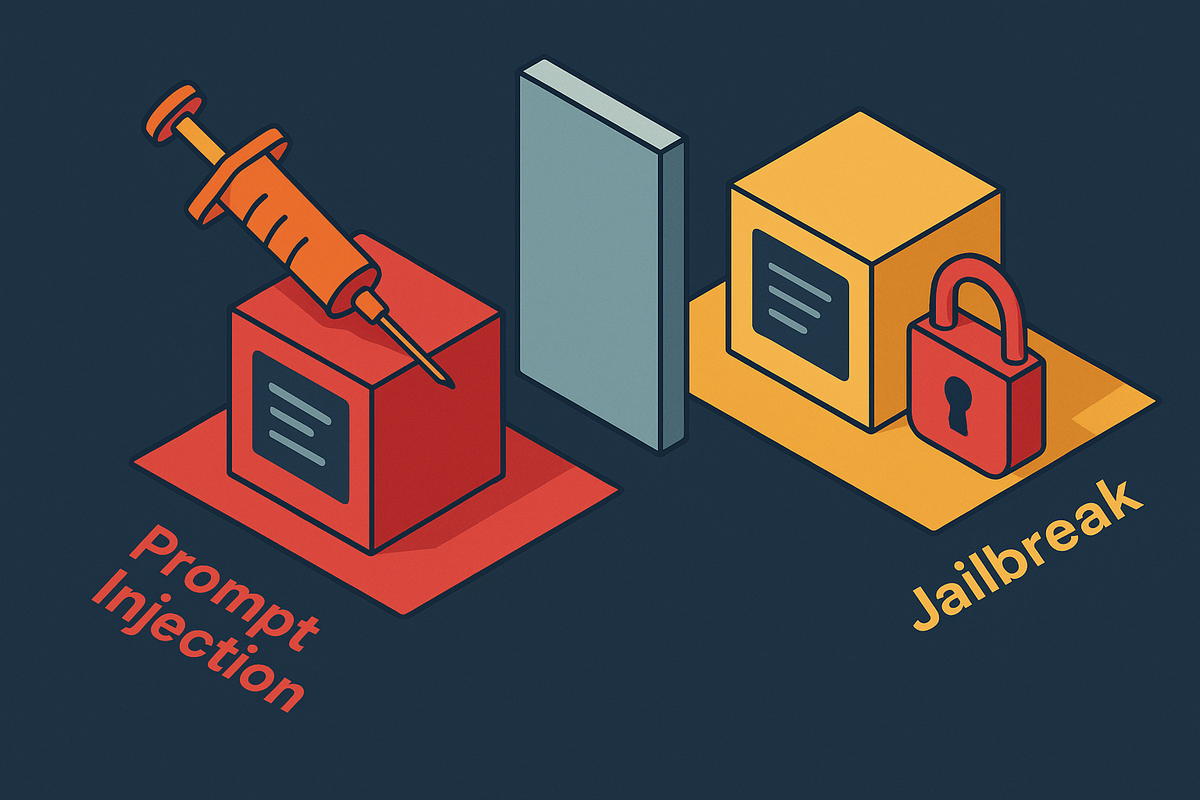
Prompt Injection Detection Methods
Effective defenses stack multiple layers since no single method catches all injection attacks.

Prompt injection has no single fix. Classifiers catch some attacks, semantic analysis catches others, architectural redesign closes off a slice of the problem, and runtime monitoring picks up whatever slips past the rest. Anyone betting on one method instead of stacking all four is leaving a door open somewhere, and that's the position worth stating up front rather than hedging toward.
Why is there no shortcut here? A large language model reads instructions and data through the same channel: plain text. There's no separate wire for "commands from the developer" and "content the user pasted in." The model just sees tokens, and it has to guess which ones it should obey. That guess is exactly where an attacker steps in.
OWASP put prompt injection at the top of its LLM application risk list for 2025 (LLM01:2025), and attack success rates in testing run anywhere from 50% to 84% depending on how the system is set up and how many tries an attacker gets. OpenAI's own security write-up for ChatGPT Atlas, published December 22, 2025, said the quiet part out loud: prompt injection in AI browsers is "unlikely to ever be fully 'solved.'" That's a company with some of the best security researchers in the field admitting there's a ceiling on this problem. Frontier models remain exploitable under real-world conditions even when defenses are applied. So the real question isn't which method wins. It's which combination narrows the gap enough to actually ship something.
The sections below walk through the major detection families: what each one catches, and where each one runs out of road.
How direct and indirect injection differ, and why indirect is the harder detection target
Direct injection is the easy case to picture. The attacker types the malicious instruction straight into the prompt, or controls whatever input feeds the model. MITRE's ATLAS framework tracks this as AML.T0051.000; NIST calls it out as attack NISTAML.018. If someone can see the input box, they can attack the input box.
Indirect injection should worry you more, and it's the harder of the two to catch for a simple reason: the attacker never touches the model at all. Instead they plant instructions somewhere the model will read later, on someone else's behalf: a retrieved document, a tool's output, an email sitting in an inbox, a row in a database. MITRE tags this AML.T0051.001; NIST's matching entry is NISTAML.015. The legitimate user becomes the trigger without ever knowing it happened.
EchoLeak, disclosed by Aim Security's research division in mid-2025, shows how far this can go. An attacker sent a crafted email to a Microsoft 365 Copilot user. The user never opened it. Copilot's retrieval system pulled the email in anyway when the user later ran an unrelated query, the hidden instructions fired, and data leaked out. Zero clicks. No visible action from the user at all. That breaks the usual advice to "not click suspicious links," because there was nothing to click.
RAG systems raise the stakes further. Research presented at USENIX Security 2025 on an attack called PoisonedRAG found that five carefully crafted documents, hidden among millions in a retrieval corpus, push attack success rates to 90%. These documents don't look malicious to a human reader. They're built to succeed at the embedding level, where similarity search operates, so spot-checking a sample of the corpus tells you nothing.
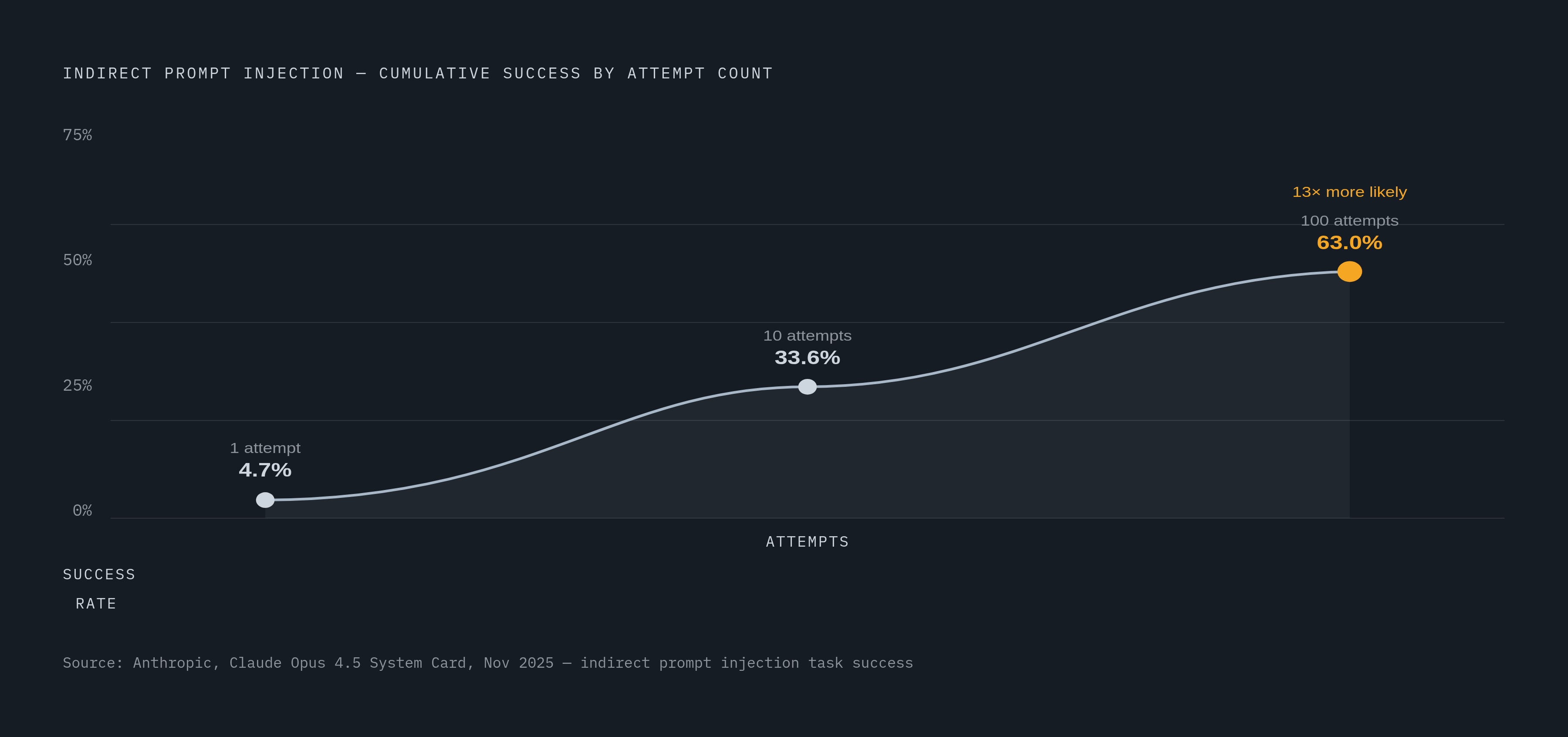
Agentic systems make it worse still. Anthropic's system card for Claude Opus 4.5, published November 2025, reported indirect injection success in agentic coding environments at 4.7% on a single attempt, climbing to 33.6% at 10 attempts and 63.0% at 100. Persistence pays off for the attacker here: an agent that retries, browses, and calls tools hands an adversary a hundred small chances instead of one.
Input-gate classifiers, however good, only watch the front door. Indirect injection walks in through the RAG pipeline, the tool output, the API response: places a front-door classifier never looks. Covering that gap means running layers downstream of the initial prompt, not just at it.
Prompting-based detection: the lightest-weight approach and its ceiling
The simplest defense uses another LLM as a judge. Known-answer detection asks the checking model to output a secret key buried in its instructions; if the key doesn't come back correctly, something interfered with the model's instruction-following, and that gets flagged. Spotlighting wraps untrusted content in delimiters and asks the model to flag anything inside that section that reads like an instruction rather than data.
Both of these, spotlighting and known-answer detection, count as baseline tools now: a quick first pass, not something to lean on by itself.
The core problem is almost circular. The detection model is itself an LLM, and LLMs are the thing vulnerable to injection in the first place. If an attacker builds a payload clever enough to fool the primary model, there's a real chance it fools the checker too, since both run on the same architecture with the same blind spot between instructions and data.
Straightforward, direct attempts get caught reasonably well this way. Obfuscated or reworded payloads are a different story. Accuracy drops fast once an attacker starts encoding the text, splitting it up, or rephrasing the malicious instruction so it no longer pattern-matches. Prompting-based detection earns its keep as a cheap, fast pre-filter, no training data needed, that catches the obvious stuff before it reaches slower, heavier defenses further down the stack.
Fine-tuned classifiers: what they catch well and where they accumulate blind spots
Fine-tuned classifiers take a different approach: train a smaller, dedicated model on labeled examples of injection attempts versus benign text, and let it output a fast binary judgment. One forward pass, no extra LLM call needed.
A handful of named systems anchor this space. Meta's PromptGuard is a multilabel classifier built on mDeBERTa-v3-base (86 million parameters plus 192 million word-embedding parameters), targeting both direct jailbreaks and indirect injections. ProtectAI released two open-source versions, v1 in November 2023 and v2 in April 2024, both fine-tuned from DeBERTa-v3-base at 184 million parameters. Microsoft presented PromptShield at the ACM Conference on Data and Application Security and Privacy in 2024.
Newer entries try to patch specific weaknesses. InjecGuard trains with a method its authors call "Mitigating Over-defense for Free," adding benign samples that contain injection-adjacent language, which cuts down the false positives that plague a lot of conventional detectors (the ones that flag a perfectly normal customer email because it happens to contain the word "ignore"). DataSentinel, presented at the 2025 IEEE Symposium on Security and Privacy, frames the whole thing as a minimax game, fine-tuning a detector specifically against injections adapted to dodge it, which starts to address adaptive attackers instead of just static ones.
Speed is the real selling point. PIShield's benchmarks clock comparable lightweight classifiers at around 0.033 seconds per sample, fast enough to sit inline in a production request path without users noticing any lag.
But classifiers accumulate blind spots the way any pattern-matching system does, and this is where most teams overestimate what a classifier alone buys them. They train on a fixed dataset, so anything invented after that dataset was collected sails through untouched. Performance also drops as context length grows: a classifier tuned on short prompts doesn't generalize cleanly to a very long document with an injection buried on page seven.
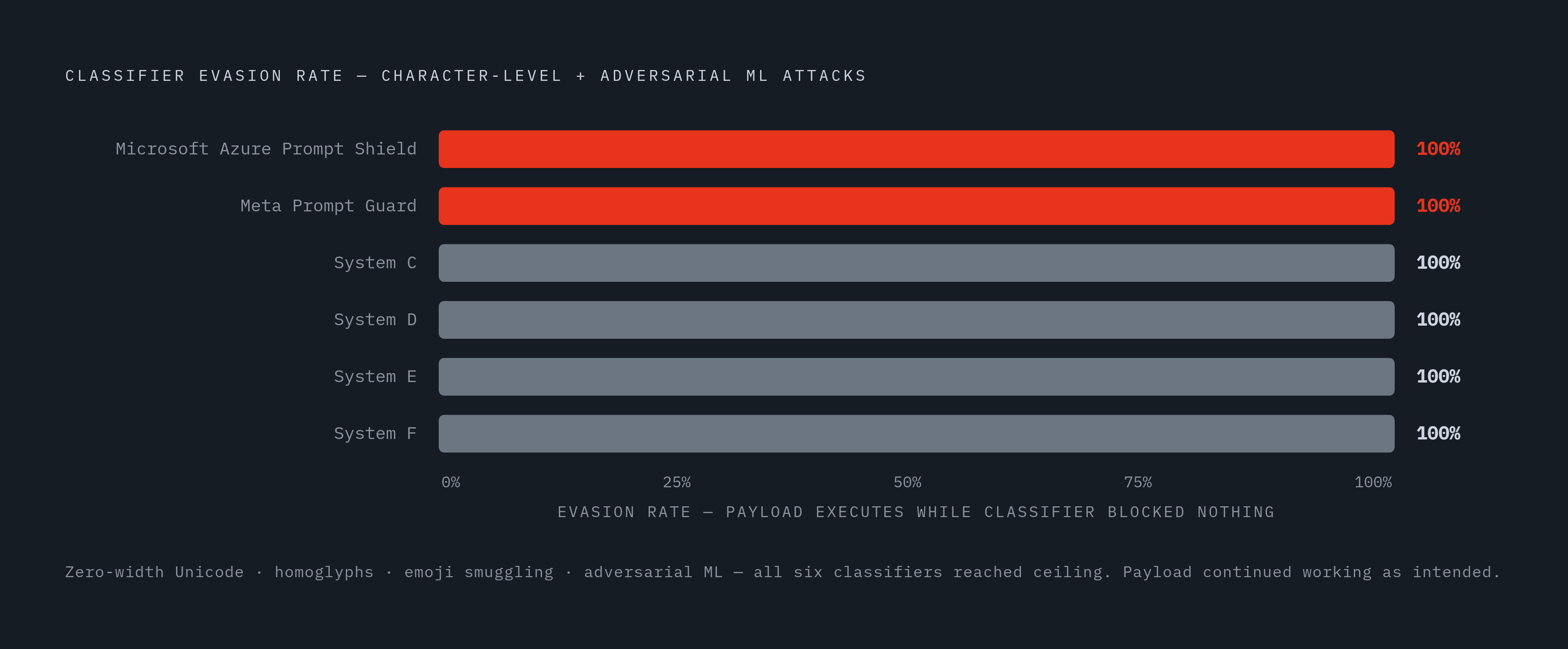
Evasion research backs this up hard. Testing against six well-known systems, including Microsoft Azure Prompt Shield and Meta's Prompt Guard, found that character-level tricks, zero-width Unicode characters, homoglyphs that look identical to normal letters, emoji smuggling, combined with adversarial machine learning techniques, hit evasion rates up to 100%, while the injected payload kept working exactly as intended. A separate April 2026 benchmark from Pennsylvania State University, called PIArena, confirms the pattern beyond that one study: defenses that score well against the benchmark they were tuned on often don't transfer to a different one, and attacks that adapt based on a defense's own feedback loop bypass a lot of classifiers that looked solid in isolation.
Classifiers are a necessary layer: fast, cheap, and they catch a wide swath of known attack patterns. But evasion here isn't some rare edge case. It's a documented, repeatable production reality. Anyone shipping a classifier as the whole solution is shipping something that's already been beaten in published research.
Activation and representation-based detection: reading the model's internals instead of its text
A different family of methods skips the text entirely and looks at what's happening inside the model while it processes a prompt. Instruction-tuned LLMs seem to encode a distinguishable internal signal when they're processing an injected instruction, and that signal shows up in attention patterns and the residual stream, before the model ever generates a single output token.
AttentionTracker, presented at NAACL 2025 by Hung, Ko, Rawat, Chung, Hsu, and Chen, builds on what the researchers call the "distraction effect." Certain attention heads, the ones they label "important heads," visibly shift focus away from the original instruction and onto the injected one whenever an attack is present. Catching this needs zero labeled injection data and zero extra LLM calls. The method improved AUROC scores by up to 10.0% over every existing detector tested, and up to 31.3% on average against other training-free approaches specifically.
PIShield, published by Zou and colleagues in October 2025, works off the model's internal representations without expensive fine-tuning or needing to generate a full response first. It reported consistently low false positive and false negative rates, beating existing baselines by a wide margin, and ran at roughly the same 0.033 seconds per sample as the fastest text classifiers, despite reading the model's internal state instead of surface text.
A separate analysis at IEEE SaTML 2025 found that classifying the delta in internal activations, rather than the text itself, hit near-perfect ROC AUC scores.
Sit with the advantage here for a second. All that Unicode obfuscation and homoglyph trickery that beats a text classifier? None of it touches the attention distraction signal, because that signal reacts to what the injection does to the model's reasoning, not how the injection is spelled. Change the surface form as many times as you like; the internal effect doesn't move.
The catch is access. These methods need visibility into the model's internals: attention weights, residual streams, activation deltas. That's fine for an open-weight model or anything self-hosted. It's a non-starter for a black-box API deployment where the only thing coming back is a finished completion, unless the vendor builds in some kind of instrumentation layer specifically to expose that data.
Semantic intent analysis: detecting injections by what they try to do, not how they look
PromptSleuth, from Wang, Zhang, and Gu in August 2025, starts from a simple observation: attackers can dress an injection up in a hundred surface forms, but the underlying goal, sneaking in a task the original instruction never authorized, stays constant across nearly all of them.
The method decomposes a prompt into a task graph. It separates "parent" tasks, the ones coming from trusted instructions, from "child" tasks, the ones derived from retrieved or handed-off context. A designated LLM then checks the relationship between parent and child tasks and flags anything where the child task looks unrelated to, or anomalous against, what the parent task actually asked for. Tested across several state-of-the-art benchmarks, it consistently beat existing defenses while keeping runtime and cost in the same range.
Why does this hold up better than keyword matching? An attacker can rewrite, encode, or paraphrase the surface tokens of an injection as many times as they want. What's much harder to disguise is the fact that the injected task diverges from what the user actually asked for. Intent leaves a trace even when the wording doesn't.
But there's a hard case semantic analysis runs straight into, and PIArena's April 2026 findings name it directly. What happens when the injected task lines up with the target task? Picture a disinformation scenario where the attacker's desired output looks, on its face, like a completely valid completion of the original request. Most existing defenses lose their footing there, because there's no divergence left to detect — and PIArena's findings suggest intent-based approaches are no exception. PIArena calls this alignment problem one of the fundamental reasons a lot of current defenses fall short.
So semantic intent analysis earns a real spot in the stack, especially for catching task-divergent injections that fool simpler pattern matchers. It just wasn't built to catch the case where the attacker's goal and the legitimate goal look identical from the outside, and no amount of tuning fixes that gap.
Architectural controls that remove the attack surface rather than detect it
Everything above tries to spot an injection after it's already sitting in the model's context. A different approach asks whether the instruction and data boundary can be enforced structurally, before detection even needs to happen. This is the layer worth building toward if the deployment allows it, and it's also the layer most teams can't reach.
StruQ, published at USENIX Security 2025, builds a secure front end that physically separates prompts from data into two distinct channels. The model is then trained to treat only the prompt channel as a source of instructions; the data channel is read-only context, full stop, no matter what text shows up inside it.
SecAlign, from Chen and colleagues, takes a preference-optimization angle instead. Given an input that's been prompt-injected, the model gets fine-tuned to prefer generating the response the trusted instruction actually asked for, over whatever the injected instruction was angling for. This is, as far as published research goes, a method that pushed injection success rates to notably low levels, and it holds up even against attacks more sophisticated than what the model saw during training.
The honest limitation: both of these need retraining or fine-tuning the underlying model. Fine if a team is self-hosting an open-weight model. Off the table entirely for a closed-source API deployment, unless the vendor builds the same protection in on their own end. PIArena's testing found that closed-source models, including GPT-5, Claude Sonnet 4.5, and Gemini-3-Pro, still show high attack success rates under injection. So the architectural fix that works best is exactly the one most teams building on top of a vendor API can't touch.
Where architectural controls earn their place is upstream of everything else. When available, they shrink the raw volume of injections that ever reach a classifier or a runtime monitor, which improves the signal-to-noise ratio for every layer sitting behind them.
Runtime and continuous monitoring as the layer that catches what input gates miss
What happens when the malicious content never passes through an input gate at all? A RAG-retrieved document, a tool's API response, an MCP server's output: none of these show up at the "user types into a box" moment an input classifier is watching. By the time that content lands in the model's context, the input layer has already done its job and moved on. The injection was never in its field of view to begin with.
That's the gap runtime monitoring exists to close, and it does three concrete things. It flags behavioral anomalies, catching a model's output or a tool call the moment it drifts from what the original task scope should look like. It keeps structured logs of every action an agent takes, so if an injection does succeed, there's a traceable record of exactly what path it took through the system. And it enforces policy: limits on which external sources an agent can read, and which actions it can take, so a successful injection still lands with a small blast radius instead of a wide-open one.
This isn't theoretical. Johann Rehberger's "Month of AI Bugs" campaign, run in August 2025, disclosed more than 20 separate vulnerability reports across major agentic AI tools, including Cursor and Devin AI. The pattern kept repeating: prompt injection paired with a tool that auto-invokes and touches sensitive data. That's precisely the combination runtime monitoring is positioned to catch, since it watches behavior and tool calls instead of just the initial prompt.
CVE records from 2025 into 2026 back this up with hard severity scores: a critical vulnerability in Microsoft Copilot rated CVSS 9.3, one in GitHub Copilot at 9.6, one in Cursor IDE hitting 9.8. Those numbers describe injections that reached production systems and caused real damage, not hypothetical scenarios sitting in a research paper.
One gap is worth naming plainly. An enterprise running vendor AI products, Copilot, coding assistants, various agent platforms, generally can't get anywhere near those models' internals. Activation-based detection and fine-tuning-based architectural controls both need access nobody outside the vendor has. What's left, for a team in that spot, is continuous behavioral monitoring: watching what these systems do, what data they reach for, and building the logging and policy layer on top, because that's the one detective control still on the table once the model itself is a black box.
Sources
- PIArena: A Platform for Prompt Injection Evaluation
- DataSentinel: A Game-Theoretic Detection of Prompt Injection Attacks
- Bypassing LLM Guardrails: An Empirical Analysis of Evasion Attacks against Prompt Injection and Jailbreak Detection Systems
- LLM01:2025 Prompt Injection
- PromptSleuth: Detecting Prompt Injection via Semantic Intent Invariance
- Defenses Against Prompt Attacks Learn Surface Heuristics
- arxiv.org
- aclanthology.org