Vendor AI Risk in Regulated Industries
Opaque AI features hidden in vendor products create untracked compliance risk for regulated firms.

Vendor risk in regulated industries used to mean checking whether a piece of software did what it claimed, safely and predictably. AI breaks that model. It brings decision logic that's opaque even to the vendor, that updates without notice, and that behaves differently month to month without anyone signing off on a change. Regulated industries inherit all of that uncertainty, then stack their own obligations on top: patient safety, credit fairness, breach notification law. Treating this as a paperwork problem instead of a monitoring problem is the mistake that keeps repeating, and it's the wrong call every time.
Start with the shape of the problem before getting into the sector-specific weight of it. A vendor sells an organization a document platform, a CRM, a help desk tool, a meeting recorder, and all of it gets approved and vetted. Then the vendor flips on an AI assistant inside that same product, under updated terms nobody in procurement re-reviewed. The tool went through review, but the AI feature bolted onto it afterward did not. That gap repeats across enterprise software stacks constantly. Vetting a vendor and vetting that vendor's AI turn out to be two separate jobs with two separate answers, and most organizations have only done the first one.
It gets worse one layer down. That AI assistant often isn't even running on the vendor's own model. It's calling out to a model provider the buying organization never contracted with, never vetted, and in many cases never knows exists. A fourth party shows up inside a second-party relationship, and this happens routinely, not as some rare misconfiguration. It's built into how AI features get bolted onto existing software.
Then there's drift. A model that passed every check at signing can behave differently six months later, because it got retrained, updated, or fed a different slice of data than it saw during evaluation. None of that triggers a new contract, and none of it shows up on a renewal calendar. Industry guidance issued in 2025 makes plain that the traditional vendor risk model, built for static software doing defined things, has fallen behind. Hallucination risk, drift, and multi-layered supply chains need their own kind of scrutiny, separate from the checklist built for conventional software.
How broadly the blind spot already runs across enterprises
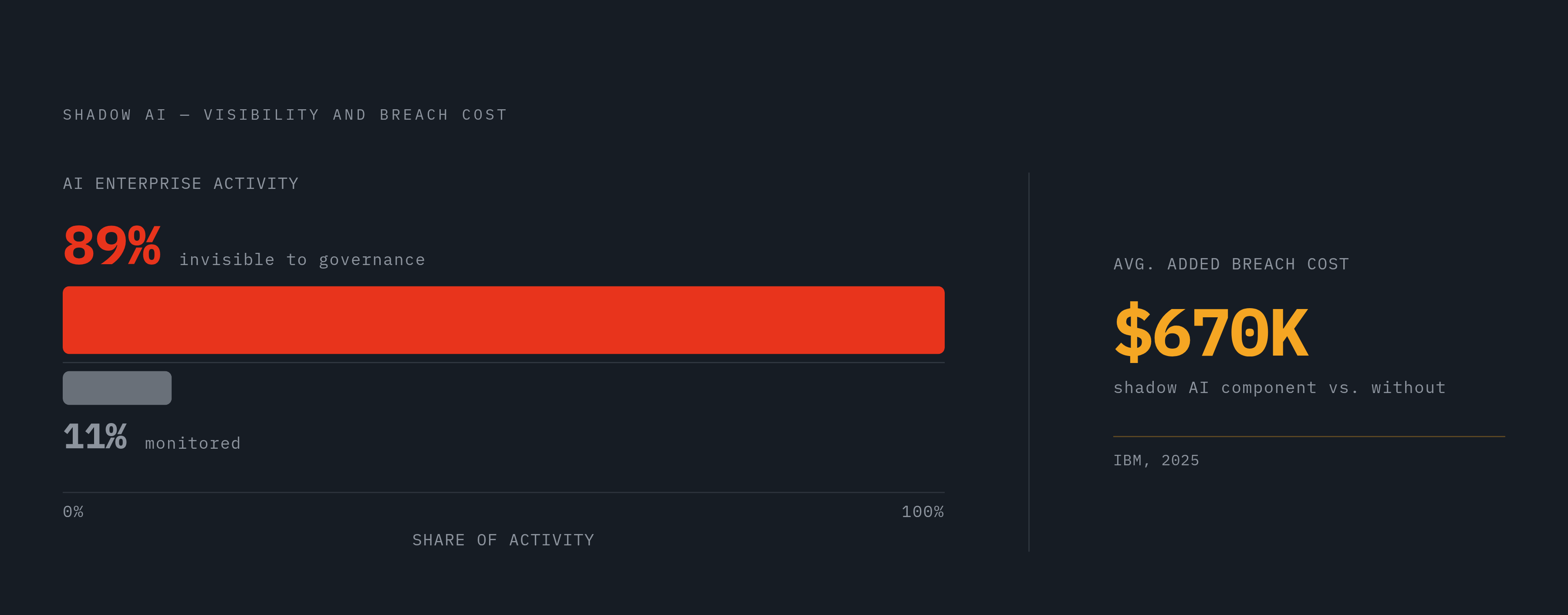
Start with what organizations can't see in the first place. 2025 industry research put the share of invisible enterprise AI usage at 89%, meaning nearly all AI activity inside a typical company happens outside whatever oversight exists. The average AI governance program audits the 11% it can see and calls that coverage.
What does invisibility cost? IBM's 2025 research tied shadow AI to roughly $670,000 in added breach cost, on average, compared to breaches without a shadow AI component. Verizon's 2025 Data Breach Investigations Report found third-party involvement in breaches doubled year-over-year to 30%.
So how's governance keeping up? Only 35% of organizations have an established AI governance framework, and just 8% of leaders say they feel equipped to manage AI-related risk. The IAPP's AI Governance Profession Report found 77% of organizations actively building programs, yet only 1.5% satisfied with their governance headcount. The numbers point to a staffing crisis dressed up as a program gap.
Put those numbers side by side. If most enterprise AI activity is invisible, and governance capacity is this thin almost everywhere, every sector-specific obligation, HIPAA, model risk guidance, the EU AI Act, lands on a foundation that was cracked before the sector-specific rule ever showed up.
Why healthcare's patient-data obligations turn vendor AI gaps into patient-harm events
Healthcare's exposure starts with where the data actually lives now. Roughly 80% of stolen patient records trace back to third-party vendors rather than hospitals directly. The perimeter healthcare organizations think they're defending has, for practical purposes, moved outside their own walls.
Why does that keep happening? Procurement isn't catching it, and that failure starts the chain reaction. Around 40% of AI contracts in healthcare get signed without any security assessment attached, and that gap is what produces the breach numbers above it. A January 2025 breach affected 10.5 million patients, a scale that turns the abstract statistic into the kind of event that lands in front of regulators and plaintiffs' attorneys both.
Healthcare's AI risk carries a second track that gets missed more often because it doesn't look like a breach at all: what the AI does while it's still inside the system. Epic's sepsis prediction model missed 67% of cases in one widely cited evaluation, a failure with nothing to do with exfiltration and everything to do with a governance gap: nobody built a monitoring loop tight enough to catch a clinical tool underperforming at scale before it hit patient outcomes. Most governance programs are built to catch data leaving the building. Few are built to catch a model quietly getting worse at its job, and that second failure mode is the one that costs lives instead of records.
The contracting instruments healthcare relies on weren't built for either problem. Standard licensing agreements and Business Associate Agreements assume software behaves consistently once deployed. AI drifts as data distributions shift, changes through retraining, and behaves unpredictably in ways a BAA drafted for a static tool never anticipated. The Health Sector Coordinating Council's 2026 Third-Party AI Risk and Supply Chain Transparency Guide, running 109 pages, exists specifically to close that gap.
Meanwhile, the regulatory floor is rising fast underneath all of it. FDA enforcement is ramping up, and the Joint Commission has issued its own guidance. HHS put out a 21-page AI strategy requiring baseline risk management protocols for high-impact AI systems, and at least 18 states have adopted language modeled on Colorado's 2024 AI law. An organization that signed its AI vendor agreement in 2023 or 2024 may already be out of step with what 2026 requires.
How financial services faces the same exposure with a regulatory framework that is explicitly catching up
Financial services just got its clearest signal yet that regulators are done treating AI-embedded models like ordinary software. On April 17, 2026, the OCC, the Federal Reserve, and the FDIC issued revised supervisory guidance on model risk management, replacing guidance that had stood since 2011. Fifteen years is a long stretch between updates, and the timing says something about how seriously the banking regulators now take this.
Here's the catch, and it's a bad one: generative AI and agentic AI are explicitly carved out of that April 2026 guidance, with a separate request for information planned down the line. The AI categories financial institutions are deploying fastest right now sit in a regulatory gray zone, covered by neither the old rules nor the new ones. Deployment is racing ahead of the guidance meant to contain it. That's backwards, and it's the part of this story that should worry a bank's risk committee more than anything else in this section.
There's a structural enforcement hole too. The GAO flagged, as of February 2025, that the NCUA lacks authority to examine the technology service providers credit unions increasingly depend on for AI-driven services. Credit unions lean harder on outside vendors every year, and the regulator responsible for them can't actually inspect the vendors doing the work. Congress hadn't addressed it as of that finding.
States are filling gaps the federal government hasn't gotten to yet, and they're not filling them the same way. New York's Department of Financial Services issued guidance in October 2025 telling covered entities to include contract language addressing acceptable AI use and whether vendor data gets used to train models, a specific ask most legacy vendor agreements simply don't cover. Colorado's AI Act took effect June 30, 2026, bringing impact assessments, disclosure requirements, and algorithmic discrimination protections. California's March 2026 procurement executive order requires AI vendor certifications on content safety, bias safeguards, and civil rights protections. None of these line up with each other perfectly, and a financial institution operating across a handful of states now juggles overlapping, occasionally contradictory AI vendor obligations, with no single federal standard covering the tools it actually uses most.
What the EU AI Act changes for any regulated organization with EU exposure
The EU AI Act rests on one principle that reorders vendor relationships entirely: the organization that puts an AI system on the EU market stays accountable, even when a vendor built and operates the system. Buying someone else's AI doesn't buy away the legal exposure that comes with using it. Most vendor contracts still read as if that isn't true, and that's the single biggest misreading regulated buyers make going in.
A sharper version of the same rule: a deployer that substantially modifies a high-risk system, or slaps its own branding on it, can get reclassified as a provider, inheriting the stricter duties that come with that label. Any regulated organization customizing a vendor's AI feature, tuning it, layering its own workflow on top, needs to ask whether that customization just changed its legal status without anyone noticing.
The penalties back this up. Fines reach €35 million or 7% of global annual turnover, whichever number is bigger, a ceiling that sits above GDPR's. That ranking tells you something about how the EU weighs this risk against data privacy generally.
Credit scoring, critical digital infrastructure, and hiring processes all sit inside the Act's high-risk categories, which means financial services and healthcare organizations will find their most consequential vendor AI tools landing exactly there. Conformity assessment for a complex high-risk system typically takes 12 to 18 months, and organizations that haven't started that process yet can't close that gap through urgency alone.
Timing has one wrinkle worth understanding correctly. The Council of the EU approved a Digital Omnibus amendment on June 29, 2026, pushing some high-risk obligations back sixteen months, to December 2, 2027. The delay narrows the window; the clock keeps running underneath it. Prohibited AI practices and the transparency requirements for general-purpose AI models are already in force today.
None of this cares where an organization is headquartered. Any vendor AI touching EU data or EU customers triggers these obligations, whether the deploying company sits in Ohio or Frankfurt.
The risk categories vendor assessments miss most often
Hallucination carries real liability weight now, and there's case law to prove it. Case law has already established that organizations can be held responsible for false information their AI tools give customers, with courts rejecting the argument that a chatbot is somehow a separate entity the deployer isn't accountable for. The organization that deploys the AI owns what it says, full stop, and Stanford's 2026 data recorded a 55% rise in documented AI incidents, a trend line suggesting Moffatt won't stay an isolated case for long.
Drift is the other blind spot, and it's structural rather than accidental. Vendor assessments happen at a point in time, but AI systems don't hold still after that point. A model that passed muster at procurement can behave differently after a retraining cycle nobody disclosed, because most vendor contracts don't require notification when the underlying model changes in a material way. Continuous monitoring of exactly that kind of post-deployment drift is what platforms like PromptArmor, an enterprise AI vendor risk intelligence tool, are built around.
Fourth-party exposure compounds through the supply chain in a way that should worry anyone doing vendor risk math. The 2026 Black Kite Third-Party Breach Report found that for every vendor breached, an average of 5.28 downstream organizations got compromised too. The median gap between breach and public disclosure sat at 117 days, and in a growing share of these cases, an AI tool was the entry point.
Where do most questionnaires actually fall short? Data terms, and it isn't close, because the thinnest coverage sits exactly where the risk concentrates hardest: data retention and training-use terms, the full processor and model chain, data residency and CUI boundaries, and contractual deletion guarantees. Most intake forms were written for software that doesn't learn, which is why these questions rarely make the list.
Then there's lock-in, which reads as a business risk until it becomes a continuity one. AI vendor dependency has become a recognized continuity concern, with enterprise leaders increasingly acknowledging they could not switch providers without real disruption. Organizations that built no fallback path have found themselves exposed when vendor availability fails. In regulated industries, that kind of disruption touches continuity obligations that sit right alongside the security ones.
What governance in regulated industries actually needs to cover
Pre-procurement assessment has to get specific, not just longer. What model sits inside the vendor's product? Who trained it, and on what data? What do the retention and training-use terms actually say? How does the vendor handle model updates, and who gets told when one happens? What's the full fourth-party chain behind the feature? A standard vendor questionnaire built for conventional software leaves these out entirely, so they need to get asked on their own.
Monitoring can't be an annual event either, and treating it as one is the most common governance mistake on this list. Models drift, updates land silently, and AI features get switched on inside already-approved tools between review cycles. A point-in-time assessment leaves an organization blind for the whole stretch between reviews, sometimes a full year. Both the HSCC guide and leading governance frameworks Risk Management Framework treat ongoing monitoring as a core function, not an optional add-on.
Contracts need to catch up too. New York DFS guidance and the inadequacy of healthcare BAAs point at the same hole: standard agreements weren't written with AI-specific risk in mind. Regulated organizations need clauses covering acceptable AI use, restrictions on how vendor data trains outside models, notification requirements when the underlying model changes, and enforceable deletion terms.
None of that matters without an inventory. The "approved software, unapproved AI" problem can't get managed if nobody knows which AI features are already live inside tools the organization already bought. That's a discovery problem before it's ever a policy problem, and skipping straight to policy without doing the discovery work first is how governance programs end up governing nothing real.
EU AI Act deployer accountability adds one more layer regulated organizations can't hand off to a vendor's compliance team. Governance has to include knowing which vendor AI tools fall into high-risk categories and confirming conformity assessment is either done or actively underway, because the legal exposure sits with the deployer no matter what the vendor's paperwork says.
NIST's AI RMF, built around Govern, Map, Measure, and Manage, gives a workable reference structure, and its March 2025 update specifically addressed generative AI and third-party model assessment. General frameworks stop short of sector-specific detail, though, and regulated organizations need overlays that speak HIPAA, or OCC guidance, or the EU AI Act's high-risk categories directly. Third-party risk management, information security, privacy, and legal teams all need to be looking at the same vendor AI inventory, because the risk doesn't respect the org chart. Fragmented ownership produces exactly the blind spots described above, just wearing a different department's name tag.
What continuous, dedicated AI risk monitoring looks like in practice
Go back to that governance gap for a second: 77% of organizations building AI governance programs, only 1.5% satisfied with the headcount running them. That gap reflects a shortage of hands more than a shortage of intent, and it means programs exist on paper that can't actually operate at the speed AI vendor ecosystems change.
What does dedicated AI risk monitoring add on top of a generic third-party risk tool? It surfaces AI features embedded inside vendor products that procurement never flagged, and it watches for prompt injection and data-exfiltration paths specific to how these systems get attacked. It catches model changes that quietly shift the risk profile of a tool approved months earlier, and it flags emerging exposure before it crosses a compliance line, rather than after an auditor finds it.
Speed is the whole point here. A 117-day median gap between breach and disclosure means any organization relying on vendor self-reporting is, structurally, finding out late. Detection has to run ahead of that, not behind it, and a monitoring program built around quarterly check-ins can't close a 117-day gap. The math doesn't work no matter how thorough the quarterly review is.
For regulated industries specifically, that monitoring layer has to map onto the obligations that actually define the sector: HIPAA and HHS's AI strategy requirements for healthcare, the OCC and FDIC's model risk guidance plus the growing pile of state AI laws for financial services, EU AI Act deployer accountability for anyone touching EU data or customers. Generic monitoring built for generic risk misses the sector-specific thresholds that turn an incident into a reportable one.
Some platforms now combine ongoing vendor risk assessment with real-time AI threat detection, watching the vendor ecosystem continuously and surfacing prompt injection, data exfiltration paths, and compliance gaps that standard governance frameworks aren't built to see. That's the capability gap regulated organizations, Fortune 50 companies among them, are actively working to close right now.
Regulated industries built these blind spots by applying frameworks designed for a different category of risk, static software, known behavior, predictable vendors, to a problem those frameworks were never built to see in the first place. AI vendor risk needs its own discipline and its own monitoring cadence, run separately from the checklist that still governs the rest of the stack. Bolting it onto that old checklist looks cheaper today, but it costs far more the day a model drifts past what anyone actually signed off on.