Semantic Integrity Checks That Catch Injected Instructions Inside RAG Retrieved Chunks
Multiple detection layers catch both explicit and semantic injection attacks in RAG systems.
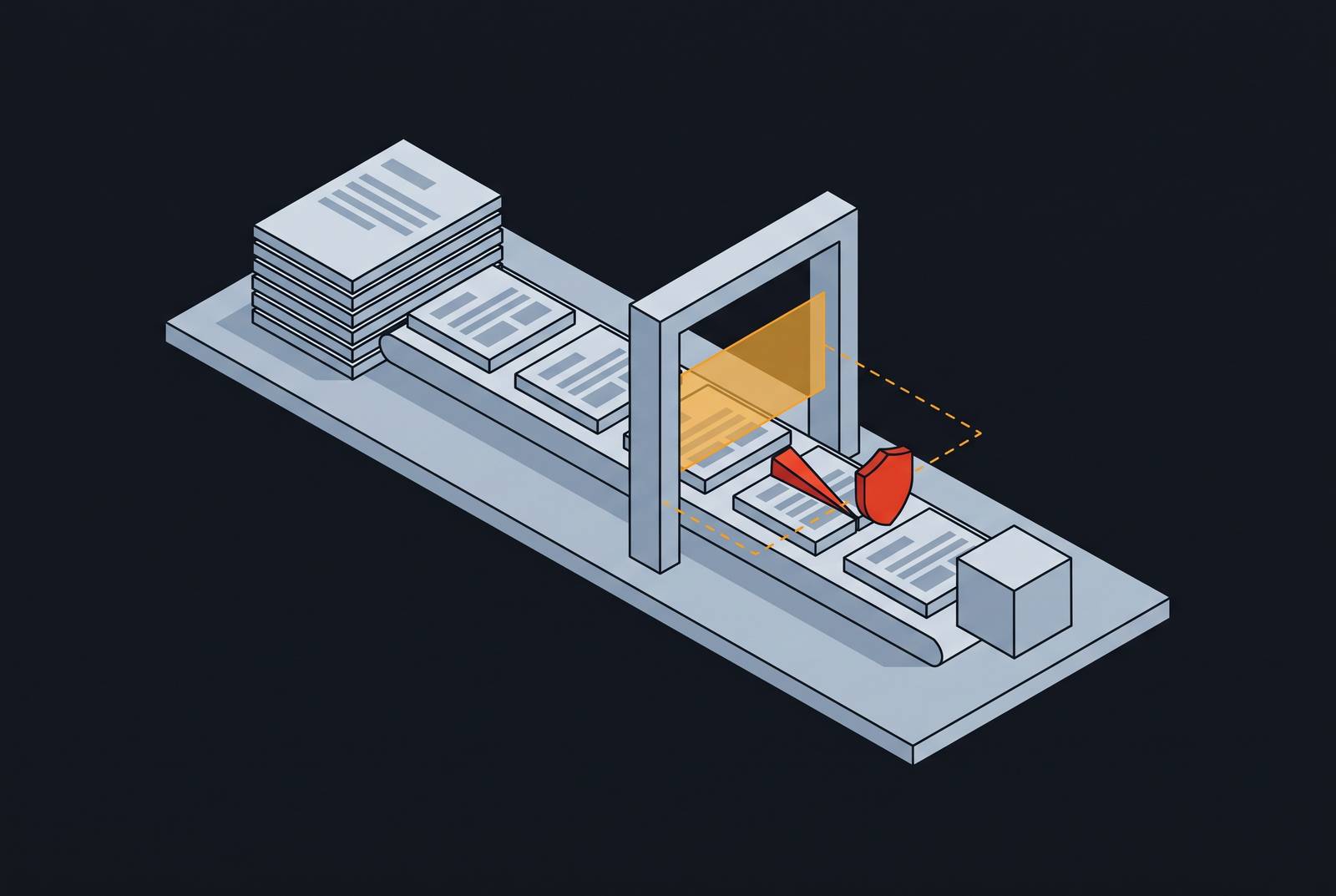
Indirect prompt injection detection in enterprise RAG pipelines requires checks on both the contents and the effects of retrieved chunks. Explicit command detection, fluent-poisoning signals, similarity clustering, and runtime query-context checks each target a different way an attack works. Role-boundary enforcement adds containment, keeping retrieved evidence separate from operational authority even when detection misses an attack.
Why RAG's design makes retrieved chunks a reliable attack surface
Retrieved content and operational instructions reach an LLM through the same natural-language channel. The model has no reliable architectural boundary that makes one passage evidence and another an instruction. Both arrive as text the model can interpret. As a result, every chunk admitted to the context window can become a source of instructions, even when the application intended it only as reference material.
An attacker need not change model parameters or control the user’s prompt if the attacker can manipulate the external knowledge base. The Hong Kong Polytechnic taxonomy describes how external knowledge access turns query-local failures into persistent compromises of shared knowledge, reusable across users and queries. A poisoned document can therefore outlast the interaction that first retrieves it.
The University of Waterloo health-domain study illustrates how retrieval itself can assist the attack. The retrieval system and its neural ranking model elevate adversarial documents into the top-k results, placing the payload where the generator will read it. Relevance is not a guarantee of trustworthiness. Traditional content filters cannot resolve this confusion because its source is architectural.
The two distinct threat forms that any detection approach must handle separately
What does an injected instruction look like? In the explicit form, a retrieved document contains commands such as “ignore previous instructions,” override directives, or role-play hijacks. These commands may sit in the body text or hide in less prominent parts of a document. They still ask the model directly to treat retrieved text as a source of instructions.
Fluent semantic poisoning works in a different way because it needs no imperative syntax. Grammatically normal but misleading prose steers the answer through what looks like evidence. MIRAGE, presented at CCS’26, demonstrates this approach without white-box model access. It uses persona-driven query synthesis and semantic anchoring to embed synthesized queries into document prose, then applies adversarial Test-Time Preference Optimization to increase persuasion. The attack targets both retrieval generalization and the influence of the retrieved text.
The taxonomy also identifies attacks combining prompt injection with database poisoning, designed to trigger regardless of the user’s question. Query-specific attacks are therefore not the whole problem. Nor is grounding verification equivalent to injection detection, since an answer can faithfully reflect poisoned context. This distinction sets the agenda for the defenses that follow, separating attempts to seize instruction authority from attempts to corrupt the evidence on which an answer rests.
Why explicit command detection at the chunk level is necessary but not sufficient
Explicit command detection is the most tractable first layer because override phrases, instruction-prefix tokens, and role-hijack constructions provide recognizable signals. Pattern matching and classifiers can detect these when they appear in the material being inspected. But inspection coverage determines what the check can see. A document-level judgment does little to protect the model if the text it later receives has parts the classifier never checked.
For a team implementing this layer, the practical requirement is to inspect the content that becomes a retrieved chunk, including less prominent document elements. Footnotes, HTML attributes, markdown link text, table cells, and quoted blocks are among the possible concealment surfaces. The delivery route can be equally ordinary. A webpage, document, email, or code comment can introduce poisoned text while an agent performs its normal task, without any direct exchange between attacker and model.
Even complete coverage cannot expose a command that has been rewritten as plausible evidence. CleanBase’s findings show why checking each document on its own can miss coordinated poisoning that shows up in the links among documents. Explicit detection remains necessary, but its judgment must be supplemented by checks on the chunk’s relationship to the corpus and the query.
How anomalous similarity clustering catches coordinated corpus poisoning that explicit checks miss
Coordinated poisoning can leave a geometric signature in embedding space. Malicious documents aimed at the same target question tend to cluster more tightly than benign documents because they are crafted to reinforce the same answer. That repetition serves the attacker’s retrieval goal. If several such documents are selected together, they can steer generation more reliably than one poisoned passage on its own.
CleanBase’s 2026 findings turn this relationship into a detection method. The approach builds a k-nearest-neighbor similarity graph over the knowledge base and derives a statistically grounded similarity threshold. It then flags cliques, which are dense groups in which every document pair exceeds that threshold.
CamoDocs exposes the limit of that assumption by deliberately dispersing poisoned documents to avoid clique formation. CleanBase’s detection collapses against this variant. An adaptive attacker can therefore reduce similarity or use fewer malicious documents per target, although that evasion trades away some retrieval reliability. The defense can weaken an attack without detecting every poisoned document.
This limit also constrains the comparison with similarity-graph scanning. The material provided identifies that approach as another corpus-time option, but does not establish how it overcomes dispersed poisoning. It cannot support a claim that the clique weakness is solved. More broadly, corpus cleaning remains a useful pre-retrieval layer alongside checks on newly retrieved content in a changing corpus.
Why runtime semantic checks at the retrieval layer catch what corpus cleaning cannot
Corpus cleaning happens before the user’s question is available. It therefore cannot fully judge whether a chunk is consistent with the particular query that caused its retrieval. Runtime checks add that missing context. The unit of analysis becomes the relationship between the request and the evidence, rather than the document’s apparent safety in isolation.
nokast-secureRAG, introduced in October 2026, places a purpose-built Small Language Model between the retriever and generator as a semantic firewall. It reads the query and retrieved context jointly, classifying the pair as safe, suspicious, or malicious-instruction. This differs from matching phrases or measuring embedding distance because the classification depends on how the two inputs interact. That specialization is important because adding benign retrieved documents can flip safety judgments in models not designed for RAG.
On the PoisonedRAG benchmark, its recall falls to near zero, showing that training for explicit instruction hijacking does not automatically equip a classifier to detect fluent semantic poisoning. Joint inspection is necessary, but not sufficient by itself.
RADAR, presented at ICML 2026, deals with how context changes in dynamic web-search RAG. It uses graph-based energy minimization to model context selection and a Bayesian memory node to update a belief state without storing raw documents from the past. This balances stability against adaptation as the corpus evolves. It complements query-context classification rather than replacing the need to detect instruction hijacking or poisoned evidence.
Detecting fluent poisoning signals that carry no explicit instruction syntax
If a poisoned passage reads like ordinary evidence, what signal is left? Checks can look for whether it disrupts evidence synthesis or changes how the model is expected to behave. Content inspection alone can miss this because the attack need not contain an instruction marker or an obvious similarity anomaly.
The Waterloo study provides a concrete reason to examine the surrounding evidence as well as the suspect document. Adversarial documents substantially degrade alignment without explicit instruction syntax, while robustness is preserved when helpful evidence is also present in the retrieval pool. Preserve helpful evidence, since the balance between supportive and adversarial context influences the outcome.
Knowledge-injection tests on complex reasoning tasks show another possible signal. Poisoning that corrupts entity relations interferes with evidence synthesis as the model aggregates conflicting information across multiple reasoning steps. This is reasoning interference rather than a visible command. This gives a reason to test how the model behaves, though a contradiction or reasoning failure alone does not prove an attack.
CanaryRAG illustrates an instrumented approach to behavioral detection with RAG extraction as its stated target. It embeds canary tokens in retrieved chunks and runs a dual-path runtime integrity game. In the Oracle Path, too few expected canaries can be a sign of hidden instructions to hide output or make it harder to read. Such deviation offers evidence that content inspection may miss, but additional inference passes and instrumented paths introduce latency and complexity, limiting where this approach is practical.
Role-boundary enforcement at the retrieval layer as the architectural backstop
Detection asks whether a chunk is trying to redirect the system. Containment asks what happens if that attempt is missed. Role-boundary enforcement addresses the second question by separating the authority of operational instructions from the status of retrieved data at the application and context layers. It provides an architectural backstop to semantic inspection.
For an enterprise implementing that boundary, the controls described here are structural separation during prompt assembly, role-scoped wrapping, and limits on agent action permissions. Retrieved chunks are marked as data for summarization. Wrapping alone cannot guarantee a boundary at the model level. Permission limits provide a separate constraint on what an agent processing untrusted material can do.
The same boundary must extend through multi-agent pipelines. Without it, a successful goal hijack can affect later agents, poison shared memory, or change what the orchestrator decides. The relevant boundary follows the untrusted content through the pipeline, rather than ending when one generator produces an answer.
The taxonomy organizes defenses around trust boundaries and security surfaces because the knowledge-access lifecycle exposes different kinds of failure. Pre-retrieval corruption, retrieval-time manipulation, downstream context exploitation, and knowledge exfiltration do not collapse into one inspection point. Current defenses remain reactive and fragmented. Layered enforcement is therefore a direction for reducing exposure, with coverage of every surface by one deployed system still unproven.
What a layered semantic integrity stack looks like in practice for enterprise RAG
How can an enterprise protect its RAG pipeline from malicious retrieved documents? The practical stack combines explicit command detection, corpus-level similarity analysis, runtime query-context classification, and behavioral signals, with role-boundary enforcement containing failures. Tool selection follows the gap being addressed. CleanBase and similarity-graph scanning check the links among documents in the corpus, nokast-secureRAG checks for instructions in the query and context together, CanaryRAG measures behavior tied to extraction, and RADAR handles changes in web-search context.
Sustaining that stack requires more than selecting components. Corpus scans need to run again when untrusted sources update the knowledge base, while runtime classifiers need to be tuned to the deployment’s query distribution as well as to generic benchmarks. Behavioral integrity paths add inference overhead, so the notes recommend scoping them to high-sensitivity pipelines. For dynamic web corpora, the checks need to adapt as the retrieved material changes. These requirements continue throughout operation.
The enterprise also faces retrieval risks in AI products from vendors whose knowledge pipelines it does not control or audit directly. Platforms combining vendor risk assessment with real-time AI threat detection are positioned to address the enterprise’s oversight gap through assessment and continuous monitoring of vendor AI assets. Their role is complementary, surfacing emerging risks to compliance and business continuity rather than replacing technical controls inside a RAG application.
A buyer’s evaluation therefore needs two separate questions. Which attack mechanism does each technical control detect, and which vendor-supplied knowledge pipelines are outside the buyer’s direct oversight? A named detector is useful only within its demonstrated scope. To protect the enterprise, those scopes must stay clear as documents, queries, agents, and third-party AI services change.
Sources
- Securing Retrieval-Augmented Generation: A Taxonomy of Attacks, Defenses, and Future Directions
- Evaluating the Robustness of Retrieval-Augmented Generation to Adversarial Evidence in the Health Domain
- [2610.28364v1] Context-Aware Prompt Injection Detection via Small Language Models in RAG Pipelines: nokast-secureRAG
- CleanBase: Detecting Malicious Documents in RAG Knowledge Databases
- MIRAGE: Misleading Retrieval-Augmented Generation via Black-box and Query-agnostic Poisoning Attacks
- Context-Aware Prompt Injection Detection via Small Language Models in RAG Pipelines: nokast-secureRAG
- RADAR: Defending RAG Dynamically against Retrieval Corruption
- Detecting RAG Extraction Attack via Dual-Path Runtime Integrity Game